Sticklepath’s Harvest Festivals

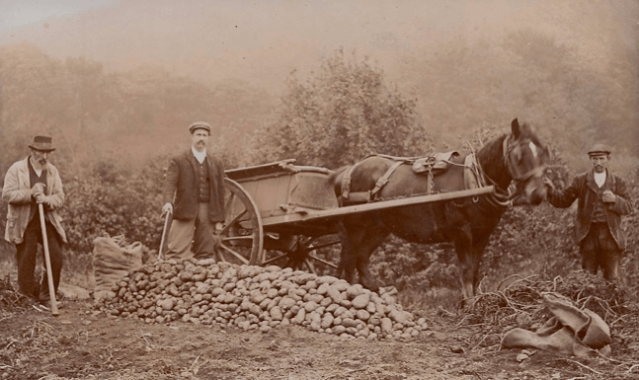
Harvesting with Scythes at Coombehead Farm

Tomorrow 3rd October 2021 St. Mary’s Church with the Community Church in Sticklepath celebrate the harvest festival.  This is a tradition going back many years but perhaps not quite a long as we might think…

Before Henry VIII the harvest was celebrated in churches on 1st August at Lammas – ‘loaf mass’. The wheat harvest safely gathered in, a loaf made from the new flour was used to celebrate Holy Communion.  

Harvest Festival in Britain as we have known it owes much to Rev. Robert Hawker of Morwenstow who held a special harvest service in 1843.  Harvest has been celebrated in our churches and chapels (also schools and pubs) since, with lavish decoration made from local produce.  Chapels and Churches in a locality agreed when the harvest services would be, so they could attend each others. Certainly in my great grandfather Albany Finch’s time, a single hard and essentially inedible loaf was baked in the shape of a wheat sheaf and was taken to the Harvest Festival services across a number of chapels over the weeks.  A local preacher, Albany was rather embarrassed when one young relative tried to eat the loaf and he had to take the nibbled version to subsequent chapels!
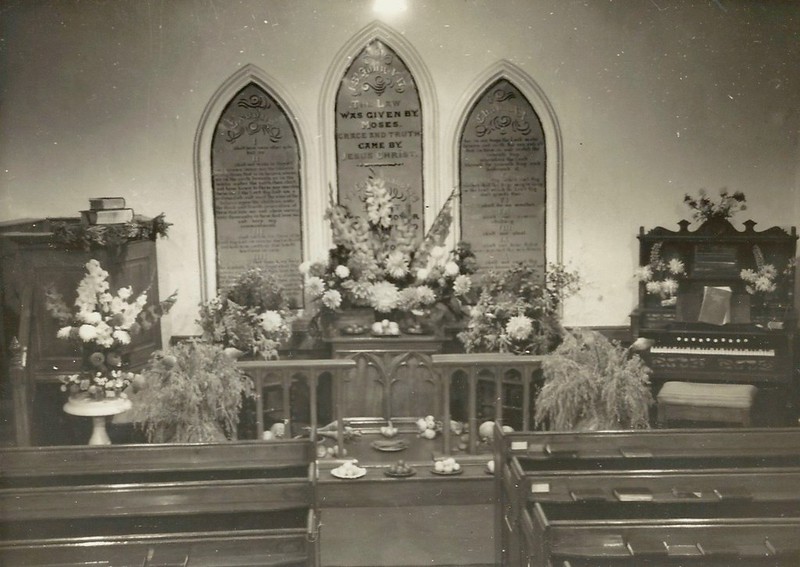
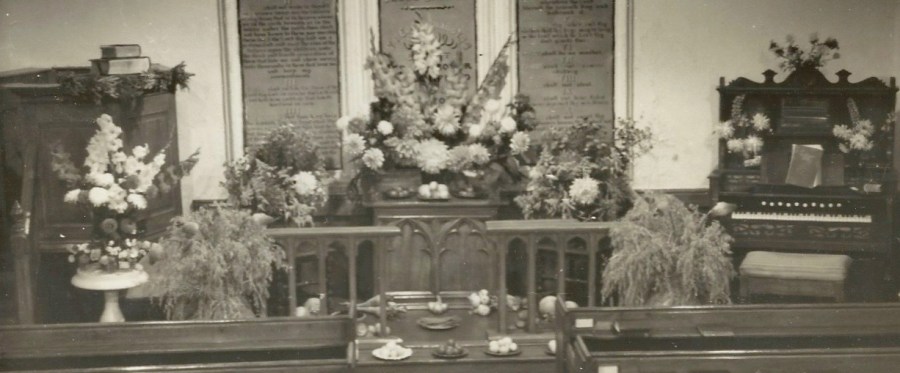
Sticklepath Wesleyan Chapel partly decorated for Harvest Festival. Note the wheat sheaves and the harmonium to accompany the hymns

Hymns were a big feature of the harvest celebrations as I was growing up, ‘Come, ye thankful people, come’, ‘We plough the fields and scatter’ and ‘All things bright and beautiful’.  Like all good traditions they have their origins elsewhere. For example, a 17 stanza German poem, with some basis in a psalm, written in 1782 by Mattias Claudius, celebrated Paul Erdmann’s harvest home, thanking both the host and God for their generosity.  Translated by Jane Montgomery Campbell, it was shortened and, with a few altered words, made more appropriate for the harvest service, it appeared in ‘Hymns Ancient and Modern’ in 1861 as ‘We Plough the fields and scatter the good seed on the land’.
Certainly in my childhood there was still a large amount of home produce brought to chapel for the celebration – from gardens, farms and kitchens, including of course Bert Stead’s jams.  The womenfolk particularly would spend hours arranging flowers and decorating the chapel. As it was a special occasion more folk would come to the service than usual. The following day, Monday, a harvest supper was laid on for all comers. A great social event. The produce was given to the poor and needy or sold at a friendly post-supper auction for charity. Local produce featured both in the displays and the supper. In Yorkshire you find Wensleydale cheese served with the apple pie at Harvest supper, rather than  Devonshire’s clotted cream. 
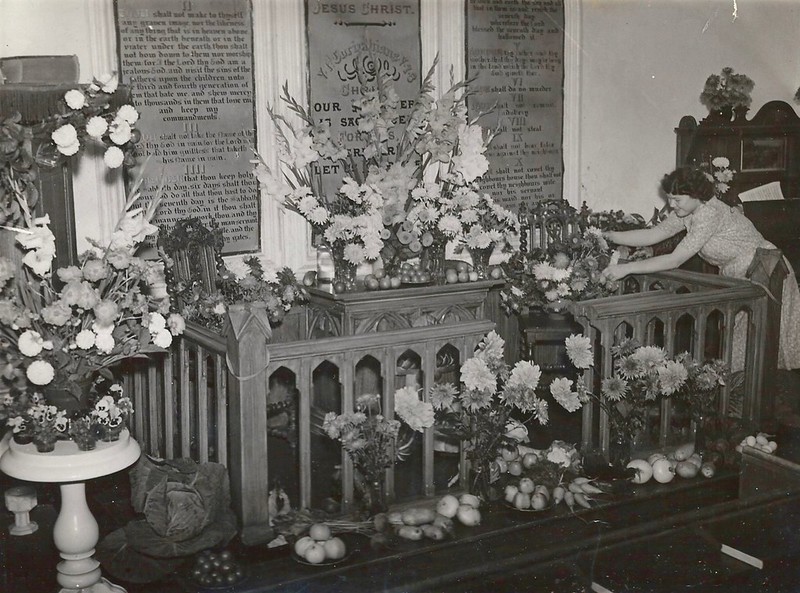
Anne Bowden, Albany Finch’s granddaughter putting some finishing touches to the harvest display Sticklepath Wesleyan Chapel 1954

These days singing traditional hymns is going out of fashion, I am not sure if any of today’s young people will know the words to harvest hymns by heart in their dotage. Now the produce tends to be shop bought non-perishables and collected for food banks or similar charities – not really so very different. Such a sad indictment of our times that in our wealthy nation so many people are still dependant on these sources for their basic necessities.

The Harvest Festival service tomorrow is a great chance to see the fantastic changes made to St Mary’s Church in recent months. It is now a more friendly, comfortable and useable space for the community. I wish I could be there. I wonder if the magnificent harmonium will be accompanying the covid-safe masked singing, or perhaps an electric keyboard?

******************************

ADVANCED NOTICE

Not to be missed! The launch of St Mary’s Interactive Heritage Displays, a Short Service of Dedication and cream teas in the village hall after. Put in in your diary now –

Sunday 7th November   2pm

******************************
Set on Fire!

I spent 3 nights in Sticklepath, my childhood and #OnePlaceStudy village, last week. It was a real treat, a “Heritage Break”. I stayed with a member of the Sticklepath Heritage Group so had lots of useful real life chats. First thing in the morning (when it was not drizzling!) I visited the Quaker burying ground and took a few photos. Then off to the archive to scan documents for study later. I was treated to a tour of the newly renovated St Mary’s, our little chantry chapel, and a preview of interactive heritage displays – listening to the actors voices in that setting really helps bring the past to life. Whilst there I took a photo of the Roll of Honour – another tick for my ‘To Do’ list. In the evenings I was then treated to an old fashioned family and local history slide show by my sister. My host’s wife had made a collection of interesting articles from many years of the local ‘Beacon’ magazine which I could peruse over my late night cocoa.

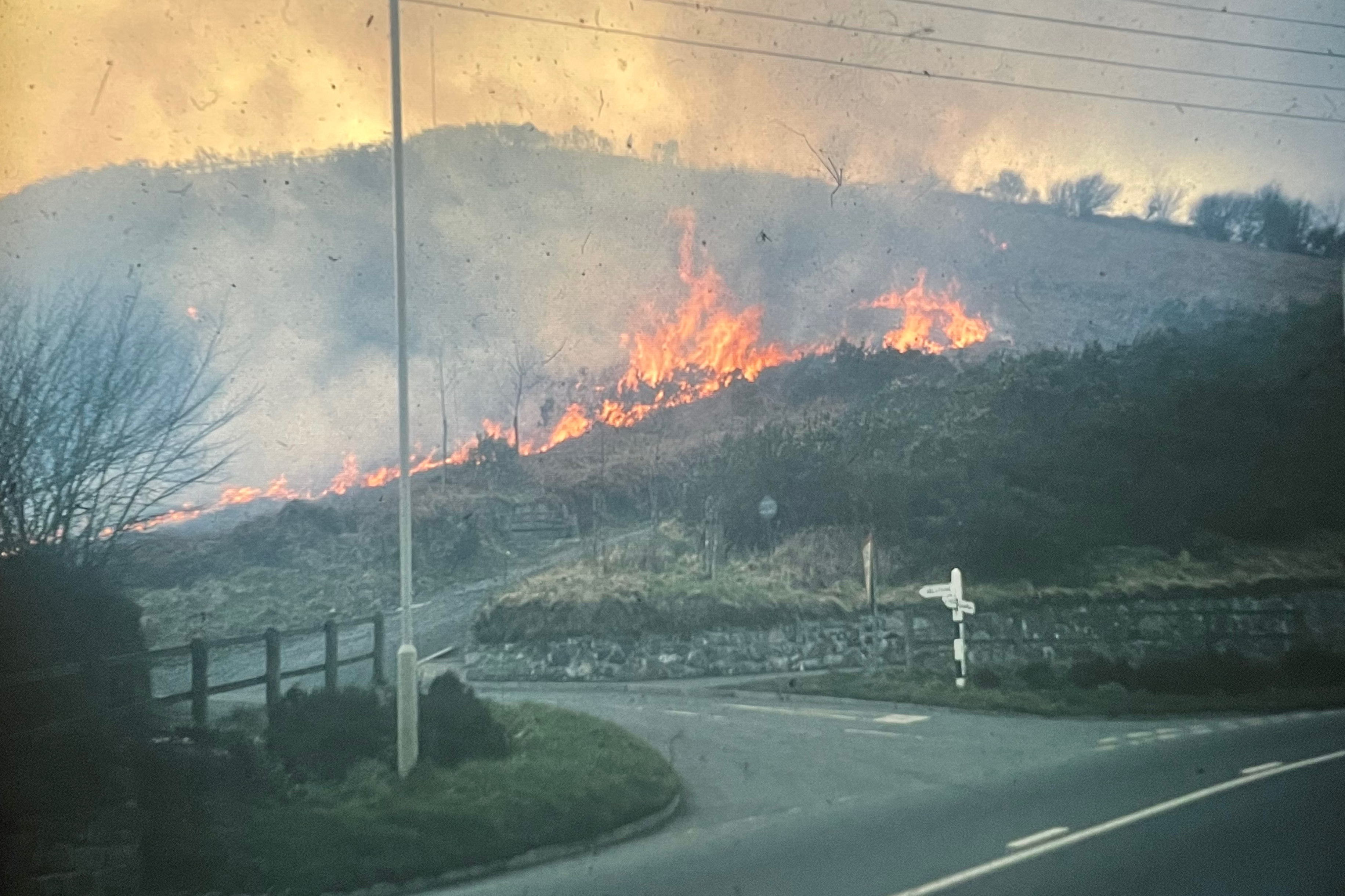
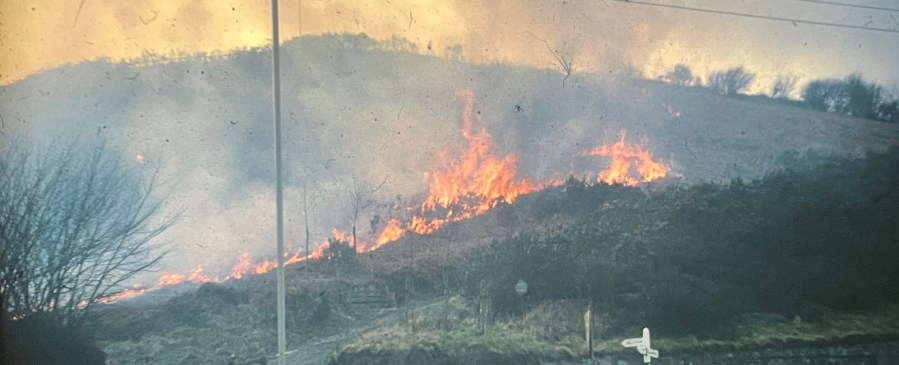
Swaling on the Mount Sticklepath, about 1970?

It has certainly fired me up to do more research, and one of the slides, as you see was of swaling on ‘The Mount’. The bracken and yellow gorse with a little broom intermingled was burnt off on a regular basis to maintain the common land in a state suitable for grazing. Now, perhaps 50 years since the traditional and controversial swaling stopped, the growth is much more varied and has quite a different feel as you walk through.

I can’t wait for the next Heritage trip – lots to do meanwhile!

SMALL-POX has broken out in the large village of #Sticklepath

That certain would be a headline grabber today! But no, this is a single sentence hidden in the middle of page 2 amongst other unrelated titbits. The Western Times 28 Oct 1871 tells us an heir is born to a Lady in London, then states:

“It is said that small-pox has broken out in the large village of Sticklepath near Okehampton, and that the wife of a miner has died from the disease.”

The paper then moved straight on to a one sentence advert for hair restorer and an unrelated item re the takings of the local railway. I wonder how many people spotted this sentence? (Spotted -rash! No pun intended).

I found this ‘newspaper clipping’ after looking at the death certificate for Jane Osborn, wife of miner William Osborn. This is the third burial in my #SticklepathQuakerBuryingGround series.

Image from BritishNewspaperArchive, originals at British Library. (Accessed July 2021)

According to the burial register Jane was buried on 24 October 1871 aged 27, and was burial No. 180. The funeral ceremony was performed by Thomas Seacombe, a Methodist local preacher who performed a great number of the burial services.

The General Registry Office Register gives a slightly different date, saying she died on 25 October 1871 (the day after she was reputedly buried!). The cause was certified. It was not a legal requirement at the time for all deaths, however the local doctors kept a close eye on infections and fevers. It does not tell us who certified the death. I suspect that any smallpox victim was buried very soon after death, to prevent spread of infection. The death was registered on 26 October by informant John Austin of Sticklepath, ‘in attendance’.

Informants are often relatives, sometimes a ‘nurse’ helping care for the person. I have not found a connection (yet) between Jane Osborn, born Coombe, and the Austin family. The only John Austin on the 1871 census, taken just a few months earlier, was the 15 year old apprentice to Mr Cook the wheelwright and undertaker. I wonder if he was the one sent to register the death? Perhaps part of the undertaker’s service, though legally he should have been ‘in attendance’ during the last days of life. On the other hand, people who had already had smallpox and survived were the ones asked to care for a new sufferer. Is it possible this could have been why he was in attendance?

I have more questions than answers!

As usual I would love to hear from anyone with more information. shields_h_f@hotmail.com