At Rest in #Sticklepath – William John #Labdon

I am exploring some of the people buried in Sticklepath Quaker burying ground. Do you have relatives or people you know something about who are buried there? Please do share your knowledge. (shields_h_f@hotmail.com) I would love to collect the birth marriage and death certificates for anyone who lived or was buried in Sticklepath. Easy enough to order from GRO.gov for most people with such life events after 1837, and only £7 for each pdf copy, but the costs soon start to build up. Please do contact me if you are willing to share information. It would be great for such a collection to be available from the Sticklepath Heritage Group.

One young boy buried in Sticklepath is William John Labdon. Possibly known as Will, he actually lived in South Zeal village, which was in South Tawton Parish. Immediately this raises the first question. Why was he buried in Sticklepath rather than at South Tawton Church? It may have been that this was the closest graveyard or the arrangements could be made more easily here, but perhaps the most likely explanation is the family were non-conformist.
Will died in 1882 aged just 13. Knowing a fact like this, the family history detective can search for other sources. A 13 year old is not likely to have a will, administration, probate or an obituary but there could be a newspaper report of his death or funeral, or a memorial stone. I have not found any of these for Will.

However, everyone dying after 1st July 1837 in England should have a death certificate. Certification of the cause of death by a doctor was not necessary until 1874, prior to this it says in the register if it was certified by a doctor.

William Labdon’s death certificate is particularly informative and a great starting point to build his family tree: It tells us he died in South Zeal on 10th March 1882 of heart disease and phthisis (also known as consumption, TB, or tuberculosis). We will never know whether the TB caused his heart problems or if he had underlying heart problems which perhaps left him frail and more prone to TB. The heart disease is likely to have been a problem with the heart valves as a result of rheumatic fever. Fortunately these problems are very unusual in Devon teenagers today.

Dr G.V. Burd MRCS, certified the death. John Knapman was the registrar. His entry in the register is what forms the ‘death certificate’ we order from GRO.gov today, a certified copy of the entry in the register. Will’s death certificate tells us that his mother, Susan Labdon, was present at the death, and informed the registrar on 15th March 1882. It also states Will’s father was Police Constable Joseph Labdon.

Thinking about the funeral arrangements I wonder how these were made. The Counter family had established an undertaking business in 1850 in South Zeal. Earlier families had to make all the arrangements themselves for items needed for a funeral, including purchase of a coffin. I wonder if the family may have been grateful to be able to hand responsibility to the Counter family for dealing with all the arrangements?

However, looking at the census data, we find that William’s father was also a carpenter. Indeed he later won the contract to provide coffins to the Guardians of the Poor for South Tawton. (Ref: Western Times 17 Mar 1905 p13). I wonder therefore whether this father actually made the coffin for his son?

NEXT TIME: more investigation into PC Joseph Labdon, carpenter and undertaker.

Please note that as I am trying to look into a large number of residents my research may sometimes be incorrect or I may jump to the wrong conclusions. PLEASE do let me know if this happens. Anything you can add would be great too. shields_h_f@hotmail.com

This is the second of a series investigating people buried in #SticklepathQuakerBuryingGround.

Sad loss of baby Battershill #SticklepathOnePlaceStudy

One of the first burials in #SticklepathQuakerBuryingGround after the introduction of death certificates in 1837 is that of William Battershill, aged 11 months, son of William Battershill and his wife Mary. The burial register shows he was burial no. 31, and the ceremony was performed by Reverend James Stott.

He died on 26 Nov 1837 and his address on the death certificate was Sticklepath, South Tawton. His father William was the informant, “who hereunto sets his mark X”. The death was registered in Okehampton by James Wilkin Thorne, registrar, on 27 November. Unfortunately the burial register shows William as age 31, likely a transcription error as the burial is this number. Several columns are not completed perhaps suggesting it was completed some time later when all the details were not available.

Baby William died of fits. No doctor certified the death, this was not a requirement until 1874.

Fits are also known as convulsions or seizures. Epilepsy is diagnosed only if a person has repeated fits not just one. Given the wrong circumstances anyone can have a fit. Alcohol lowers the ‘fit threshold’ the level at which a fit may occur, and if, for example, someone then has a head injury, a single fit might occur. About one in every 100 people now has epilepsy. The vast majority are well controlled.

Hippocrates recognised epilepsy as a brain disorder but this was not commonly believed until the mid-1800s. Fits were often blamed on spiritual problems or bad spirits. In the mid-1800s bromides began to be used to treat fits but they were themselves very toxic leading to many side effects. Phenobarbital became available 1912 and was the next medication widely used. Even paracetamol to control fever wasn’t available in UK until 1959, a little earlier by prescription.

Having worked in Malawi 2010-12 I have seen many patients with uncontrolled seizures. We had to just walk past the bed, or mattress on the floor, as no medication or oxygen was available. Positioning the patient to avoid further harm or injury is important.

So in 1837 there would be no effective medication to control a babies convulsions. Herbal remedies or other treatments might have been tried. Tepid sponging would be another home remedy that might help if fever was the cause (full body not just a flannel on the forehead).

Why might an 11 month old baby have fits? We don’t know if this was something new or had been occurring since birth. Fits can be caused by oxygen deprivation during birth or other causes of brain damage. Prolonged labour, pre-term or early delivery, and low birthweight all make fits more likely. They may be associated with cerebral palsy or developmental problems.

Infections would be a leading cause – TB meningitis, other causes of meningitis or encephalitis, and the common childhood illnesses of the time. Viral illnesses, especially Viral Haemorrhagic Fevers similar to Ebola, would be another cause. Imbalance of salts in the blood could also cause fits, including sugar levels, calcium, magnesium, and potassium. There are also some rare inherited causes. Some types of fits only occur in childhood or become less common with age. New fits can occur at any age. A stroke for example can cause fits in older people.

Some people may have had occasional short seizures and otherwise led a normal life. Untreated, as they would be in 1837, fits may lead to further brain damage, affect intellectual development, cause mental health problems and sudden death. These are particularly likely after prolonged seizures or ‘status epilepticus’ (fits lasting more than 30 minutes or repeated fits without regaining consciousness between).

This must have been very distressing for poor Mary and William the parents leading up to William’s death. There will have been many others with similar experiences in the village to support and try to comfort them. Teething may well have been mentioned as the cause at the time – this was held to blame for many childhood ailments.

The Battershills are a new family to me, which means new research avenues to add to my growing list! I have not yet confirmed the family connections but there is a William Battishill also buried in Sticklepath, aged 48 in 1845, likely to be the father. He is noted in the burial register to be Labourer, of Sticklepath (Bridge) We also find a widow, Mary Battershill, in the 1951 Census, with her family living near Sticklepath Bridge (in South Tawton Parish):

Mary BATTERSHILL  Head  Widow aged  51y  born Southtawton Hand Loom Weaver (Serge) 
Susan BATTERSHILL  Daur   12y born  Samford Courtney Scholar 
William BATTERSHILL  Son   10y born  Southtawton Scholar 

Elizabeth Ann BATTERSHILL   2y born  Okehampton
(HO/107/1885-Fo.416-Pg.11)

If anyone has already researched this family and is willing to share some information I would love to hear from you. shields_h_f@hotmail.com

NEXT TIME: Another Quaker Burial Register death – William John Labdon (part 1)

‘Mapping your Ancestors’ A Simple Guide Part 2: Walking in their footsteps #OnePlaceMaps

Another simple idea is to look at a large scale detailed map and work out an ancestor’s likely route to school or church or work. Best on a map of their era or if using a modern map, be aware of possible changes. Ideally actually walk the route or do so online on something like Google street map. Ask yourself questions about what the experience of walking in their shoes might have been:

Do they pass a market or perhaps a blacksmith’s forge – imagine the noises and smells. like that of the Finch Foundry in Sticklepath, dominating the main street.

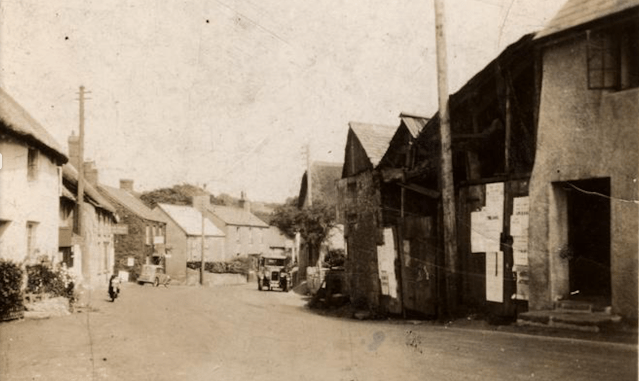
Finch Foundry on right. One of the photographs from Mr Stead’s collection, now available on https://dartmoortrust.org/archive/record/103308

What sights were there, views or landmarks, features or milestones? How would that vary in the seasons or over time? How would it look different to today? Types of architecture, specific features of the buildings? Looking at ‘listed’ buildings online can be helpful

What help might your ancestors have needed eg where was the nearest workhouse? Any charitable institutions nearby? Fire service? Police? Do you know where the Police House was in Sticklepath? Initially near the Bridge, later Pixie Nook, on the way out of the village towards Okehampton.

Where is the graveyard? Non-conformists may not have used the Churchyard. Some places like Sticklepath have an ecumenical burying ground.

Trade directories can add more information and help looking for businesses your ancestors might have used or worked at. 

Don’t forget to make a note of your findings! I have made a start on a detailed Walk through Sticklepath’ essentially following the main street through the village and noting anything of historical interest along the way.

(Snowy Footprints Image by jenlargo88 from Pixabay)