Doing a #OnePlaceStudy it is easy to lose sight of my own family history. Whilst the two overlap, creating databases of residents and investigating Sticklepath’s local history can ‘take over’. I therefore decided to use some of Amy Johnson Crow’s prompts for a weekly note about my own ancestors. Largely these do have a #Sticklepath connection too. The prompts are usually one word which can be used however we wish, to trigger recording something. If you are struggling to get your family history written down, why not sign up – make 2021 the year you make a start? https://www.amyjohnsoncrow.com/52-ancestors-in-52-weeks/
Week 1: (New Year) Beginnings – We are all advised to start our family history with ourselves. Perhaps for our own great grandchildren should they be interested in family history, but it helps us see what facts are possible and to realise that the facts alone do not sum up who we are! My New Year’s resolutions included a new beginning on writing up my own life story and, in the process, enjoying and then disposing of much of the memory paraphernalia I have collected over the years in many boxes!
Week 2 (Jan. 11-17): Family Legend – Most families have passed stories down through the generations. Commonly these are grandiose such as being related to Royalty. (Royalty in turn wanted to prove their connection to Adam and Eve and such ‘family trees’ can be found). No such aspirations in my family, though there was a whisper of being related to one of the four knights who killed Thomas a Beckett on 29 Dec 1170! My family tree is no where near that date as yet.
The family story or ‘legend’ that I want to look at is that a Finch is said to have walked from Sticklepath to Tavistock with a load of iron tools to sell when heavily pregnant, to have given birth and then walked home.
William Finch moved from Tavistock to Sticklepath in 1814 to set up the Foundry. William born in 1779, in Spreyton, a little village not far from Sticklepath as the crow flies. The son of Isaac Finch and his second wife Elizabeth Harvey or Hardey, we know little of his early life, but when William married Ann Rowe in Tavistock in 1803 he is described as a whitesmith. Whilst this can mean working with white metal such as tin, I think in our family context it meant working with cold metal ie finishing the tools made by the blacksmith. Sharpening and polishing, adding handles and so on.
William was living in Tavistock with his wife Ann, and likely working in the iron foundry there. They had three sons, William Rowe Finch, Isaac and Joseph. By Joseph’s baptism in 1809 in Tavistock, William is a blacksmith. When William moved to Sticklepath he brought his three sons with him and chose Silverlake as their home. I suspect Ann died in Tavistock between 1809 and the establishment of the foundry in 1814. William married his second wife Susanna, and their three sons, John, Samuel and George, all born at Silverlake, who became the Foundry edge tool makers.
Census 1841 household of William Finch
William Finch 60y Susanna Finch 46y Maria Finch 21y Susanna Finch 12y Harriett Finch 9y John Finch 18y Samuel Finch 15y George Finch 7y James Finch 5y Samuel Woodley 22y
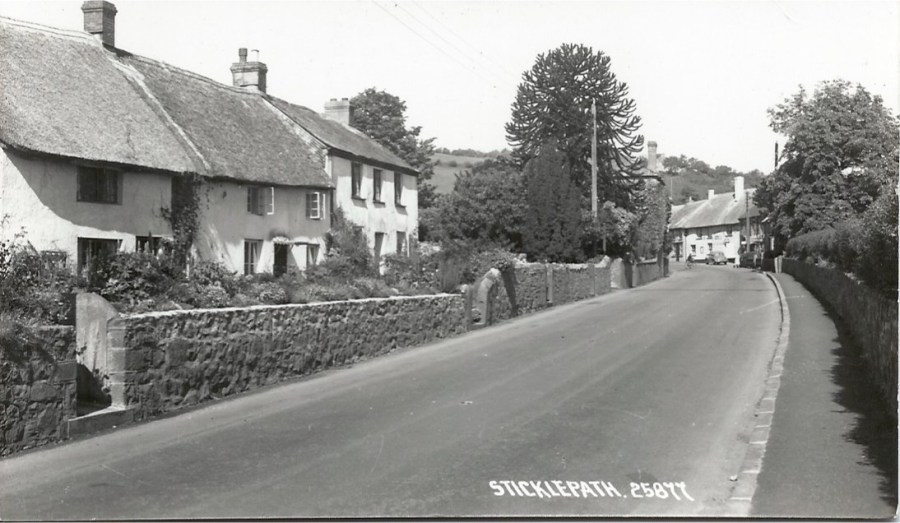
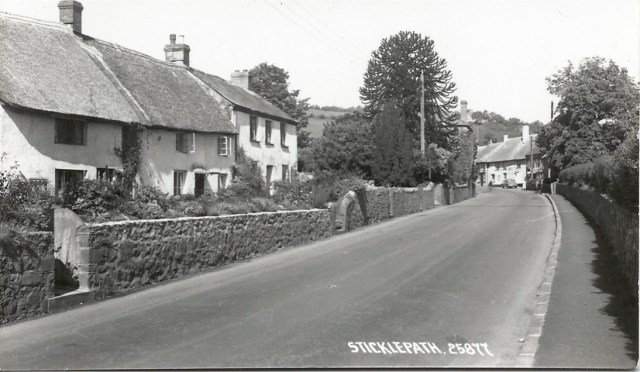
Silverlake is the third house on the left
There is some hint of a family scandal here, as on paper Susanna appears to be William’s half-sister, sharing the same father, Isaac Finch, but I am sure there is a good explanation. My guess is that her mother Mary was pregnant by her previous husband or perhaps had actually had the child before Isaac Finch married her. It may be possible in the future to find out more exact dates for these events to clarify.
Back to our #52 ancestors Legend – it is highly likely that Susanna Finch was the women who walked from Sticklepath to Tavistock carrying a bag of tools for sale in the market there whilst heavily pregnant. Their first child Maria, was born in Tavistock on 12 March 1821, (two hundred years ago), long after William moved to Sticklepath. Tavistock must have been at least 20 miles, a full day’s walk. No one would consider walking to Tavistock these days let alone when heavily pregnant and certainly not with a load of tools!
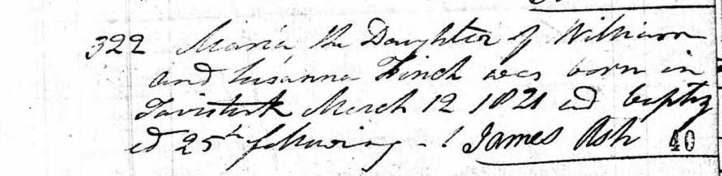
The implication that she walked straight back again however is unlikely given that we have Maria’s baptismal record, showing she was baptised by James Ash in Tavistock 25 March 1821:
England & Wales Non-conformist and Non-parochial Registers 1567-1936. Piece 0341 Tavistock Wesleyan 1808-1837 accessed via Ancestry.com Jan 2021
William had connections in Tavistock so it may have been that Maria chose to go to Tavistock for some reason, such as a relative or highly respected mid-wife. She may well have had a hand cart and perhaps did not go alone. I suspect we will never know any more details.
“Landmarks, by their pure existence, structure environments. They form cognitive anchors, markers, or reference points for orientation , wayfinding and communication. They appear in our sketches, in descriptions of meeting points or routes, and as the remarkable objects of an environment in tourist brochures.” (Richter and Winter)
Landmarks are often visible from a distance, or are features which, for a traveller passing through, mark One Place as different to another. I would add to that: ‘scars’, symbols or indicators in the environment which point to the history of our place.
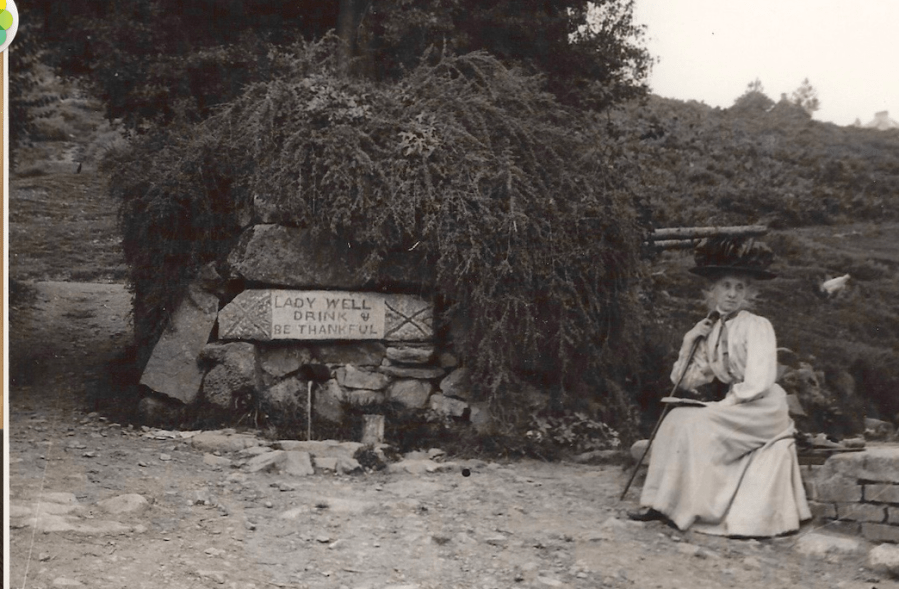
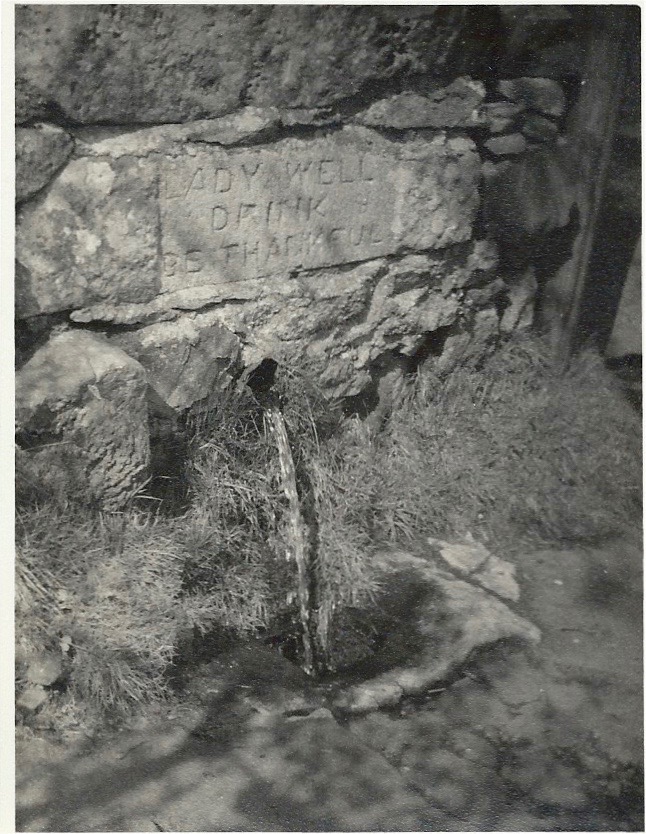
“Lady Well Drink & Be Thankful” 1900-1910. Mrs Elderton of Laurel Cottage/Staplers. (Notice the standing stone to the right hand side, at about the same level as the top of her hat. Note the crosses marked on the Lintel either side of the inscription.)
Ladywell is mentioned in tourist information about Sticklepath, it represents both a physical landmark and landmark in history, before piped drinking water came down the street or into our houses. I surmise Ladywell would also have been an important social gathering point where people exchanged news whilst waiting to fill their containers. (Long before lock down, so no evidence of 2m marks!)
1920s
It is not clear where the lintel stone came from. The crosses seen on it in early photographs have eroded considerably.
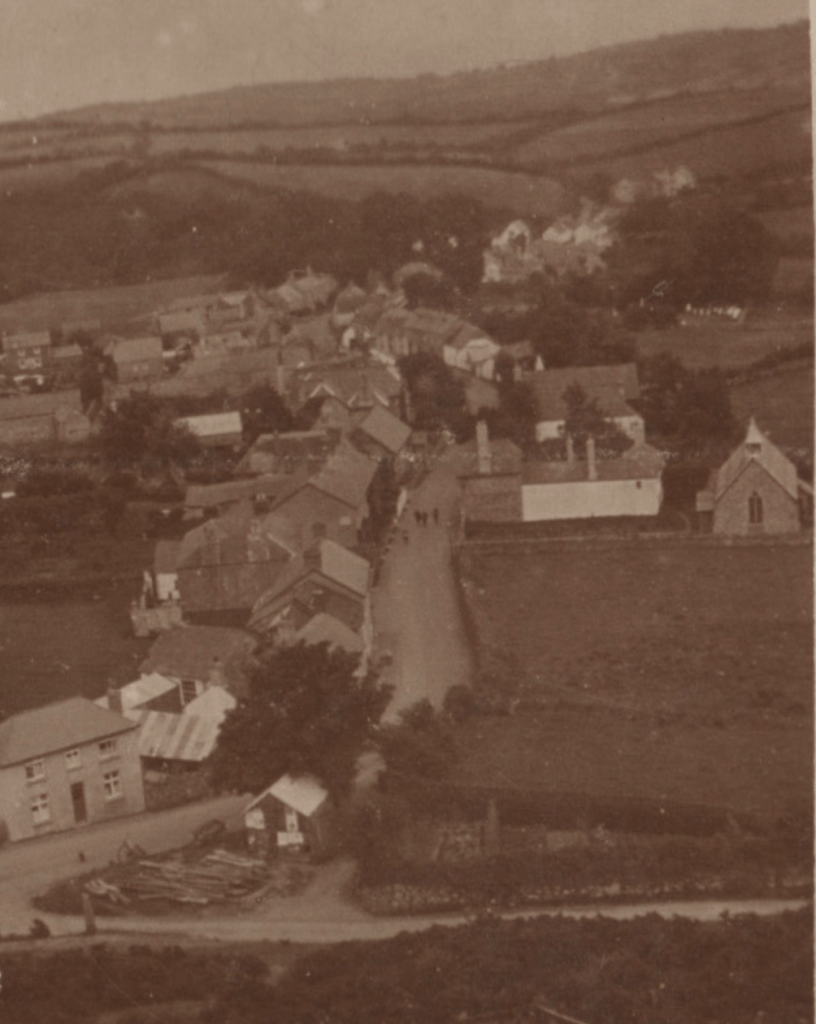
First let’s orientate ourselves using some other landmarks. As you travel through the village towards Okehampton and Cornwall, look past the small St Mary’s Church to see Ladywell on the left. Just there, by the roadside, as you start to notice the rise of the hill under your feet, with ‘White Rock’ and its flagpole on the Mount above.
The tree and building are long gone, but find a pleasing bench on which to rest your weary legs, admire the village scene and ‘Be Thankful’. Probably not wise to drink!
Ladywell to right of centre below the tree, where the children stand. Shame we missed the horses… Above are White Rock and flag pole, and to the left the bare rock of the quarry can be seen. Chapman postcard
In about 1820 John Pearse, wool-stapler from Cleave Mill, had the overflow from Ladywell spring piped to the present Ladywell site, for the convenience of his Mill workers and the rest of the village. Ladywell much as we see it was built in 1831 – 2 yrs after the road was widened. A concealed pipe leads to a tank hidden beneath granite blocks and from there runs out through the short pipe we see, beneath the engraved lintel, ready to fill containers, to quench a thirst and flush the roadside drains.
Looking down from the Mount near White Rock, Sticklepath is laid out before us. The dark tree marks Ladywell, bottom left, and can see St Mary’s church on the right. (Phyllis Finch Album)
Ladywell Spring
In fact Ladywell spring, essentially a round well 2 ½ – 3 feet diameter and perhaps 4-5 feet deep, is towards the top corner of a field known as Allermead, further up the hill on the opposite side of the road (see photo below for indication of where it is),
There has been some suggestion that this was a ‘Holy Well’ and that the origin of Allermead could be essentially ‘Hallowed meadow’. I am not aware of anything to support this but being close to the church it is possible it was at one time part of the incumbent priest’s lands.
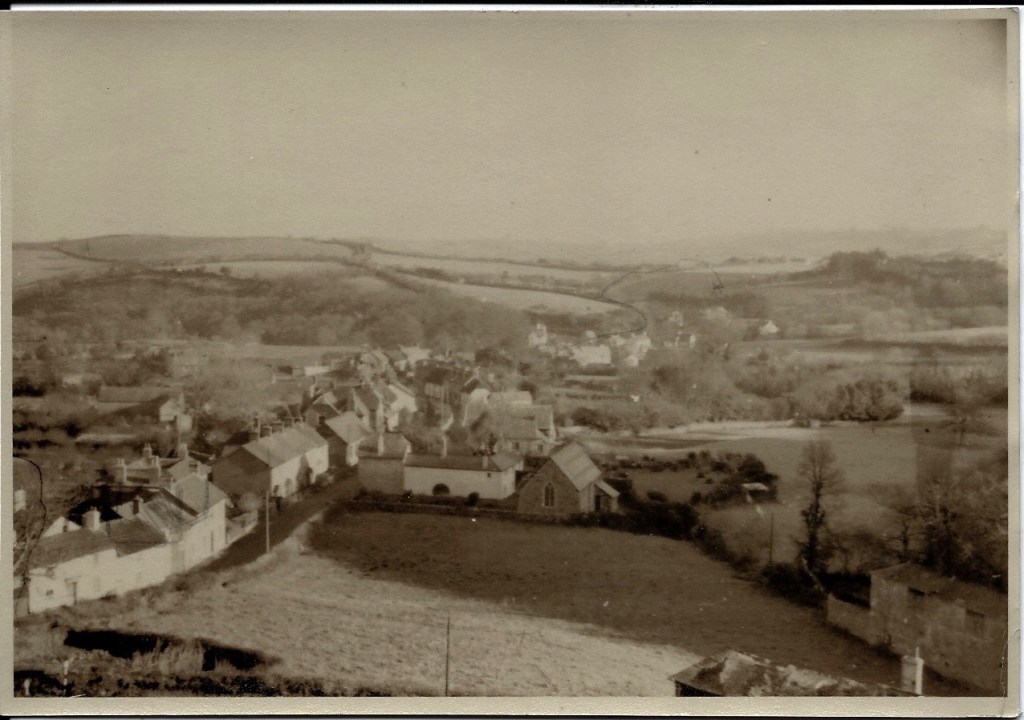
If we could pan left, just out of shot, towards the far corner of that field (known as Alder Meadow or Allermead) we would find the spring that supplies Ladywell. Imagine now we can take our camera and pan across to the right –
Looking in the bottom right corner of the photo we see the start of some buildings…
These are Pearse’s Cleave Mill buildings. (Photo about 1960?)
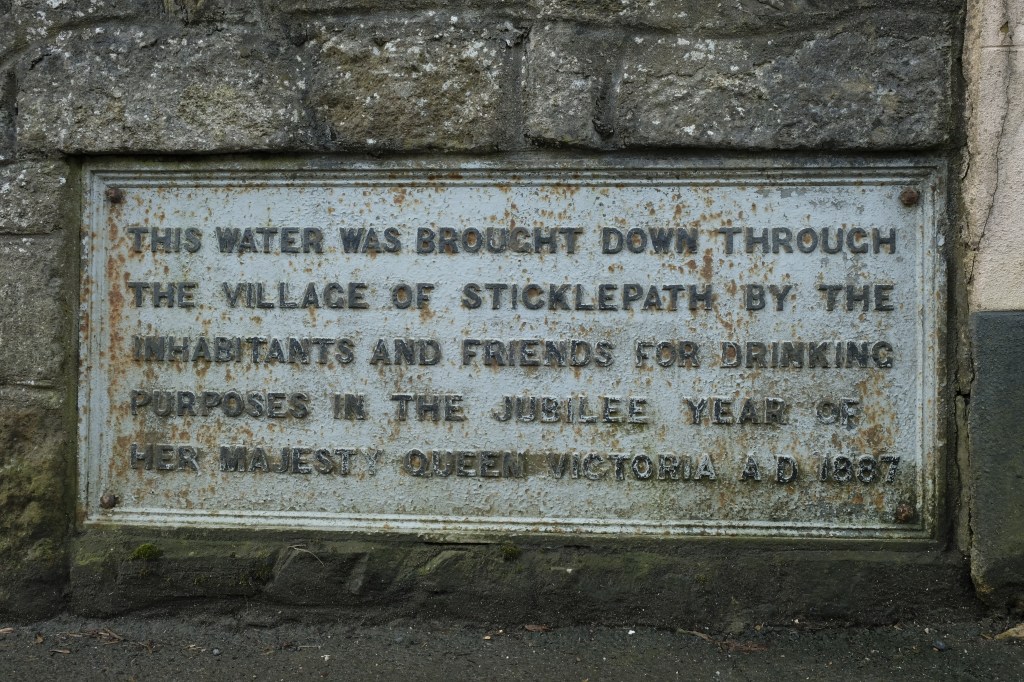
In 1887, the villagers arranged for the Ladywell water to be piped down the village street. This is commemorated on a plaque on the wall next to the chapel. (The wall was taken down and rebuilt with the plaque re-installed, when the road was widened). Being almost ‘outside’ the Parish, certainly not the main focus of Parish affairs, Sticklepath arranged many projects like this one without input from the Parish, relying on locals and wealthier well-wishers.
The wording suggests a standpipe would have been next to or below the plaque. I think a stand pipe is visible on this photo, below the plaque. Before the road was widened.
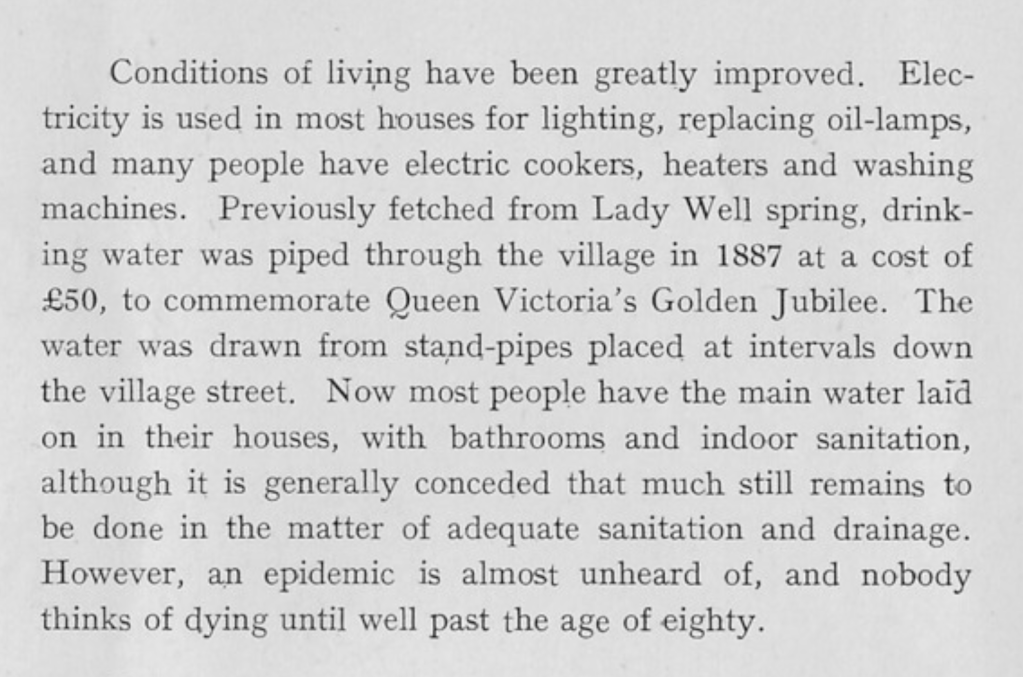
Jessie Barron tells us more in her book. Referring to living conditions following the 2nd world war she says:
Her final sentence a timely reminder of the infection free, quality monitored, piped water we all take for granted, but which was a luxury innovation for our grandparents generation.
Dartmoor water whilst commonly considered ‘natural and pure’ can be contaminated in various ways, even on open moorland, due to the geology and farming – radon and radioactive carbon contamination, excessively acid and corrosive, high aluminium or other metal content, urine and faecal contamination, decaying matter upstream, and even vehicle pollution, for example.
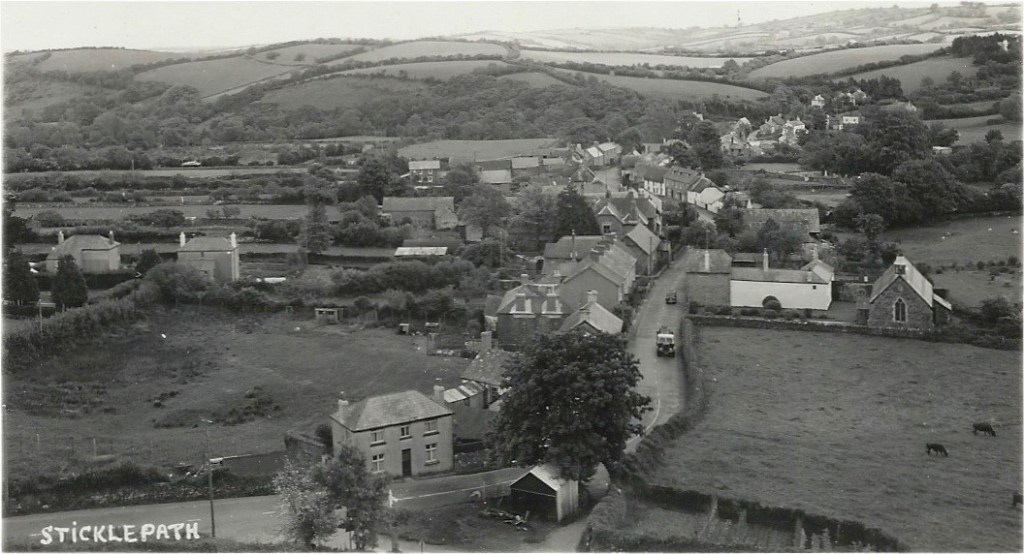
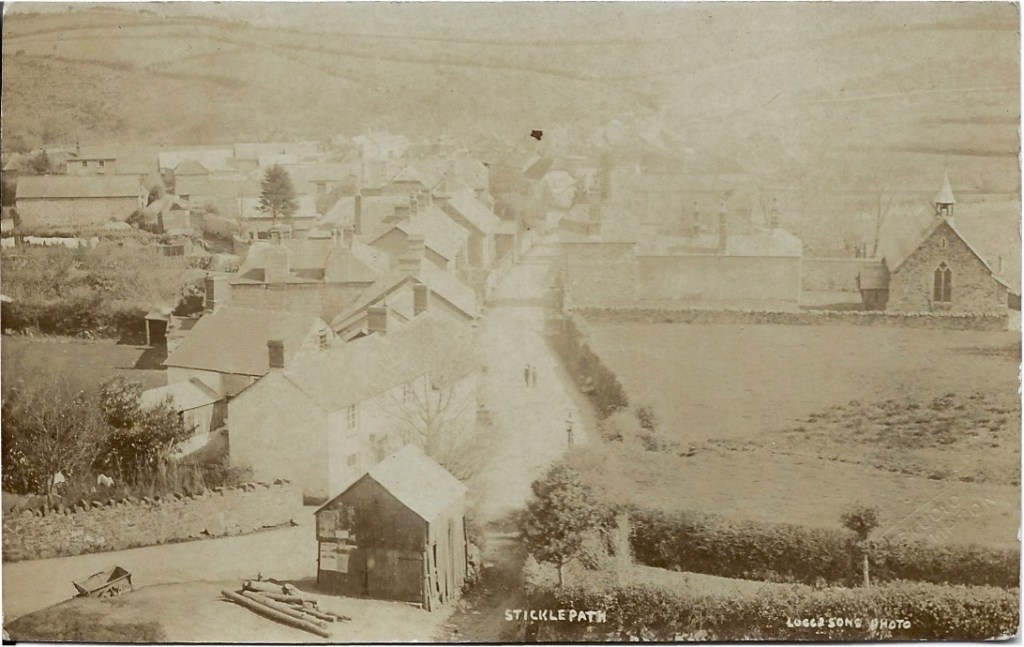
Before moving on to the delightful subject of sewerage and Ladywell’s role, we turn to the building just above Ladywell, the shed in the foreground of Lugg’s photo:.
Photo by Lugg & sons of Okehampton
This substantial building with double ‘garage’ doors, is large enough to house a carriage. We can see posters on the lefthand side. This building was constructed and owned by wheelwright and carriage builder James Cook, as stated in his will. His workshop is on the lefthand side of the road part way between St Mary’s and Ladywell. The shed must have been demolished when the road was substantially widened and re-modelled here, perhaps in 1960s? We can see wood and a small cart on this photo. On photos further above there are wheels seen too around the shed.
Extract from the Will and 3 codicils of James Cook this final codicil dated 22 Jun 1918. He died 15 Oct 1918. Probate granted 11 Apr 1919 to Son William Gilley Cook of Shilston Farm, Throwleigh.
Sanitation – A sewerage system of a reasonable standard came much later than piped water. Until then the Well was the means of flushing away household waste through the open drains on the North side of the road. Ladywell overflow ran into a ‘tip-tank’ beneath an iron grating. This was later replaced with a siphon mechanism. Waste from houses on the South side, however, just joined the leat water. Despite knowing this, most villagers on the South side freely dipped the leat for uses other than drinking, as it flowed just by their back doorsteps. Permission to use the leat water was written into most of their contracts.
In the middle of the 17th century the whole village and surrounding lands including mills and therefore the leat supplying them with power, was in the ownership of the Lethbridge family. By the late 18th century most was owned by the Underhill family. Conveyance of the Western and Carnall Mills (Eastern end of the village just by the bridge) from Richard Underhill to George Underhill includes permission to use the leat water for up to one hour a day to water Mill Meadow, and for him and the tenants of adjoining properties to use the leat water to wash their wool on payment of 6 pence per year. The leat itself and access to it remained the property of the mill owners. (Barron). However, they and I think Cleave Mill also, had to give one hour’s notice of wool washing to the Mills lower downstream.
The W.I.’s ‘The Book of Sticklepath (Dartmoor)’ in 1955 commented that not everyone had running water to their home yet:
“Some of the modern inhabitants of the village do the same today, leaving a pail or pitcher to fill under the steady trickle while they ‘run down the village’. ”
The village school which opened in 1879 is higher up the hill than Ladywell. This caused problems for water supply and sanitation. All drinking water was carried up the hill to school. In 1938 a Ministry of Health Inspector wrote
“The water has to be carried an unreasonable distance and I recommend that this matter is given urgent attention” (Hutchison)
It wasn’t until 1952 that a pump was installed to take water up the hill to the school. School toilets could be flushed using rainwater from holding tanks above the playground, as long as it had rained and was not frozen. These tanks were only disposed of in 1970 (the year I left the school!). There were times the tanks had to be filled, for example by Okehampton Fire Brigade during summer droughts, or by a Water Board Tanker during the freeze of winter 1960-61.
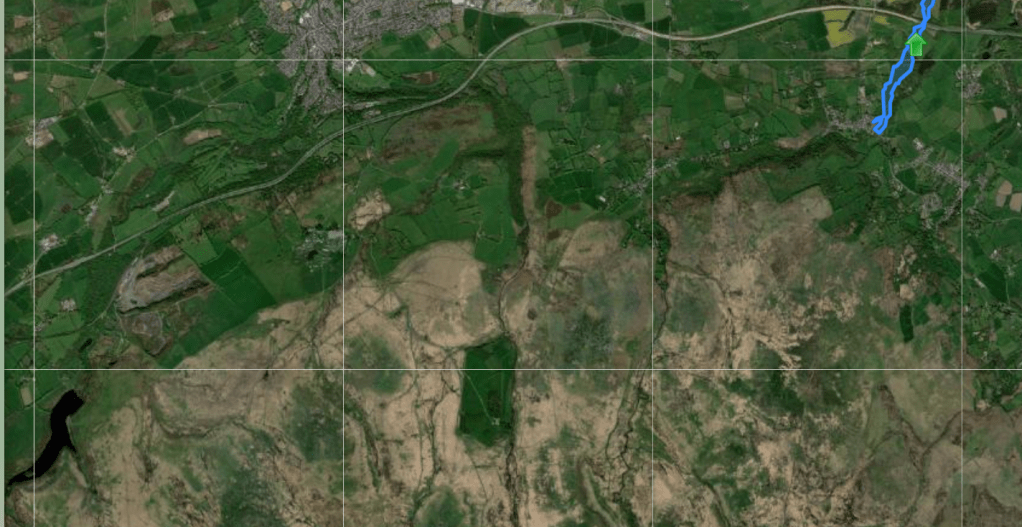
The main supply for Sticklepath village now, along with Belstone’s, is pumped from Meldon Reservoir, about 7 miles away. (I remember visiting the valley before construction of the damn began in 1970, and several times since).
Meldon reservoir far left bottom corner. Sticklepath top right.This aerial view of the same area makes the inhospitable nature of Dartmoor obvious. Sticklepath at the lower end of the blue marker, the dark water of Meldon reservoir bottom left corner.
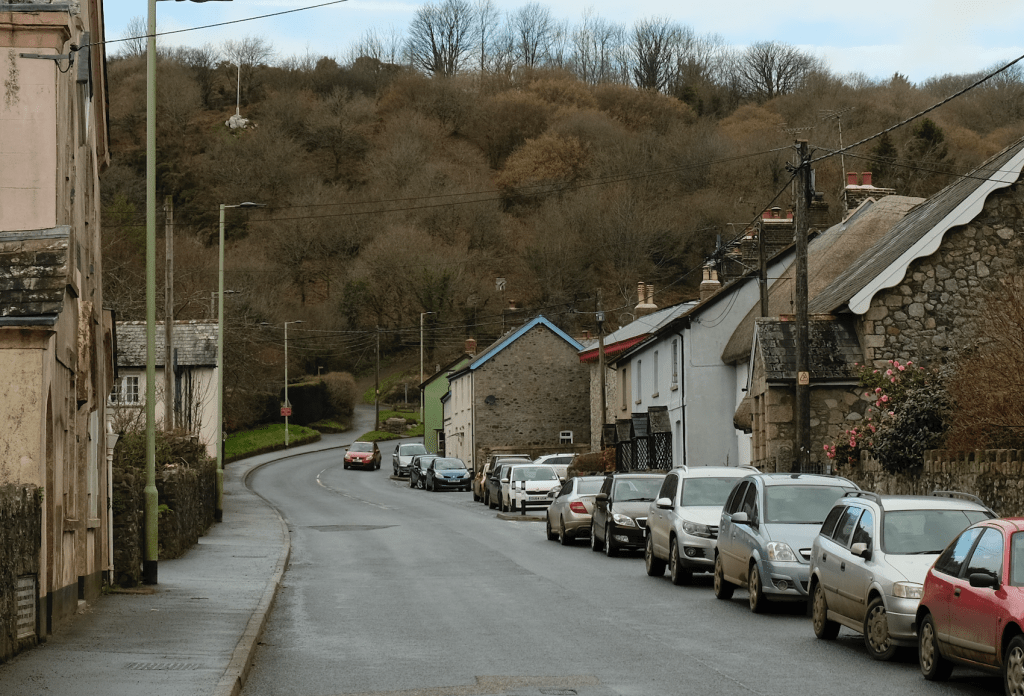
2019 shows the water plaque bottom left in the wall next to the Wesleyan Chapel. Ladywell and its bench can just be seen in the distance above the red car driving down the road. On the right, adjacent to the 4th car in, we see the granite porch of the village hall.
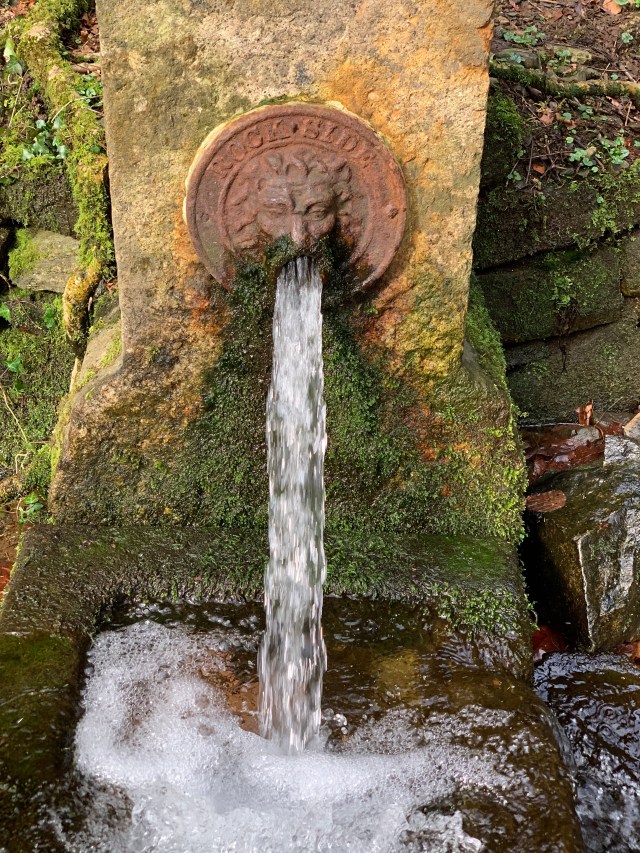
Lion’s Mouth deserves a mention here, purely as a source of drinking water for residents of Skaigh Hamlet, and a pleasing stopping point on a circular walk from Sticklepath Bridge, along the banks of the Taw, through the Skaigh Valley. It likely dates from 1870 in it’s current form.
The Lion’s Mouth, situated not far from the lane leading from Sticklepath up to Skaigh Hamlet and Belstone
Rockside, as it is labelled, otherwise known as Skaigh House, one of the wealthiest estates, at one time owned by Symington who contributed greatly to our village including the building of Sticklepath Village Hall (Next week’s #Sticklepath #OnePlaceLandmark). Again drinking this water is NOT advised, after contamination was found in 2000 by the Environmental Agency.
Additional Notes: 1. Ladywell lends its name to a house on the opposite side of the road but that is not considered here. 2. We should also note residents at the East end of the village used a different spring behind the Taw River Inn in Skaigh Lane. 3. Further photographs of Ladywell can be found in “South Tawton & South Zeal – with Sticklepath – 1000 years beneath the Beacon by Roy and Ursula Radford, pages 26 and 61 – including Chapman postcard no10049, as well as a photograph by Douglas St Leger-Gordon in the WI booklet, those detailed show the position of the standing stone in relation to Ladywell better than those shown above). 4. Water supplies to parts of the village were complicated by being part of, and adjacent to, several parishes. The WI booklet again tells us: “When six ‘council’ bungalows were built down Willey Lane in 1953, pipes for their supply were attached to South Tawton mains, on the other side of the bridge.” 5. Historic England Research Records no 444182 says no evidence was found to substantiate a medieval date for Ladye Well, though the name might suggest a pre-reformation origin. 6. Sticklepath Conservation Area Appraisal suggests a 10th century date for the Ladywell stone, though this may refer to the standing stone rather than the lintel. Conservation Area Appraisal 2017 PDF – http://www.dartmoor.gov.uk. 7. Details of the history of the water supply to Belstone is given in The Book of Belstone (Walpole p131-134) much of which applies to Sticklepath, with various schemes to use Taw Marsh water proposed and some enacted.












 Sticklepath a Village and its People