If you asked people to come up with landmarks in England, Salisbury Plain’s Stonehenge would not be far from the top of the list. There is something mystical about megaliths that attracts our eye and a tactile quality about their solidity, calling us to reach out on a grey blustery day to touch their un-forgiving heat-absorbing surface. On sunny days, they willingly sharing their warmth with us as we eagerly explore the crevices and uneven textures of their surface. Sadly one can no longer explore Stonehenge as we did in childhood, coming up close to appreciate their size and impact.
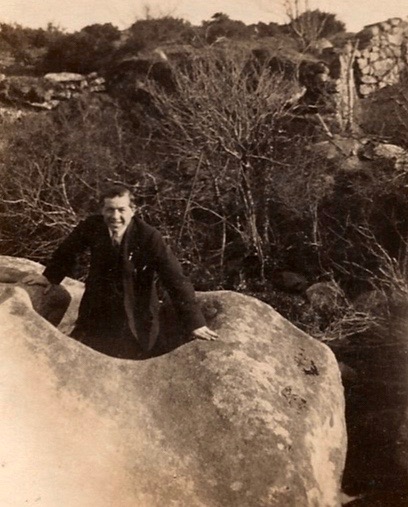
Dartmoor provides many examples of granite landmarks – stone circles or lines, remains of ancient huts to intrigue the hiker, stone walls, and, of course, the Tors. I love the shapes made through weathering and lichens on the surface, adding character and apparent antiquity. Folklore surrounds many formations – the Tolmen stone (celtic for hole – stone) is said to have been used in Druid purification ceremonies and later thought to have the power to cure rheumatic disorders – if you were able to pass through the the hole the requisite number of times.
Charlie Bowden climbing through the Tolmen stone on the Teign 1923
Celtic for Long Stone is maen hir. There are about 12 generally recognised genuine Menhir long stones remaining on Dartmoor but only 3 still standing, guarding the hill tops, stone beacons visible for miles around up to 3.5 or even 4.2m tall. Landmarks which guide walkers on their way but perhaps drew ancients to worship, pointing to the wonders of creation. A few of the largest have been dated to show they do originate in the bronze age, 4,500 years ago.
Some of the less grand Menhirs are the only remaining post in a row or structure, where smaller stones were likely removed for wall or house building elsewhere. Others are thought to have marked Medieval cross roads or tracks. They may have marked meeting places, perhaps for marketing goods, or been boundary markers of some sort. In our neighbouring village South Zeal, the Oxenham Arms was built around a large menhir. Others indicate ancient burial places, much as the gravestones of today, a memorial to the people or time, lest we forget.
All these Menhirs, crosses and boundary stones have been well documented by historians such as William Crossing, Rev Sabine Baring Gould, W.G. Hoskins and D.J.L Brewer as well as our own St Leger Gordons, many academics from Exeter University and others.
The Incised Stone, close to Ladywell, Sticklepath. Here shown with William John Tucker, son of Aubrey Tucker of 1 Ska View Cottages. Chapman Postcard C1905
Sticklepath can not claim one of the giants, but we have our own ancient granite Menhirs which have attracted attention, speculation and stories: the Honest Man and the Incised Stone. These have been re-purposed over the years, likely St Andrew’s crosses added to Christianise them and more recent use as Parish boundary markers, first between Belstone and Sampford Courtenay and now Sticklepath Parish. Much has been written, often with great consternation, of the orientation and exact position of the stones. There has been natural sinking, and of necessity movement for road widening or for preservation of the stones. Both are about 6 feet tall but most often 3-4 feet of granite is visible.
The Honest Man, of similar appearance, has two stories associated with it, documented by Ruth St Leger-Gordon of sticklepath (St. Ledger-Gordon, 1972, The Witchcraft and Folklore of Dartmoor, EP Publishing, Wakefield). Firstly a ‘Good Samaritan’ story suggests it was erected by a man who had been assaulted as a memorial to his rescuer’s kindness. The second reminds us that the stone marks the Mariner’s Way, the route taken by sailors across the county when changing ships. It tells of one coming up the hill from the Inns of Sticklepath, rather the worse for ale, probably in the semi-dark, mistaking the stone for a person and asking “Be ye an honest man?”
St Leger-Gordon also speculates that it may once have been a signpost for the meeting of a pagan religious group. Page describing the stone slightly earlier doesn’t mention the name ‘Honest man’, which is likely therefore to have been a more recent innovation (Page, J. Ll. W. 1895 The Exploration of Dartmoor, Seeley & Co. London). The best photo I have found showing some markings is at https://www.legendarydartmoor.co.uk/honestman.htm
From the Honest Man at the entrance to Bude farm, for 300 yards the Mariner’s way is also the Parish boundary. Beating the Bounds, a strong local tradition still occurs perhaps every 7 years, Covid allowing!
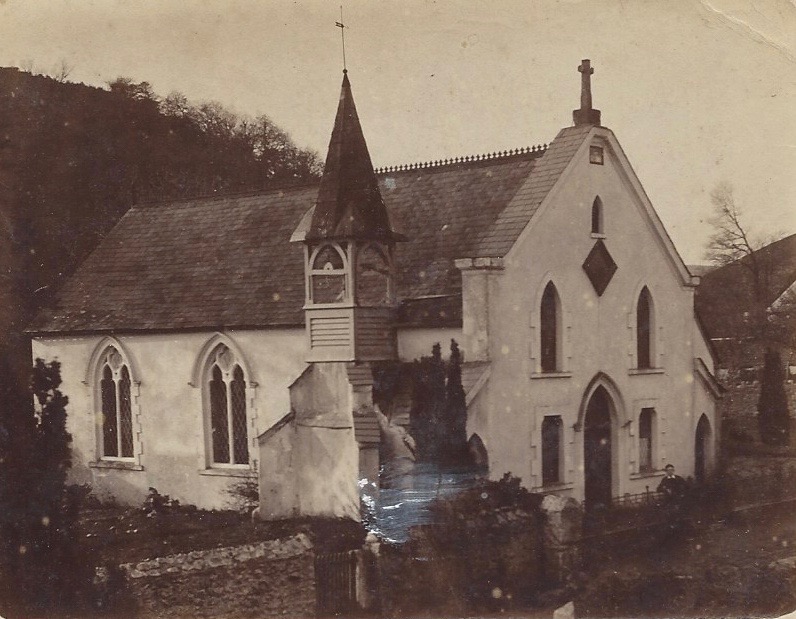
Sticklepath also boasts an ancient granite cross, of medieval style. This is found on top of the Wesleyan Chapel which was built in 1816. The origins of the cross are lost in the mists of time.
Sticklepath Heritage Group has done research on the standing stones and may have further information available.
COMING SOON… #OnePlaceTragedies
The One-place Studies Society invites anyone with an interest in local history or family history or house history to join us with monthly blog prompts throughout 2021
One Place Studies can be found throughout the world – Sue Wyatt in Tasmania has a message encouraging her readers to contribute too – READERS: DO YOU HAVE ANY OTHER IDEAS FOR POSTS? – it would be great if anyone with an interest in Sticklepath would like to join in… let me know if you don’t have a blog or website, I can help with that! No need to stick to the suggested topics, but please let me know so I can flag it up here too.
52 ancestors prompts are designed to help us put something in writing about an ancestor each week (though there is no come back should you miss a week! All voluntary, meant to be fun!). The words help us record more than just dates and facts.
Namesake made me think about my great grandfather, parent of my paternal grandmother. He was called Albany George Finch (28 Nov 1863 – 29 Aug 1945). We all know where a surname comes from, no real choice there. George was his father’s name. But Albany? That is a bit of a mystery. There is an Albany House in the village of Sticklepath, which I guess is named after AGF. (He often refers to himself as AGF just as my grandmother called herself MCB in writing). So why Albany?
My best guess is that there was a local MP called Albany Savile from 9 May 1807 – 30 June 1820. ( https://www.theyworkforyou.com/mp/24255/albany_savile/okehampton ) Whilst I do not think our Albany was in any way named after him, it will have raised the profile of the name in the local area.
As is often the case, delving into the life of this man took me in a new direction (a diversion!) – the complete change in social structure during the 19th century. E.W. Martin reflects on the change from ‘Squire-archy’ to democracy, using Albany Savile and Okehampton, the nearest town to Sticklepath, as an example. He says –
“the squire and his kind manipulated local life with the effortless skill of a puppet-master.” “Very little could be done without their sanction and nothing was achieved without their approval.”
( “The Shearers and the Shorn – A study of Life in a Devon Community” 1965, one of the Dartington Hall Studies in Rural Sociology).
The list of families he mentions as “’embalmed in the musty grandeur of Burke’s Landed Gentry” is headed by the Saviles and includes Luxmoores, Woollcombes, Burdons, Calmady-Hamlyns, Holleys and Wreys.
Albany Savile (1783 – 1831) married into wealth in 1815 when Eleanora, daughter of Sir Bouchier Wrey, squire of Tavistock Court in Tawstock near Barnstaple, became his wife. He purchased the manor and castle of Okehampton in 1820. There were only 180 freeholders of sufficient status to vote in elections for the two MPs Okehampton had at that time. (Population 2,033 in 1821). Albany ‘served’ alongside his father Christopher and later his son also became MP. Albany Savile had major input to the appointees for mayor and vicar and recorder, and the Burgesses came completely under his influence. He could elect as many freemen (voters) as he wanted. Magistrates appointments were influenced by him too. He was essentially the owner and ruler of Okehampton. Even following his death his nominees continued to run the Corporation, and the Municipal Corporations Act of 1835 didn’t really come into effect in Okehampton until 1885.
My interest here is not to vilify Mr Savile but rather to begin to understand how the ruling classes had such power over individuals and the way the society our ancestors lived in was run. Martin mentions that one witness described Mr Savile as
Sticklepath Village Hall 1983 with Tawburn House seen behind.
The Village hall was built 1883-4 through the interest and organisation of Mr W.W. Symington Esq. of Rockside, Belstone. The site was given by Ellen, Thomas Pearse’s daughter. Villagers raised some money. The hall was opened by Sir John Phear. In 1897 Ellen paid the remaining mortgage and handed the building, free of debt, to the village. A billiard room was added by public subscription in 1928.
We will explore the people mentioned and the building in some detail before considering the social function of the village hall though images.
William Weldon Symington JP was a fortunate young man from a fascinating family. The family became wealthy through ‘W. Symington & Co’ founded in 1827 by his father. A grocer, ‘Coffee Roaster’, and inventor in Market Harborough, his father became famous for dehydrated soups based on developing a pea flour in 1852, which could make a soup just by adding boiling water. It was much used by the military during the Crimean War (1853-5) as well as Scott’s Antarctic expedition later. The family also owned a corset factory, one of the first factories to use Singer sewing machines. It became famous for the ‘Liberty Bodice’, invented by Fred Cox, Marketing Director at R & W H Symington & Co Ltd in 1908. This was a fleecy knitted vest which helped modernise the way children dressed in the early C20th, with rubber buttons, re-enforcing cotton tapes and buttons to attach drawers and stockings. For more information:
William Weldon Symington (1845 -1904) was the fifth child of William Symington (1809 – 1898), the pea flour inventor, and his wife Mary Weldon (1815-). On 2 April 1871 census we find him in Halstead, Essex, working at the Colne Valley Iron works. In the census he is described as Civil Engineer, Senior Partner in Iron Foundry employing 35 men and 20 boys. In 1871 he married Susan Mary Dening (1843-) and they had two children, Lyndsay Dening Symington (1872-1942) and Beatrice Gertrude Susie Symington (1875-1954). He was made a member of the Institute of Mechanical Engineers in 1872.
( He is also listed on Grace’s Guide to British Industrial History, Institution of Mechanical Engineers: Members lists: 1872, at Colne Valley Iron Works, Halstead, and 1875 at Bowden Steam Mills, Market Harborough. Perhaps he might have bought shares in the Suez Canal Company when it opened in 1869? Probate March 1905 shows he died in Trinidad, though his address is given as Pixies Holt, Dartmeet, Princetown, Dartmoor.)
Our interest is in the family in the 1880s, when they can be seen together on the 1881 census with 2 servants and a niece in Belstone. However, there is room for confusion since Willian Weldon Symington appears in two different places on census night 1881! I wonder if he was in fact with his parents on that night in Little Bowden Northamptonshire, but added in Devon as he was head of the household? Retired engineer of the same age in both census returns. I have not found any other William Weldon Symington entries in other census years, so it seems likely he was documented twice. I do wonder how he managed to retire at such a young age!
1881 England & Wales Census Image accessed through myheritage.com January 2021
Entry split over two pages, (image from Ancestry.com)Registration district Market Harborough ED 20 Piece 3121. Folio 56. Page number 5
“The house grounds were laid out in style with terraces, walkways and summerhouses. Between the tennis court and combined croquet lawn and bowling green was a maze, covered rosery, pine copse, two peach and tomato houses, heated glass houses and three vineries. The main house included 13 bed and dressing rooms, with a billiard room lighted by Gasoline produced in the garden and a conservatory.” Many outbuildings, subsequently turned into houses are described.
The Symington family took part in many musical entertainments in Sticklepath village hall, often raising funds to pay for the building, with flowers from their conservatory sometimes mentioned as providing decoration.
The Village Hall was opened on 9th July 1884. Here is the full transcript of the report from the Express and Echo – Thursday 10 July 1884 (accessed from BritishNewspaperArchive.co.uk January 2021):
OPENING OF A VILLAGE HALL. – The village of Sticklepath, about four miles from Okehampton, was yesterday the scene of a very pleasant ceremony, the occasion being the opening of a village hall by Sir John Phear. The hall, which is 40ft. by 20ft. and about 18ft. in height, is situate near the head of the village, and is a very substantial building of Dartmoor granite. Mr. W. W. Symington, J.P., of Rockside, Bestone, has, since his coming into the neighbourhood, taken a great interest in the welfare of the inhabitants, and has been mainly instrumental in procuring the necessary funds for the structure. The work has been done by local builders, Mr. Symington maintaining a personal supervision. The hall has cost about £200, of which £72 11s. has been subscribed. The site of the building was given by Mrs. Thompson, of Bideford. and formerly of Sticklepath. A tea was held at the grounds of Rockside in the afternoon, when various amusements were provided. including exercises in the magic arts by Mr. Morris; several large balloons were sent up. A large number of people arrived on the ground from Okehampton, and a very pleasant day was spent. The Rockside brass band was in attendance.
The village hall was opened by Sir John Budd Phear, whose mother was the only child of Dr Samuel Budd, of nearby North Tawton. Sir John was a judge who worked in the UK and then in India. He had returned to England in 1879 and settled in Exmouth, Devon. Perhaps Symington JP met him through his work as a magistrate or through social or political interests and invited him to open the village hall.
The opening ceremony was an important occasion for the village and perhaps some were allowed a day off for the celebrations. We can imagine Sticklepath folk in their Sunday best walking up the Skaigh valley to Rockside where, no doubt, many dignitaries from Okehampton and the surrounding area joined in the festivities.
Chapman Postcard Skaigh Belstone 7319
The person who gave the land and paid off much of the cost of building the hall was in fact Ellen Pearse, daughter of Thomas Pearse who had also done much for Sticklepath. Ellen married Dr John Thompson GP and coroner of Bideford. Ellen later moved back to Sticklepath, building Tawburn on the land adjacent to the village hall for herself.
Tawburn House (tall, ivy clad) and further on the porch of the village hall abutting the road. (Note the shadow in the wall of the cross on top of the Wesleyan chapel)
The Bowdens and friends outside Tawburn 1954 photo. Charles and Muriel Bowden in centre
Ellen’s generosity is remembered in her portrait which (as far as I know) is hanging in the hall still.
Flower Show Display after judging 1961. Portrait on the wall Ellen Pearse (Mrs Thompson).
There have been quite a few changes to the building over the years:
It must have been obvious to planners that the village hall porch and tall building in the centre were squeeze points when it came to widening the road and adding pavements. Demolishing the end part of the house in front of the church (leaving the long white building) must have been distressing but inevitable.
This Guard of Honour extended from chapel to hall for a leader’s wedding 1948 reminding us how important uniformed organisations used to be. The porch is clearly structured so that the village hall door originally opened straight onto the busy road. Now moved around, as below –
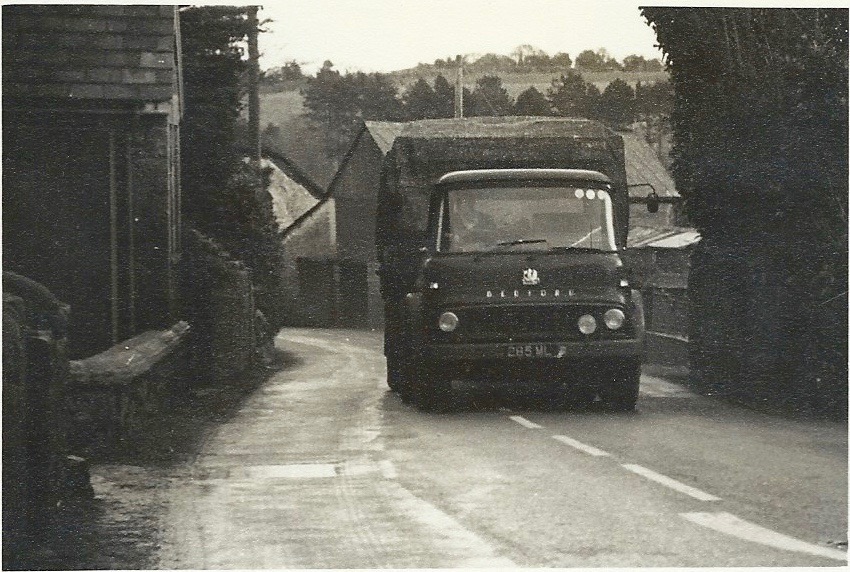
Here the hall door has moved but there are no pavements. The relatively small lorry emphasises the narrowness.
Two windows replaced the door, which moved around 90 degrees. Tawburn again seen next to the hall entrance. Pavements! 1983
On Monday 02 August 1926 The Western Morning News announced a new extension –
NEW VILLAGE HALL FOR STICKLEPATH. The foundation-stone of the village hall extension at Sticklepath was laid on Thursday by Mrs. Rashleigh, of Rashleighs, who enumerated the advantages of an up-to-date village hall. Mr. A. G. Finch, chairman of the trustees was the master of ceremonies, and opened the proceedings by explaining the objects of the scheme. Miss Kathleen Cook presented a bouquet to Mrs. Rashleigh immediately after the stone had been laid, after which Mrs. Rashleigh invited all those present to lay foundation bricks, and to hand their donations to Mr. Elderton, the treasurer, in envelopes which had been previously distributed. A whist tournament which was subsequently held was well attended, as was the public tea preceding the ceremony. It is understood that over £40 was realized during the afternoon and evening, over £30 of which was actually raised at the foundation-stone ceremony.
We are lucky to have many many name rich clippings from the newspapers and can see how the main players changed over time. (A project in itself!)
Aerial view of village hall and The Old Cottage on the left. Electricity sub-station behind (top of photo), with Back Lane curving round between them. (Darke’s Acre drive straight up) War Memorial plaques are clearly seen on the hall between the two middle windows.
There have been various extensions behind the hall, toilets were required, then altered as legal requirements increased. The kitchen too has changed, and was commandeered during WWII for the NAAFI. I understand at one time there was a laundry behind the hall, a reading room, billiards, the ‘committee room’ of the 1960s now opened up into the kitchen area, and coffee mornings are held in the re-named ‘Bert Stead’ room. (Again a project in itself to look at the Hall committee minutes and plans and document the changes.)
ENTERTAINMENTS
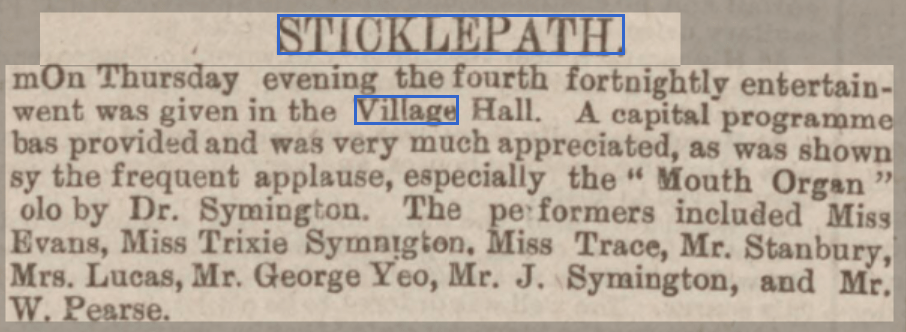
At this time of lockdown many are remembering happier days. Western Times – Friday 14 December 1888
In addition to this being an example of the entertainments provided more than 130 years ago, I have included the cutting above to show the typos. Transcription errors, such as ‘Miss Trixie Symnigton’ are well recognised by genealogists and historians. Here, however, the first letter of each of the first 4 lines is showing a line too high. Such an error would not happen today and reflects the type setting methods of the time (though of course columns can get misaligned on spreadsheets today). The pale r in performers likely represents a mis-alignment of that letter too.
“There was always a large and appreciative audience in the Village Hall when Messrs. Rogers and Welch, a company of strolling players, gave thrilling representations of ‘East Lynne’ and ‘Maria Marten, or the Murder in the Red Barn’. Upon other occasions the Walford family, a travelling concert party, gave musical selections on the ‘Bells’ or initiated us into the mysteries of the Hydro-daktulo-Psychic-Harmonica, or showed the first moving pictures that were seen in the village.” (Jessie Barron writing 1950)
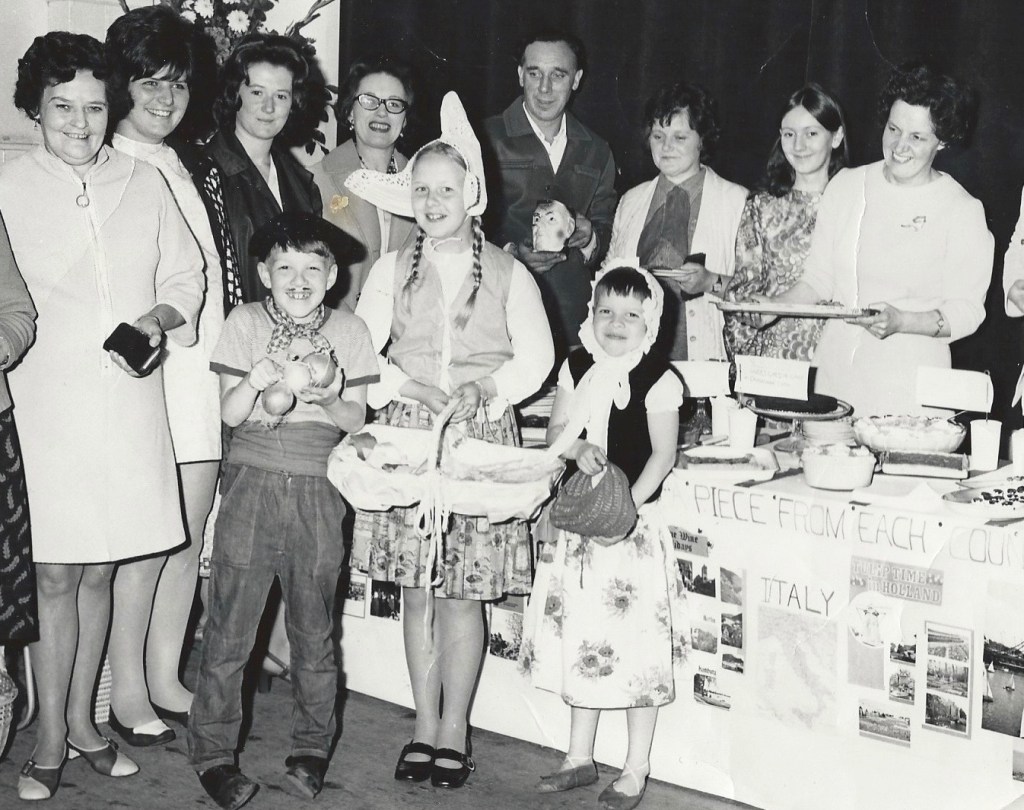
European evening Perhaps 1969? Reminds us we did not have the range of foods then we have today, people invited to try a something from each country. (Or at least made with recipes from that country!)
WI Welsh evening 1971. From left standing Joyce Madden, Doris Holman, Phyllis Finch, Mrs Jameson, Margaret Bowden. Sitting far left Mrs Smith. From right Standing Cyril’s sister, Miss Ogilvie, Muriel Bowden, Cyril’s Mum, Joyce Brockman, ?Winnie Salter, Meg Walton. Girl kneeling Francis Hawley? Can you confirm or add names – please send a comment 🙂
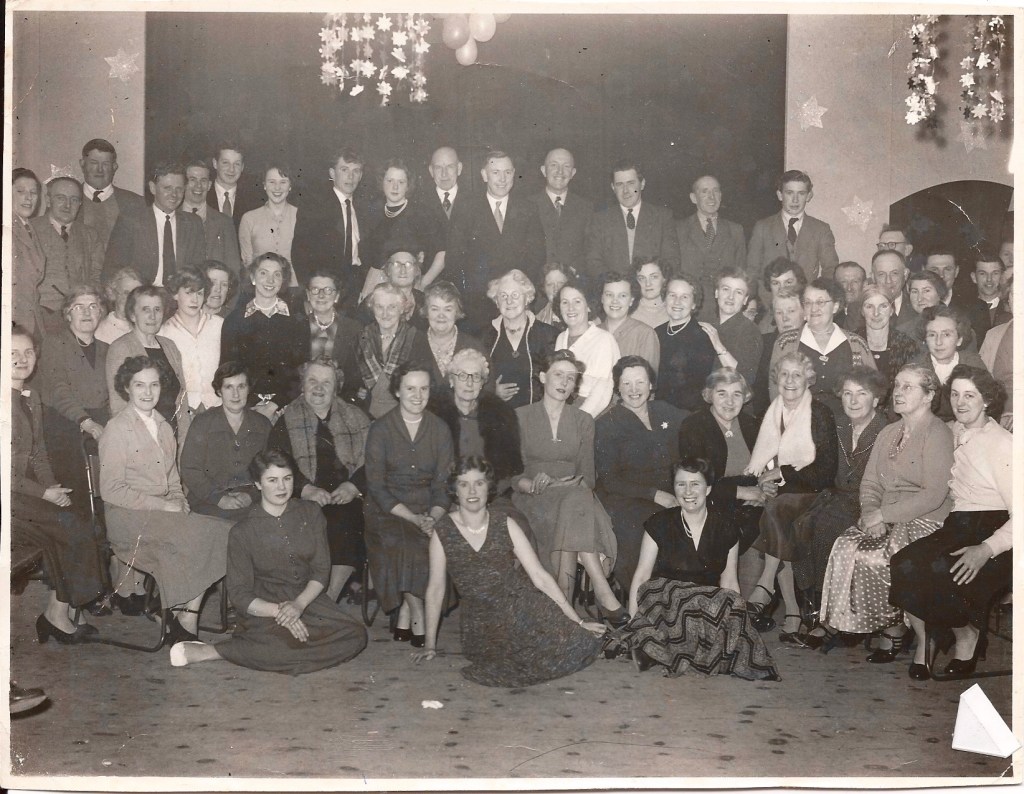
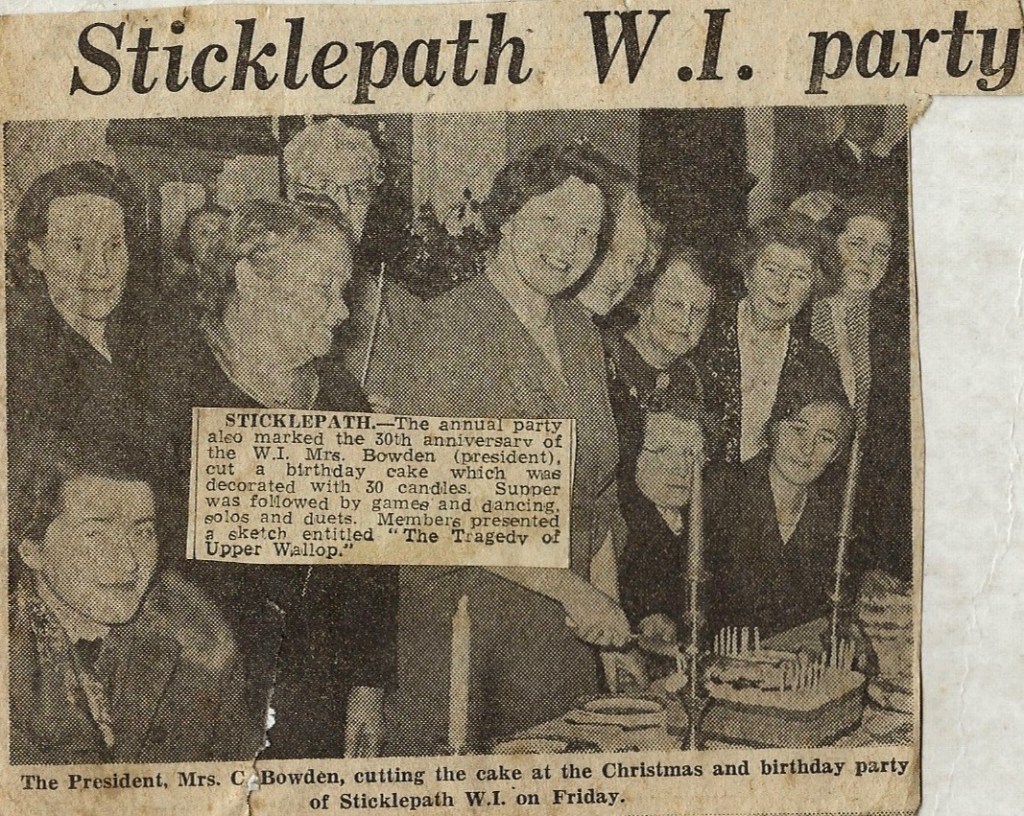
Christmas Party? Mid -late 1950s? Can you name anyone? Please send a comment thank you.
Coronation Tableau, rehearsal (no audience). 1953
Bicky Blower on left seated, Girlie Eveley stood behind her. On the right end seated Margaret Bowden. Can you name more? Please send comments to shields_h_f@hotmail.com
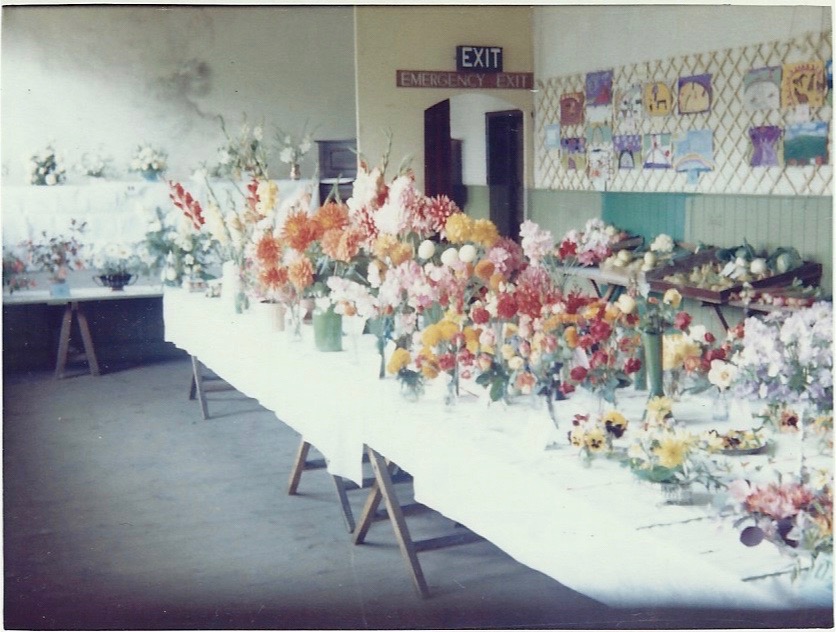
Flower Show ?1961 (note the ‘Exit’ before it was altered, turned 90 degrees)
The Judges and organisers enjoy a well earned cuppa (Ann Bowden dark hair near centre. Meg Walton far right?)
Trestle tables were well used for many years. Candle contravene health and safety today… Possible Christmas party, late 1940s? Do you recognise anyone on the near or far table? Mr Stead third face from left far side of near table. Joyce Madden 3rd on right of near table. Roger Bowden 2/3rds way along that row. I wonder if there is there a third table over to the right? A good turnout!
I am always looking for additional documents, postcards and photographs of Sticklepath, places people or events. If you have any you are willing to share (not necessarily for publication on the web) or can confirm or add names to photos, or have memories you can add please do contact me shields_h_f@hotmail.com or get in touch with Sticklepath Heritage Group.















 Sticklepath a Village and its People