Helen Finch Bowden about 1964 Taken by C Roger F Bowden
Rather self indulgent but this photo of me was taken by and developed and printed by my Dad. He had a keen interest in photography from his time at Shebbear College, I suspect encouraged by his physics teacher Mr Barfoot, a life long friend. He took many photos of the school and later had his own dark room in Cleave House (Sticklepath). The desk would be cleared after dark, the shutters (internal wood ones) unfolded and secured, and out came all the equipment. All was done in near darkness, only a dim red glow. Much more of a procedure than editing on a laptop today! The chemicals had distinctive smells. The timing had to be just right or the result was too light or too dark. The papers floated in each chemical bath in turn, transferred using tweezers, then had to dry before the resulting print could be handled and enjoyed. Fascinating to a little girl who was occasionally allowed to watch.
Can anyone explain the shadow? I presume added during the initial exposure of the photographic paper for artistic effect?
If you asked people to come up with landmarks in England, Salisbury Plain’s Stonehenge would not be far from the top of the list. There is something mystical about megaliths that attracts our eye and a tactile quality about their solidity, calling us to reach out on a grey blustery day to touch their un-forgiving heat-absorbing surface. On sunny days, they willingly sharing their warmth with us as we eagerly explore the crevices and uneven textures of their surface. Sadly one can no longer explore Stonehenge as we did in childhood, coming up close to appreciate their size and impact.
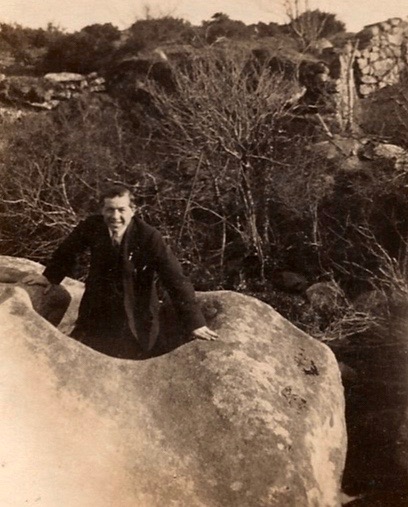
Dartmoor provides many examples of granite landmarks – stone circles or lines, remains of ancient huts to intrigue the hiker, stone walls, and, of course, the Tors. I love the shapes made through weathering and lichens on the surface, adding character and apparent antiquity. Folklore surrounds many formations – the Tolmen stone (celtic for hole – stone) is said to have been used in Druid purification ceremonies and later thought to have the power to cure rheumatic disorders – if you were able to pass through the the hole the requisite number of times.
Charlie Bowden climbing through the Tolmen stone on the Teign 1923
Celtic for Long Stone is maen hir. There are about 12 generally recognised genuine Menhir long stones remaining on Dartmoor but only 3 still standing, guarding the hill tops, stone beacons visible for miles around up to 3.5 or even 4.2m tall. Landmarks which guide walkers on their way but perhaps drew ancients to worship, pointing to the wonders of creation. A few of the largest have been dated to show they do originate in the bronze age, 4,500 years ago.
Some of the less grand Menhirs are the only remaining post in a row or structure, where smaller stones were likely removed for wall or house building elsewhere. Others are thought to have marked Medieval cross roads or tracks. They may have marked meeting places, perhaps for marketing goods, or been boundary markers of some sort. In our neighbouring village South Zeal, the Oxenham Arms was built around a large menhir. Others indicate ancient burial places, much as the gravestones of today, a memorial to the people or time, lest we forget.
All these Menhirs, crosses and boundary stones have been well documented by historians such as William Crossing, Rev Sabine Baring Gould, W.G. Hoskins and D.J.L Brewer as well as our own St Leger Gordons, many academics from Exeter University and others.
The Incised Stone, close to Ladywell, Sticklepath. Here shown with William John Tucker, son of Aubrey Tucker of 1 Ska View Cottages. Chapman Postcard C1905
Sticklepath can not claim one of the giants, but we have our own ancient granite Menhirs which have attracted attention, speculation and stories: the Honest Man and the Incised Stone. These have been re-purposed over the years, likely St Andrew’s crosses added to Christianise them and more recent use as Parish boundary markers, first between Belstone and Sampford Courtenay and now Sticklepath Parish. Much has been written, often with great consternation, of the orientation and exact position of the stones. There has been natural sinking, and of necessity movement for road widening or for preservation of the stones. Both are about 6 feet tall but most often 3-4 feet of granite is visible.
The Honest Man, of similar appearance, has two stories associated with it, documented by Ruth St Leger-Gordon of sticklepath (St. Ledger-Gordon, 1972, The Witchcraft and Folklore of Dartmoor, EP Publishing, Wakefield). Firstly a ‘Good Samaritan’ story suggests it was erected by a man who had been assaulted as a memorial to his rescuer’s kindness. The second reminds us that the stone marks the Mariner’s Way, the route taken by sailors across the county when changing ships. It tells of one coming up the hill from the Inns of Sticklepath, rather the worse for ale, probably in the semi-dark, mistaking the stone for a person and asking “Be ye an honest man?”
St Leger-Gordon also speculates that it may once have been a signpost for the meeting of a pagan religious group. Page describing the stone slightly earlier doesn’t mention the name ‘Honest man’, which is likely therefore to have been a more recent innovation (Page, J. Ll. W. 1895 The Exploration of Dartmoor, Seeley & Co. London). The best photo I have found showing some markings is at https://www.legendarydartmoor.co.uk/honestman.htm
From the Honest Man at the entrance to Bude farm, for 300 yards the Mariner’s way is also the Parish boundary. Beating the Bounds, a strong local tradition still occurs perhaps every 7 years, Covid allowing!
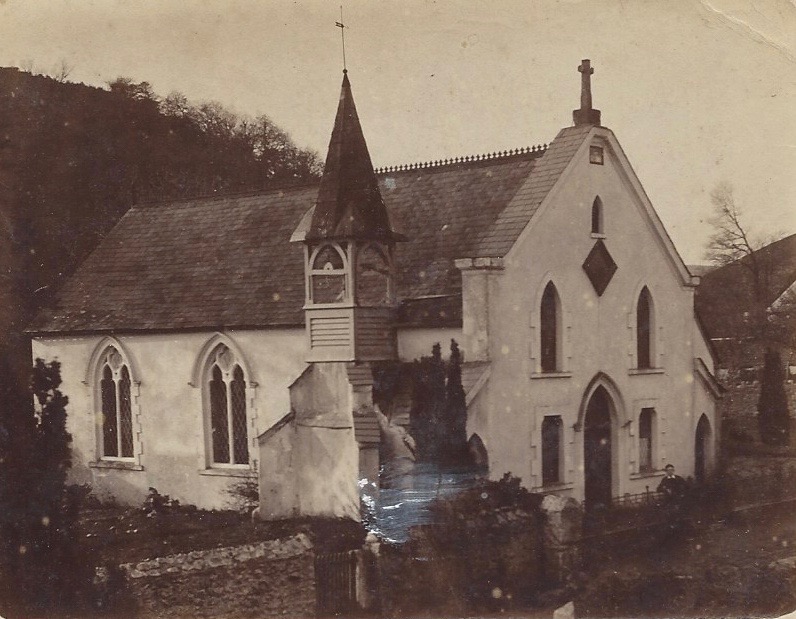
Sticklepath also boasts an ancient granite cross, of medieval style. This is found on top of the Wesleyan Chapel which was built in 1816. The origins of the cross are lost in the mists of time.
Sticklepath Heritage Group has done research on the standing stones and may have further information available.
COMING SOON… #OnePlaceTragedies
The One-place Studies Society invites anyone with an interest in local history or family history or house history to join us with monthly blog prompts throughout 2021
One Place Studies can be found throughout the world – Sue Wyatt in Tasmania has a message encouraging her readers to contribute too – READERS: DO YOU HAVE ANY OTHER IDEAS FOR POSTS? – it would be great if anyone with an interest in Sticklepath would like to join in… let me know if you don’t have a blog or website, I can help with that! No need to stick to the suggested topics, but please let me know so I can flag it up here too.
52 ancestors prompts are designed to help us put something in writing about an ancestor each week (though there is no come back should you miss a week! All voluntary, meant to be fun!). The words help us record more than just dates and facts.
Namesake made me think about my great grandfather, parent of my paternal grandmother. He was called Albany George Finch (28 Nov 1863 – 29 Aug 1945). We all know where a surname comes from, no real choice there. George was his father’s name. But Albany? That is a bit of a mystery. There is an Albany House in the village of Sticklepath, which I guess is named after AGF. (He often refers to himself as AGF just as my grandmother called herself MCB in writing). So why Albany?
My best guess is that there was a local MP called Albany Savile from 9 May 1807 – 30 June 1820. ( https://www.theyworkforyou.com/mp/24255/albany_savile/okehampton ) Whilst I do not think our Albany was in any way named after him, it will have raised the profile of the name in the local area.
As is often the case, delving into the life of this man took me in a new direction (a diversion!) – the complete change in social structure during the 19th century. E.W. Martin reflects on the change from ‘Squire-archy’ to democracy, using Albany Savile and Okehampton, the nearest town to Sticklepath, as an example. He says –
“the squire and his kind manipulated local life with the effortless skill of a puppet-master.” “Very little could be done without their sanction and nothing was achieved without their approval.”
( “The Shearers and the Shorn – A study of Life in a Devon Community” 1965, one of the Dartington Hall Studies in Rural Sociology).
The list of families he mentions as “’embalmed in the musty grandeur of Burke’s Landed Gentry” is headed by the Saviles and includes Luxmoores, Woollcombes, Burdons, Calmady-Hamlyns, Holleys and Wreys.
Albany Savile (1783 – 1831) married into wealth in 1815 when Eleanora, daughter of Sir Bouchier Wrey, squire of Tavistock Court in Tawstock near Barnstaple, became his wife. He purchased the manor and castle of Okehampton in 1820. There were only 180 freeholders of sufficient status to vote in elections for the two MPs Okehampton had at that time. (Population 2,033 in 1821). Albany ‘served’ alongside his father Christopher and later his son also became MP. Albany Savile had major input to the appointees for mayor and vicar and recorder, and the Burgesses came completely under his influence. He could elect as many freemen (voters) as he wanted. Magistrates appointments were influenced by him too. He was essentially the owner and ruler of Okehampton. Even following his death his nominees continued to run the Corporation, and the Municipal Corporations Act of 1835 didn’t really come into effect in Okehampton until 1885.
My interest here is not to vilify Mr Savile but rather to begin to understand how the ruling classes had such power over individuals and the way the society our ancestors lived in was run. Martin mentions that one witness described Mr Savile as



 Sticklepath a Village and its People