#OnePlaceStudies #SticklepathOne #Sticklepath #House history
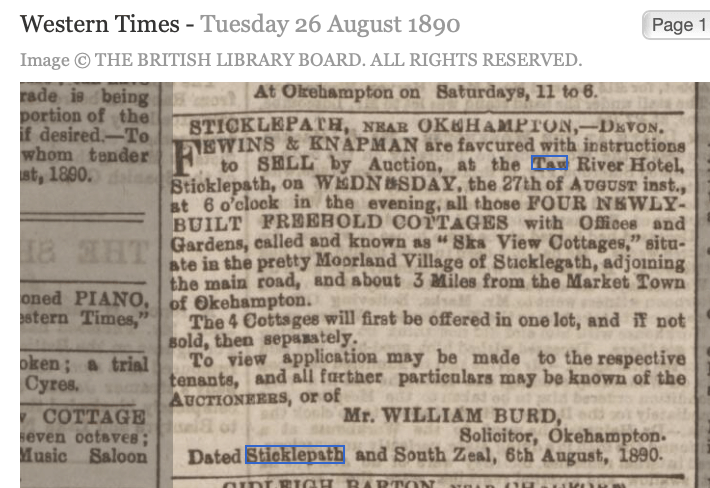
Three things have happened in this last week: while preparing for #OnePlacePubs I spotted an auction for the new Ska View cottages in Sticklepath (1890 advert image below); I heard a Zoom talk by Ivan Bunn at The Voice Cloud helpfully going through house deeds in some detail; and yesterday’s @househistoryhour with the amazing Steve Jackson @oneplacestudies – together these have spurred me on to consider the history of at least one house within that row of cottages.
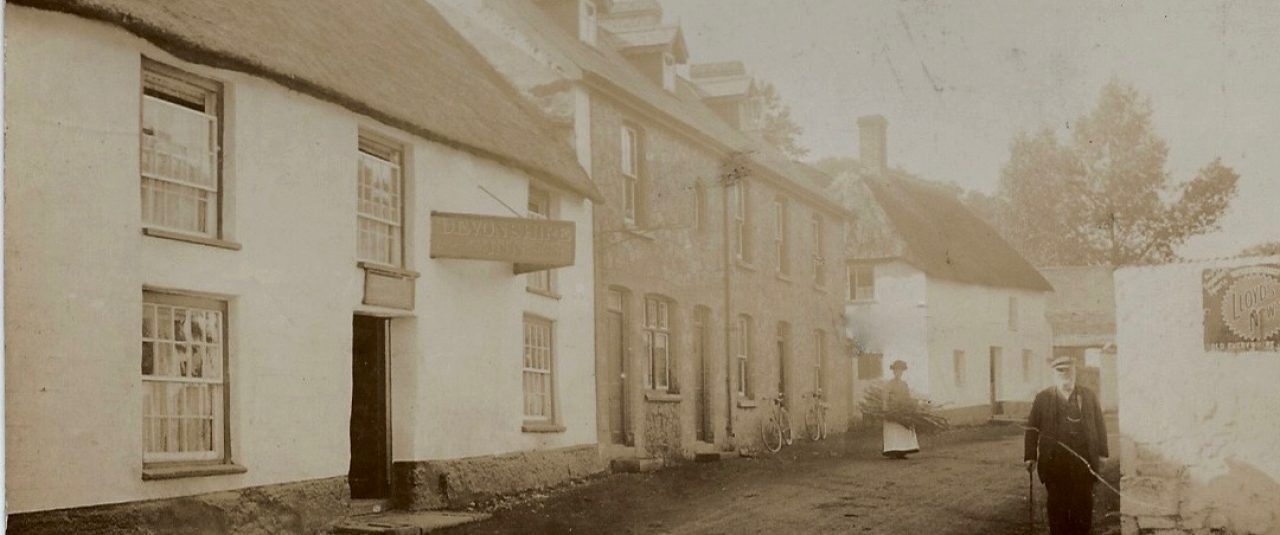
Ska View Cottages (also known as Skaigh View Cottages) could have been built by one of the employers in Sticklepath to house their employees, perhaps Pearse to house some woollen mill workers or Finch for his Foundry workers. However, this theory does not seem to have any basis in fact. No mention within the traditional stories of either family handed down through the generations as far as I can see. Though more recently, 1960s-early 1970s, at least one was used as a ‘tied cottage’ for a long distance lorry driver working for Bowden’s Haulage.
Where to start? The best place is probably to speak to the current owners and work back. One cottage has been occupied by the same family for 60 years. If only I lived locally I would have started with an oral history. Sadly I am far away.
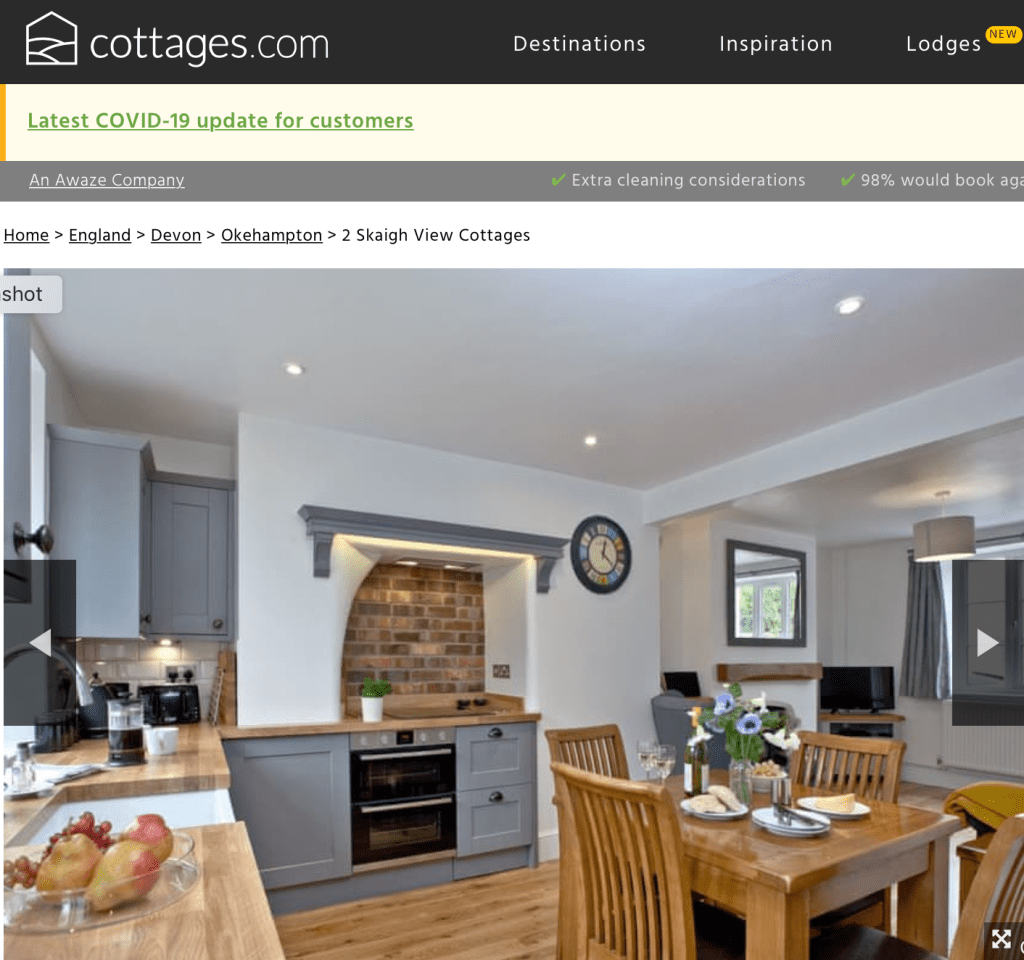
No 2 today – a holiday cottage
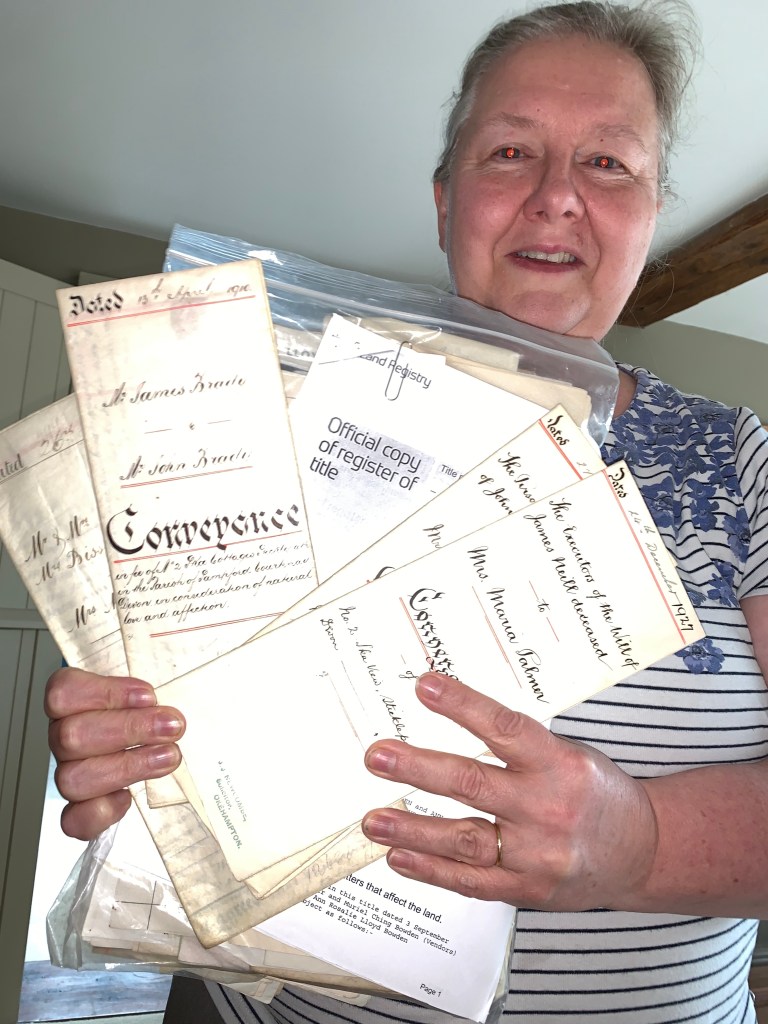
Another option is to study ‘The Deeds’. Unfortunately in recent times many sets of deeds have been lost. Since land registry became essential, the deeds and history of who has owned the property is no longer needed. House conveyancing has become slightly easier but so much history lost! Luckily, when clearing out a deep dark cupboard of Cleave House in 2015 some dusty deeds surfaced. They have sat in a box moving around the country with me ever since.
Time to blow away the cobwebs and take a step back into history…..
The Genealogist’s eyes light up at the prospect of opening old documents!
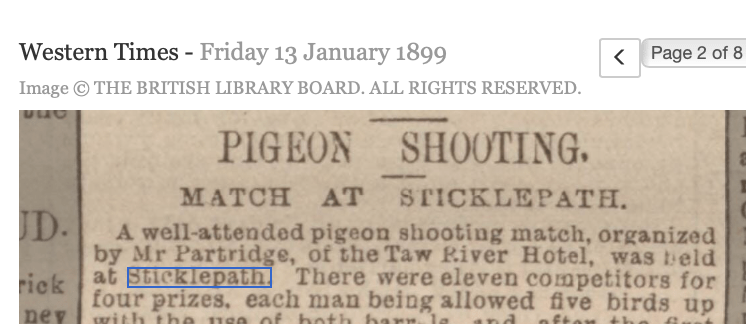
Up with the lark today. As a member of the Finch family I thought I should do a swift tweet about this on #OnePlaceWednesday – No need to get in a flap but the time for next month’s blogging prompt is nearly here…. research led me to find these eagle-eyed gun men of #Sticklepath at one of our local pubs. Not sure which Mr Partridge was involved, could it have been Robin? No pot shots here (ie shot at animal intended for the pot), no feathers ruffled, only clay pigeons. Some were out for a duck – or is that just cricket? (Did you know that expression is just based on the shape of a 0 duck egg!). So I invite all one-placers and friends to p-p-p-pick up a proverbial pen and have a flaming-go at more pecking puns, ornithological imagery and other avian wordplay. I can just hear my mother saying “Fool”, but that’s for tomorrow. Now for my swan song: Must fly … RSPB – whoop(er)s – RSVP!
For #OnePlaceWednesday, #OnePlaceStudies, #Sticklepath, #SticklepathOne
Emma Powell was a twin born 2 Sep 1902 alongside Thomas, in Cross Houses, Berrington Shropshire. They were baptised on 5 Oct 1902 Berrington, Salop (Salop is an old name for Shropshire)
Her parents were John Richard Powell (1871 – 1904), a railway plate layer, and Ethel Jones (1877-1948)
Thomas and Emma Powell 1903
In addition to her twin Tom, she had a brother John Richard Powell 6 apr 1904 – 6 May 1962. Her mother remarried and so she also had half-siblings Frederick Hill and Edward Hill, who were both born in Cound Shropshire
Sadly her mother was not able to keep both twins, so Thomas stayed with Mum and Emma went to her Aunt. She was brought up by the Lockley family, but kept in touch with others especially Tom.
Genealogists always hope their ancestors will marry someone with an unusual name. Morris son of John Jones, a village shop keeper in North Wales doesn’t quite fit the bill! From a young age Morris had wanted to work for a gentleman’s outfitters (Bradleys) because he admired the navy suit worn by their assistants. He eventually became the manager.
Morris and Emma both worked in Shrewsbury, where they met. Emma had trained to be a milliner, making hats and serving in the shop. A gentleman’s outfitter and a ladies milliner seemed to be a perfect combination. Banns were read in Wotton Under Edge, Gloucestershire, Morris’s Parish of residence but they became Mr & Mrs Jones in Wellington, Wrockwardine, Shropshire, Emma’s Parish on 18 Jan 1928.
His middle name was Lloyd and Emma always wanted to be Mrs Lloyd-Jones, so much so that she changed her name by deed poll 16 March 1955, stating that she had used the new name for at least 10 years.
Ann and Emma
They moved to Wotton Under Edge, where daughter Ann Rosalie Lloyd Jones was born (later Bowden 1934 – 2015). When Ann was 3 years old they moved to Bristol (78 Northville Road, Sodbury) and Morris worked in the aircraft factory at Filton.
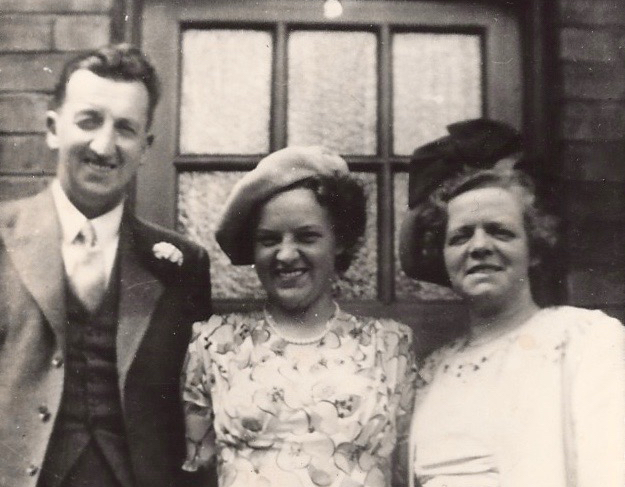
Morris, Ann and Emma
The 1939 Register shows them at this address with twin Tom, who was also working at the factory, and a lodger. Morris continued to work at Filton even when they moved to 210, Dovercourt Road to open a green grocer’s shop in Bristol later in 1939. During the war Ann was sent to Wotton Under Edge to family friends, the Beakes’, rather than join the mass evacuation. The war brought challenges for the grocery business but it survived.
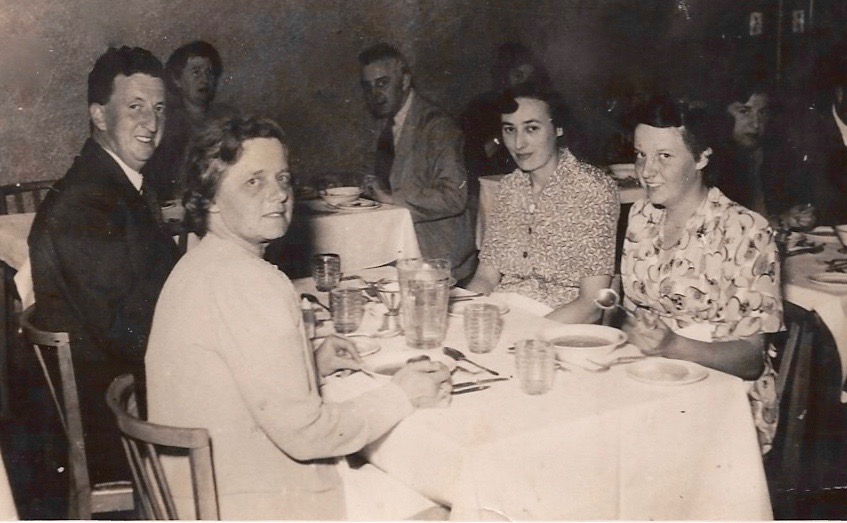
Molly Beakes sat next to Ann. After the war the families remained friends. Molly was Godmother to Ann’s daughter.
Ann went to Exeter to study maths at university and just as she was coming home at the end of the year, Morris suddenly and unexpectedly died. In fact Ann thought for a few moments as she approached the house that day, 20 June 1954, that the crowd of people had gathered to welcome her home. Sadly not.
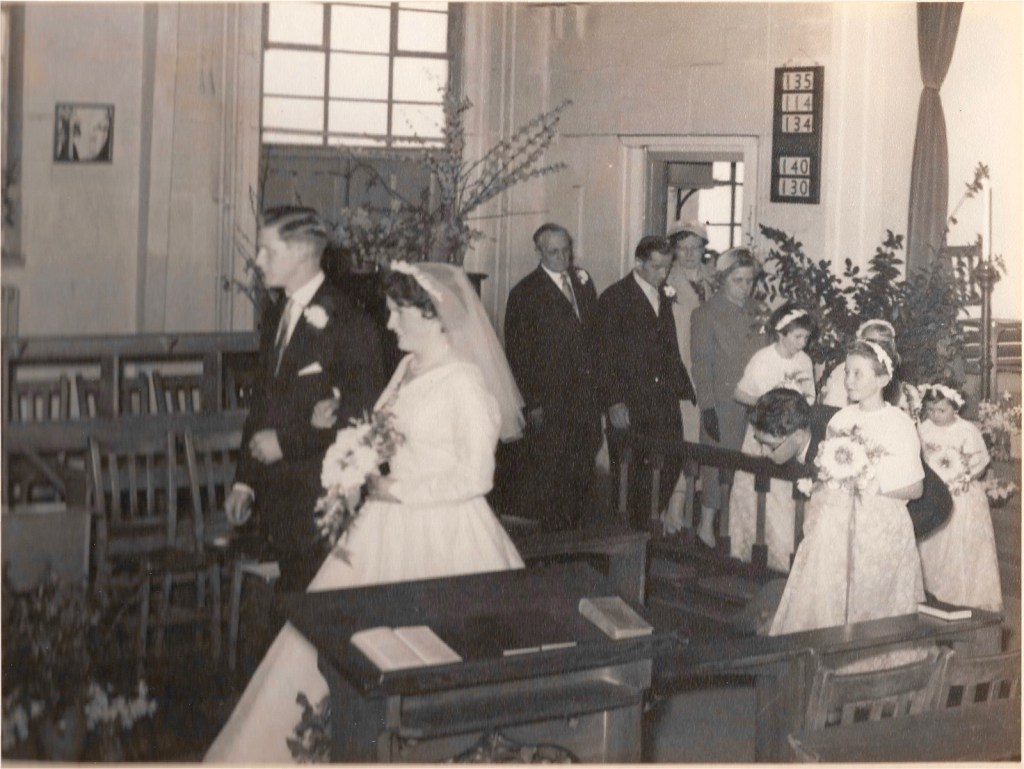
Ann and Roger’s wedding. Emma just behind the bridesmaids, Tom at the back. Muriel and Charlie Bowden also seen. 1959
Ann met Roger Bowden at University, married and moved to Sticklepath. After the birth of her grand daughter Emma also moved to Sticklepath to be near to Ann and family. She lived in Bracon Cottage, in the centre of the village, opposite the Finch Foundry, with a good view of passers by. She had a dog Marcus and a budgie.
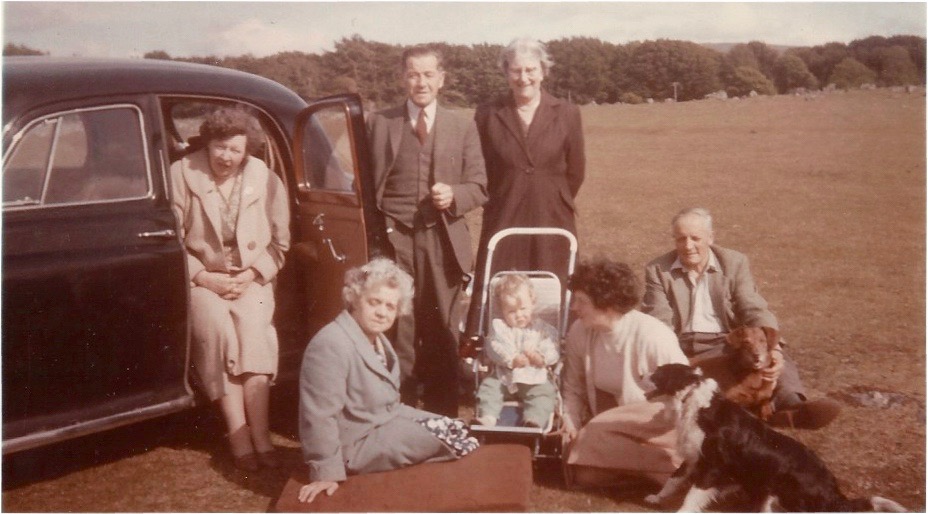
Family Outing, Emma sat on floor, Helen in pushchair, Ann and Tom on ground, Tom holding Marcus the brown dog. Muriel Bowden sat in the Rover and Charlie Bowden stood next to Phyllis Finch 1961-2
Her religion was Church of England, though when you know the details it makes you question what religious labels mean. She attended St Mary’s church on Sundays but I happened to be visiting her one day when she spotted the Vicar doing his rounds – we had to hide in the back toilet for a while, as she didn’t want him to know she was at home!
When we look at the facts, so much loss and emotion is hidden within the story. Although she was always supported by family, she never knew the love within her own nuclear family as a child. There was clearly a strong tie with her twin but she spent most of her childhood away from him. Marriage and a child meant loss of her role as a milliner and times were changing in terms of demand for hat-making. Her daughter had to move away in her early teens due to the war. Then soon after coming to terms with her daughter leaving for University, her husband died. Loss of health had another major impact.
It is not clear at which point Emma’s mental health first deteriorated. She suffered manic depression (now called bipolar disorder) and had several courses of ECT treatment and a number of admissions both in Bristol and Exminster. Ann’s letters to her future husband show the turmoil this caused her as a young adult, and we get some idea of the severity of Emma’s illness.
On a lighter note, on one of her manic spending sprees she booked to go on a long voyage, to visit New Zealand with stay with family. Unfortunately she suffered greatly from sea sickness and consequently lost her false teeth on the journey out, not replacing them until her return! She brought me two lovely Maori dolls on her return.
Emma Lloyd-Jones and Gertie Harvey, I think at an Okehampton Castle Hospital Christmas party.
Old age brings more loss of health and friends, and I remember her telling me how unhappy she was at having to go to ‘the Workhouse’ for day care. The Okehampton Castle Hospital was previously the workhouse, though not during the time Emma had lived locally. Its reputation though continued for many years! Nevertheless she seemed to enjoy herself there. Emma died in Okehampton District Hospital in 1979.




 Sticklepath a Village and its People