Depending on the school there may be a wikipedia page or for current schools the school website. Some schools still store their old documents and especially old school magazines.
Peter Higginbotham’s Children’s Homes website covers many types of school set up to look after paupers and criminals, check under “All About…” on the left hand side menu, or search for a specific school. Check out this short video for how to explore the website and the range of information shown.
One-Place Studies (OPSs) may have detailed information about a school and its pupils and teachers. Some OPSs focus entirely on the school – for example this study of an orphan school in Hull
Check out some blogs eg Children in Victorian Times, this one on Schooldays or short videos, consider visiting local museums with a focus on education to get an idea of the desks and equipment used in the past.
Newspapers add colour and many different types of information regarding events, fund raising, absences, advertisements for teachers or other staff, regional teachers meetings, retirements, marriages of women teachers (which usually meant they stopped work), appointments of governors or managers, awards won, scandals, changes to the buildings. etc.
The National Archive and county or more local archives may well have more specific advice leaflets regarding how to research the school and teachers in their area and sources available.
The Modern Records Centre, University of Warwick, houses teacher’s union resources and National Union of Students information. Remember to check nearby University Archives too.
What you really want, are school admission registers, punishment books and minutes. These are usually found in the archives. There its usually a ban on accessing those records for 96-100 years.
More specific information about Sticklepath School follows …
Auntie Kate is gearing up to tell you a bit about Sticklepath Board School at the #AllAboutThatPlace Event (26th Sept at 12 non BST and available for the following 2 weeks, subscribe for free to find out about the 130 free talks). So today we are starting to think about how to investigate a school. My experience is of board schools in England, which were established around the 1870s.
Where do you start when investigating a school? Here are some suggestions:
“Explore Your Genealogy” has some useful background to schools in England. Lots of other good links here too but scroll on down to “Exploring Education Records” right at the bottom.
This recent blog from My Heritage tells you something of schools around the world (and demonstrates photo enhancement for school photographs).
For a fantastic timeline re: education (UK) see Gillard D (2018) Education in the UK: a historywww.education-uk.org/history
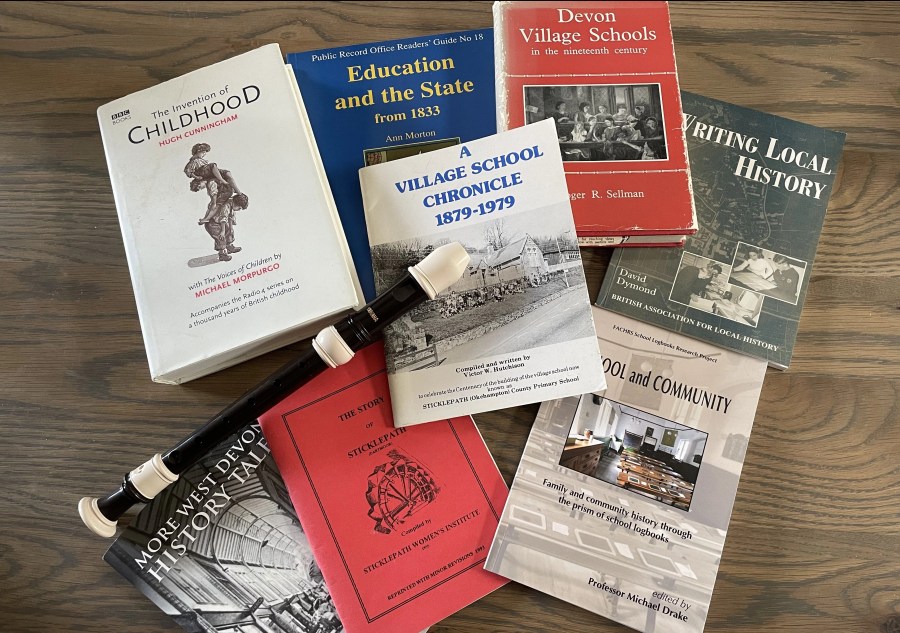
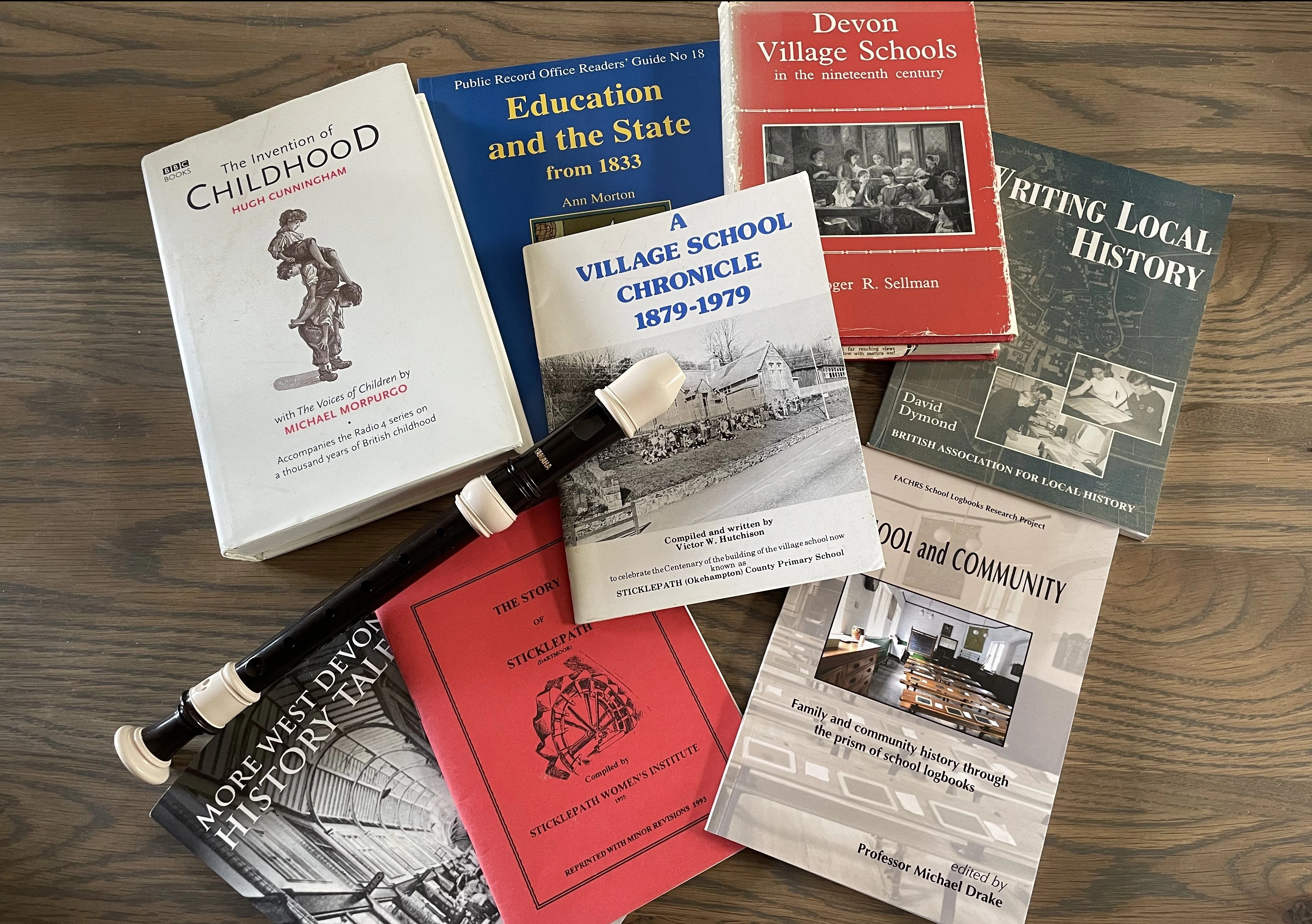
Libraries and online sellers may have local leaflets with information about your school. Since English board schools were all built around the same time, those that survived celebrated a centenary around the 1970s and you could be lucky to have a publication like Sticklepath’s “A Village School Chronicle 1879-1979”. Other local history booklets might include the school. Look for those covering the districts or county and perhaps even national too.
Trade directories give a fantastic insight into a place. Many are available through the University of Leicester Special Collections – the introduction to the place often states the school’s name, the teachers, perhaps secretary, and even pupil attendance numbers. Average attendance, not numbers of pupils who should be attending was a vital statistic as it formed the basis of the school’s funding.
People love talking about their school and time spent there. IF you live locally make some enquiries. Otherwise local Facebook groups can be very informative. When it comes to writing it up there is plenty of advice. Often smells and sounds evoke memories, and start to engage the reader or listener – the school bell or recorder lessons for example. The smell of poster paint or taste of non-refrigerated full cream milk. What would the hit the senses in your school at that time?
Reading how others have written is also a great way to get ideas of what you like. “The Few Forgotten Women” have looked at some records and researched pupils who were at the Leeds Girls Industrial School and The Mount School in York, and looked at Teachers from Crewe Training College . Do read a few stories. Reading around the topic not only demonstrates what can be found and perhaps sparks some ideas of new sources you could look for, but you start to get a feel for what was usual at that time and place and how your research demonstrates the norm or was exceptional.
IF you are not familiar with options for collaborative genealogy research do explore their website further and learn about the Friday Research days.
Wider reading about childhood and how that has changed can also be informative. Children should be seen and not heard? The changing expectations of children working or earning their keep. Differences between social classes.
Academic articles can give a different perspective too. The Family and Community Historical Research Society have covered many topics in their projects too, encompassing a wide range of researchers.
For a much more detailed insight check out this course from Pharos Tutors. Highly recommended by many amateur and professional genealogists.
Today’s challenge is, of course, to check out some of the links above and think about the educational institutions in your place of interest. More sources follow…
Auntie Kate with step daughter Muriel. They lived in the same house for 20 years.
Auntie Kate, memorialised as Kate Finch, died at home on 27th July 1933 after a long illness. There were a lot of people at the funeral, almost 130. This may have partly been a mark of respect for her husband, Albany Finch, J.P. but seems significantly more than at other similar funerals. The side door from the chapel into the Sunday School Room would have been opened as well as the gallery and seating under the gallery which was usually (in living memory) hidden from site.
(Note according to My Wesleyan Methodists Wesleyan bottoms were reckoned to only be 18-20 inches wide when calculating capacity of pews in the 19th century. Not only body size but personal space today means considerably more than 20 inches should be allowed!).
She was buried in Sticklepath Quaker Burying ground. Kezia Huxtable Ching is memorialised simply as Kate Finch with a horizontal granite stone. She is buried close to her Ching relatives and her first husband, William Middle. Albany out-lived her by 12 years but never re-married.
She left £440 7s 10d, a substantial proportion of which was left to Sticklepath Wesleyan Chapel.
So we say good-bye to Auntie Kate as she once was.
Those reading the Obituary below will note she was a gentle personality. Auntie Kate re-born, alter ego of the author, is portrayed rather differently for dramatic effect. She will be appearing on the 5th day of the #AllAboutThatPlace Event, Telling Tales of Sticklepath School at 12 noon BST Tuesday 26th September and available for 2 weeks after. (Full schedule with over 100 ten minute talks and information about how to access the talks can be found in the Guides section of the Facebook group.)
Western Times – Friday 04 August 1933
STICKLEPATH’S LOSS Funeral of Mrs. A. G. Finch, of Cleave House LARGE ATTENDANCE
There was a large gathering of relatives and sympathisers at the funeral Mrs. A. G. Finch, wife of Mr. A. G. Finch, J.P., of Cleave House, Sticklepath, head of the firm of Finch Bros. Deceased was the only surviving daughter of the late Mr. George Ching and Mrs. Ching, of Coombe Head, and she passed away on Thursday week at her residence, after a long illness, patiently borne, aged 72. She was a gentle personality and was highly respected.
The service in the Methodist Chapel was conducted the Rev. W. M. P. Wilkes. B.A., B. D., and the hymn “Tell me the old, old story” (deceased’s choice) was sung, Miss Yeo being at the organ.
The bearers were employees of the firm: Messrs. W. May, W. Rowe, W. Daniels, M. Jury, Horace Mallett and W. Davey.
The immediate mourners were Mr. A. G. Finch and Mrs. C. Bowden (widower and daughter), Mr. James Finch and Mrs. Drew (brother-in-law’and niece), Mr. Thos. Finch and Mrs. Finch (brother and sister-in-law), Mr. George Ching and Mrs.Ching (sister-in-law and nephew), Mr. C. Bowden (nephew), Mr. Ralph Finch and Mrs. Finch (nephew and niece), Miss Rose Ching and Mrs. Ching (niece and sister-in-law), Mrs. Jessie Barron and Miss Barron, (daughter and grandchild).
There was a very large number of wreaths, although deceased’s wish was that no flowers should sent.
Among those attending were Mr. Reg. Harry (Okehampton), Rev. A. C. Northlock (Okehampton), Mr. G. Blatchford (Okehampton), Mr. and Mrs. Collihole (Winkleigh), Mrs. Jones (Chicacott), Mrs. and Miss Colin Brown (Old Meadow), Misses Brock (Belstone), Major Sinclair, ret. (Drakes Acre), Mr. Glandfield (Exbourne), Mr. Bayley, representing bank (Okehampton), Mr. and Mrs. Baker (Halford Manor), Rev. Lister James (Belstone), Mr. A. W. Coles (Okehampton), Mr., Mrs. and Miss Heggadon (Sunnymead), Mr. Raymont (Winkleigh), Mr. W. Avery and Miss Tucker (South Zeal), Mr. S. Perrott (Chagford), Mr. Perkins (Broadley), Mrs. Reddaway, (Reddaway Farm), Miss Seward (Sticklepath), Miss Watson, Erin (Sticklepath), Misses Littlejohns (2) (Okehampton ), Mrs. Jenkins (Sticklepath). Mrs Scaramucci (Ker Janet), Miss Brotherton (Ker Janet), Mr. W. Sampson (Throwleigh), Mr. and Mrs. Jas Wright (Stickle path), Mr. and Mrs. Reg Cook and Mrs Osborn (Sticklepath), Mr. Millington (Sticklcpath), Mr. and Mrs. Bert Gratton (Belstone) Mrs. Gratton (Perryman). Mrs Arscott (Belstone), Mr. Ackford (Belstone) Miss B. Warne (Sticklepath), Mrs May (Bere Alston), Miss Palmer (Moor Farm) Mr. W. Endacott (South Zeal), Mr w Jordan (South Zeal), Mr.S. Earland, jnr (South Zeal), Miss Jackson Holton Cottage), Mr. Jackson (Okehampton). Mr Burgess (Okehampton), Mrs. Chammings (Okehampton), Mr. Allan (Broadley Mr Down (Broadley), Mrs. Simpson Gary (Moor Croft), Mr. Elderton (Sticklepath) Miss Stewart (Sticklepath), Mr Lavis (Southcott), Miss Mesney (Sticklepath) Mr. and Mrs. Sanders (Belstone)Miss Kate Jackman (Chagford), Mrs. Sydney Bowden (Belstone); Mr. and Mrs. A.Bowden , Mrs. Bowden, Miss May Osborn, Mrs Arscott, Mr. Cecil Tucker, Mr. J Lethbridge , Miss Audrey Brown, Mrs.Francis, Mr. Duston, Miss G. Harvey, Miss V Mallett, Mr. and Mrs. C. Mallett, Mr W. Harvey, Miss Rowe, Miss Huxtable. Mrs Ching, Mr. Jack Mallett, Mr. George Hellier and Mr. W. Brook(all of Sticklepath) Mrs. Rowe (Prospect), Mrs. Petherick (The Bungalow), Mrs. Davey (Coombe Head) Miss Nelly Brook (Sticklepath), Mrs Simmons – (Prestacott), Mr. Ewens .(Corscombe Down); Mr. Reg. Eveley, Nurse Gater, Miss White, Mrs. A. Holman, Miss D Yeo Mr. and Mrs. S. Yeo, Mr. W. Bennett junr., Mr. Percy Brook and Mr Steve Daniels (Sticklepath), Mrs. Jeffery (Quarries), Mrs. Friend (East Week), Mr W. Aggett (Poltimore), Mrs. Underhill (Skaigh), Mr. George Hussey (Sticklepath) Mr. J. Newcombe (Sticklepath), Mr Warren (Addiscott), Mr. Norman Bowden (Sticklepath), Mr. Reg. Bennett (Sticklepath) Mr. James Counter (Prospect) Mrs Jasper (Coombe Head), Mrs. Endacott (Coombe Head), Mr. and Mrs. J Cooper (Sticklepath), Mr. Smale (Okehampton), Mr.Syd Mallett (Sticklepath), Mr. J. Standlake (Wood Cottage). Messrs Bowden (Sticklepath), Mrs. Hill (Dry Bridge).




 Sticklepath a Village and its People