Sticklepath Houses: No. 2 Ska View (again!)

On 24th December 1927 Maria Palmer bought No. 2 Ska View Cottages Sticklepath. The previous owner, her father, Mr James Neill had died in February. Sadly his other daughter Beatrice had died in the interim. (Will dated 7 April 1927, she died on 26 May 1927). Frank Richards, her husband, was the sole Executor and Beatrice left her estate (which included a half share of No 2 Ska View) to her nephew Bernard William Palmer aged 13y, the son of Maria and John Palmer. The conveyance therefore became a little complex legally, with John Palmer representing the ‘infant’ son Bernard in the transaction.

Frank Richards was the headmaster of Sticklepath School and his wife’s death is noted in the school records, just to say that he took a half day because of her death!
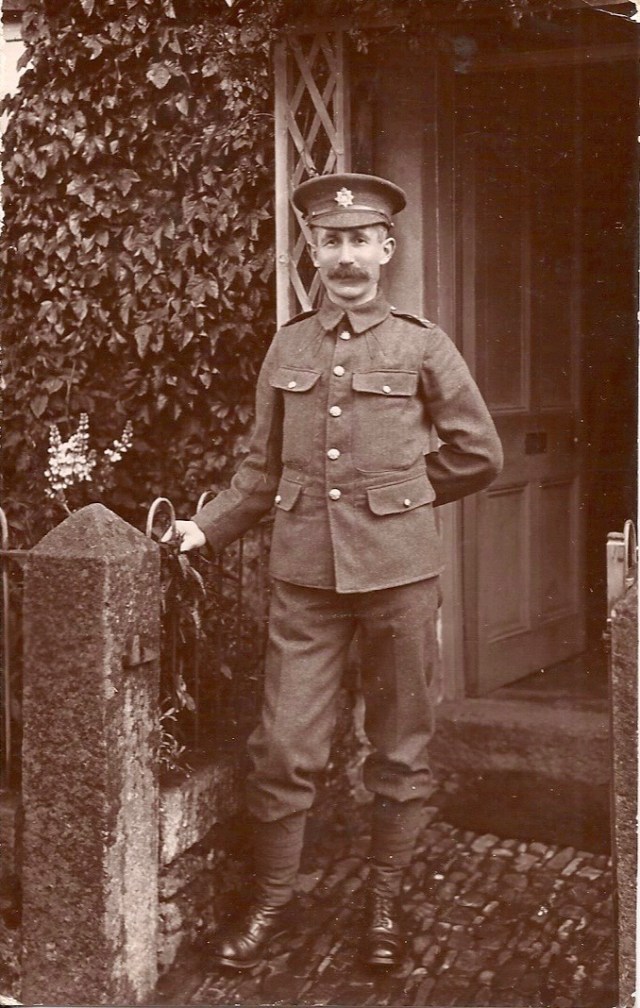
Frank Richards, WW1 uniform. Details seen of cobbled path, granite pillars and ‘trellis’ porch.

No.2 was valued by Mr Arthur John Powlesland of Okehampton, a duly qualified valuer, who fixed the price as £320. The current tenant was a Miss Cann.

I have at this time no evidence to suggest Maria Palmer ever lived in Ska View Cottages. She wrote her Will 12 June 1958. Her son Bernard became a Chartered Accountant, and at the time of Maria’s death lived at 22 Mill Lane Felixstowe, Suffolk. Maria was said to be of the same address and formerly of ‘Kolar’ Okehampton. Maria died at The East Suffolk Hospital, Ipswich on 24th October 1958. She left everything to her son, Probate was granted in Exeter to him 9th January 1959. Assent to the vesting of Number 2 Ska View Cottages from Mrs M Palmer deceased to Bernard William Palmer is dated 22nd April 1959.

At some point Bernard moved to 19 Goyfield Avenue, Felixstowe. 11 December 1959 the cottage was sold again to Mr Charles Bowden, haulage contractor of Cleave House Sticklepath for £550. Witness to the signature was RK Barron of Foundry House Sticklepath, Tool Maker. In March 1965 a further valuation, by Anthony Wonnacott, likely for re-mortgaging purposes shows the property to be valued at £1,500.

A Memorandum appended to the conveyance shows that 26th October 1992 Charles Bowden gave the garden by Deed of Gift to Charles Roger Finch Bowden (his son) in fee simple. Charles died 20 March 1994 and Probate was granted (Bristol) 16 Nov 1995. The property assented to Charles Roger Finch Bowden and his wife Ann Rosalie Lloyd Bowden 28 January 1997. Land Registry Official Copy of Register of Title in 2008 valuation was £140,000 (without the detached garden). The type of joint ownership was amended 12 Dec 2012. Marketing websites show it sold in 2018 for £150,000.

In 1975 plans were submitted to make an interconnecting doorway between No.1 and No.2 Ska View Cottages. At that time Miss Phyllis Finch lived in No. 2 and the doorway and firecheck door enabled her to visit her sister in No.1 without venturing outdoors in the final weeks of her life. Planning was approved 17 October 1975. She died in March 1976. The doorway has since been blocked up.

I have not included much detail of the owners themselves, and even less of other occupiers. Perhaps another time. I am also aware that there may be other connections – I spent many hours in the Ska View Cottages as a child, visiting relatives or with my ‘child-minder’ after school, which is of course not documented. Nor do the papers survive to tell us how the houses were financed, how much mortgage was payable. I do not have any insurance documents for No. 2. ‘Official searches’ in 1959 do not add anything specific. Several documents declare no land tax was payable on these small properties.

It is interesting to see the increasing valuation or sale prices:

1890. £100. Sale

1924. £380 Sale

1927. £320 Valuation/Assent

1959. £550 Sale

1965. £1,500 Valuation

2008. £140,000. Valuation

2018. £150,000 Sale

One might surmise that the assent value in 1927 was on the low side but market fluctuations may mean it was accurate, and there was a tenant in situ.

Perhaps equally interesting is to understand the size and type of housing of a headmaster and mine manager in the 1920s, perhaps some of the better off villagers, with a total floor area of 56.5 sq m . The plan prepared for Stags estate agent Okehampton 2017 shows there were two downstairs rooms and two upstairs.
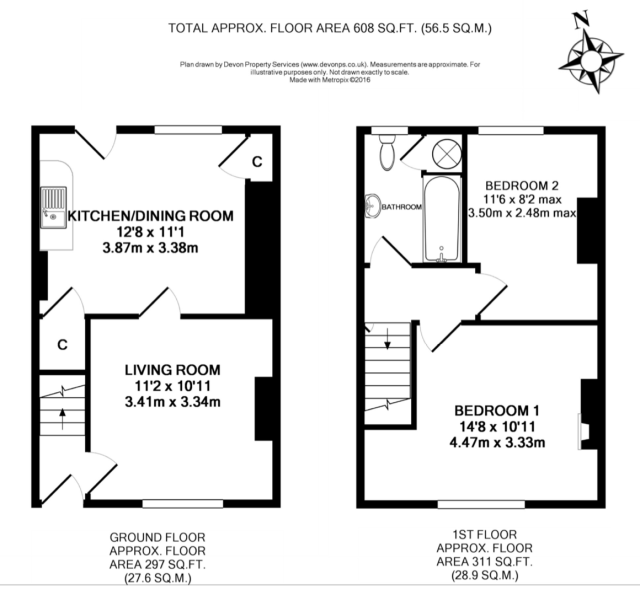
There was no bathroom in their time. It is not clear when a bathroom was added to No. 2, planning was sought for indoor bathrooms in other cottages in 1972. The outdoor toilet across the yard was certainly in regular use in 1960s. They did not have covered sewerage or electiricity, so no electrical appliances. (Details of how the drains were ‘flushed ‘ see Ladywell).
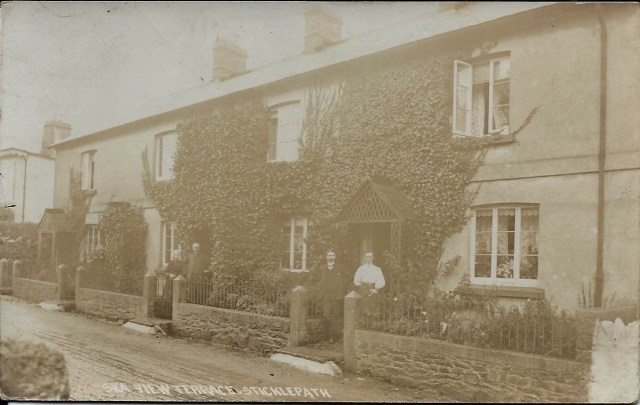
The open drain can be seen just infront of the wall with a step from each Cottage bridging the gap. (Chapman of Dawlish Postcard)

The detached garden was a small allotment used to grow vegetables, a necessity not a hobby. Compare that to expectations of families today both in terms of space, amenities and services.

The row of 4 Ska View Cottages with stone outbuildings behind. The Old Cottage and Village Hall are seen to the right. Between these two the Back Lane leads to the electricity sub-station (black)and just past this, off the picture would be the garden allotment.
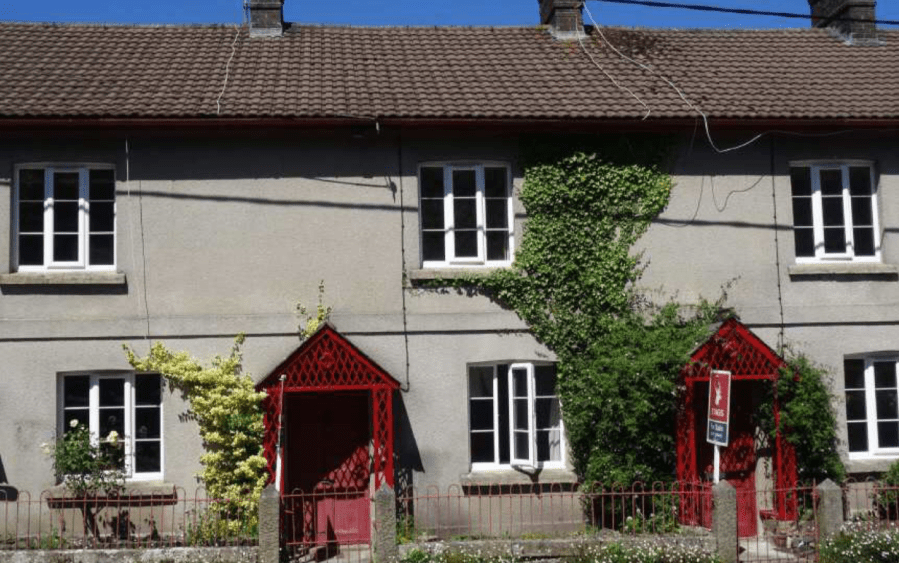
Tiled roof and chimney detail No.1 and No.2

Sticklepath has several small terraces of houses running parallel to the road. The cottages are well built of solid masonary. Originally they had a shared roof space – as with many old rural houses this has provided a roost for bats (myotis sp.).
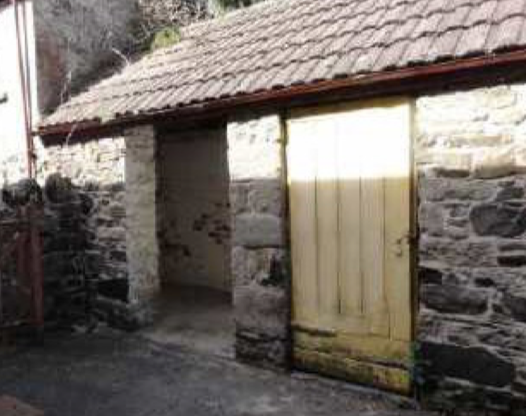
Stone built out-house believed to have stabled a pony at one time. Later W.C.(water closet or toilet)

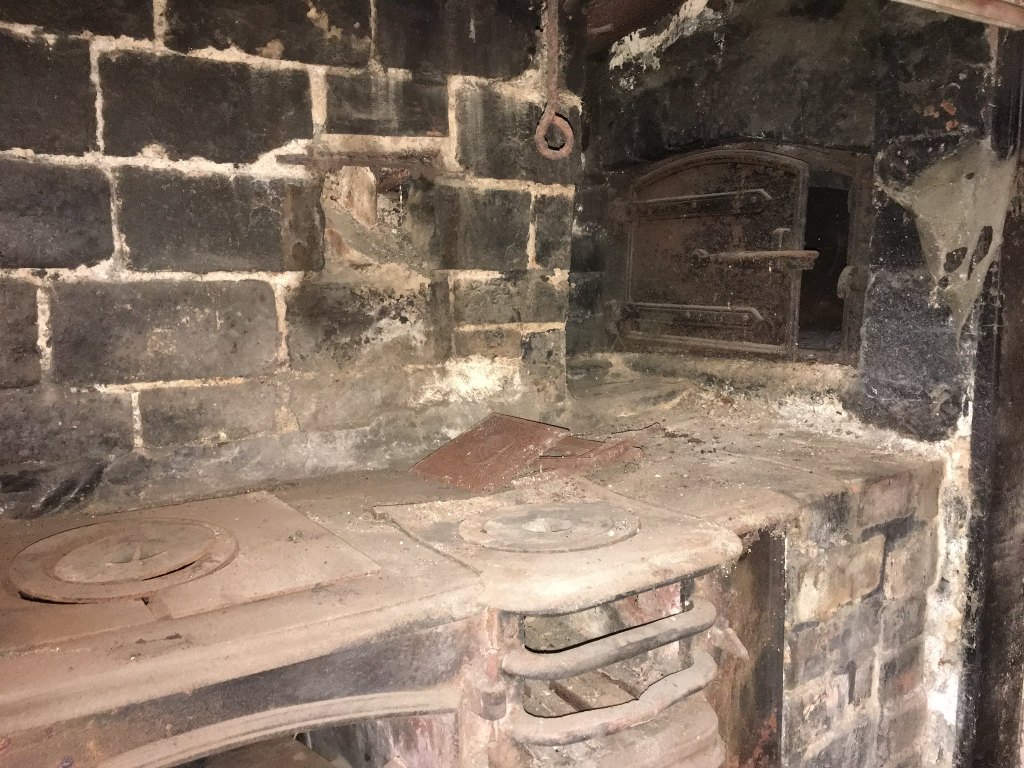
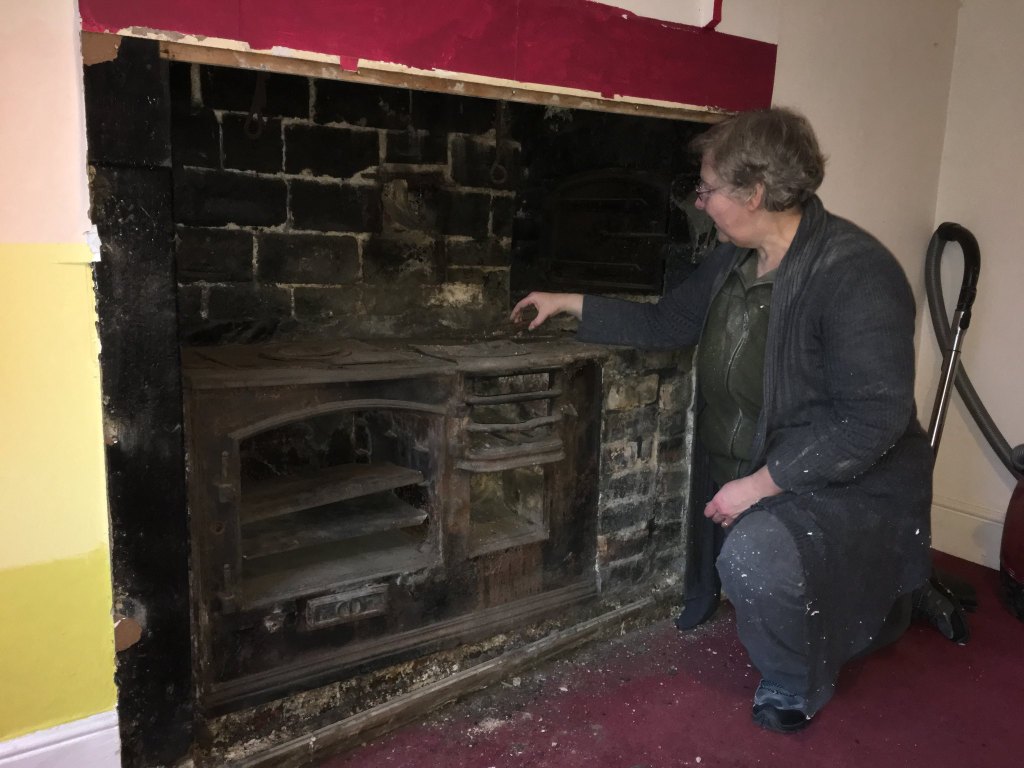
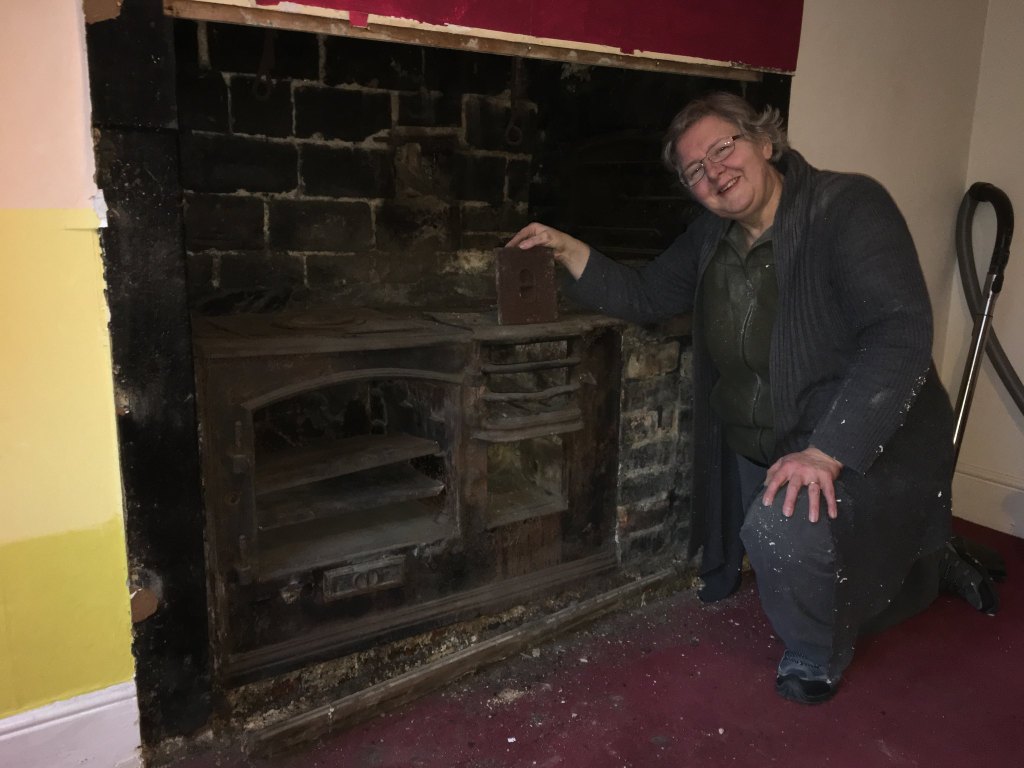
During renovation work in 2017 a small Victorian range was found in No. 2 kitchen. The plaque above suggests it was made or at least sold by an Okehampton firm. It was in a poor state and Okehampton Museum were not interested in preserving the remains. It seems very likely Captain Neill and his family would have benefitted from food cooked in such an oven, on the hob, a fire in the grate and bread from the bread oven. A family with these facilities may have made extra to sell to other villagers.

Times change and No.2 is now a holiday cottage, no longer accomodation for local residents. The railings and matching porches (also seem on Farley Cottage and previously on Effra, opposite the Methodist Chapel) give some character and unity to this row of cottages.

Photo
2017

Here endeth my Easter Housing Mini-Project.

A rather gruesome concealed pregnancy at #Sticklepath for #OnePlaceTragedies

The Western Times – Tuesday 15 November 1904 reported a ‘STICKLEPATH SENSATION’.  (Complete transcript, photo not from the paper).

Supposed Case of Concealment of Birth.

Mr. Prickman (coroner) held an inquest, at Sticklepath, on Saturday, relative to the finding of dead body the day before. Mr. Thomas White, gardener, deposed that on Friday he discovered the body of a female infant, wrapped in a piece of rag, and placed just beneath the grass behind a tombstone, about 16 feet from the entrance gate of the Cemetery. He communicated with P.C. Berry, who removed the remains to the Taw River Hotel.

Coroners court often met at the local public house, as here. Chapman postcard.

Dr. Davies, of Okehampton, said he had made a post-mortem examination of the body, which was in a bad state of decomposition. The child was fully developed, 20 ½ inches length. It was not born alive. There was no external marks of violence about the body, and no bones were broken, but there was evidence of general inattention at birth. The lungs had not been inflated.

The child had evidently been born more than three weeks, and certainly under two months. The Coroner said, under the circumstances, the jury could not return a verdict, but they could make a memorandum to the effect that The body which the jury had viewed that of a female child, born not more than two months, and not less than three weeks since.” Mr. A. G. Finch was the foreman of the jury.

Comments – Pregnancies can be denied or perhaps some women are not aware of their pregnancy (about 1 in 400 women are said to be 5 months pregnant before they realise).  I have certainly seen a young teenager who concealed their pregnancy and presented in A&E with ‘abdominal pains’ shortly before giving birth.  

The pregnancy in 1904 must have been concealed and then when the child was born dead, the birth was concealed. It seems most likely that this would be an unmarried mother, a married woman whose husband had been away or possibly the result of rape or incest. The mother could seek no advice or help. The Offences against the Person Act 1861 meant that every person involved in the endeavour to conceal a birth, regardless of whether the baby was still born or died later, was guilty of  a Misdemeanour and could be given a prison sentence of up to two years with hard labour.  

The contraceptive pill first became available, to married women only, on the NHS in 1961.  

Double #OnePlaceTragedies

Our saga of Thomas Finch and family continues. Last week we heard about the Coroner’s case when Victor Thomas Finch drowned aged 22 months. Happier times followed when Gladys Lena was born in 1897 and then Leslie George in 1900.

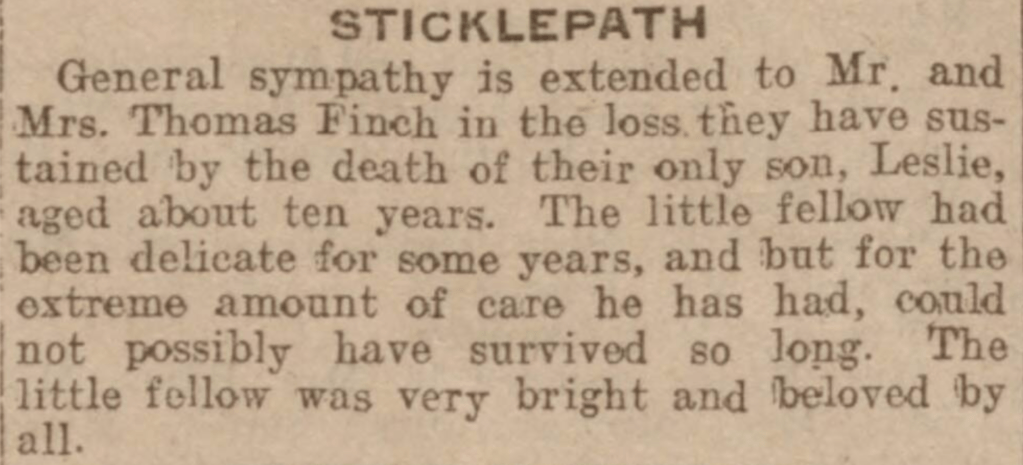
Sadly the newspapers tell of further tragic circumstances 10 years later.

The Western Times on Friday 25 November 1910 reported:

The British Library Board accessed via British Newspapers Archive online February 2021

It paints a touching picture of the relationship with his sister. So many wreaths for a small coffin. I need to investigate further, as, for example, I don’t know who was at Walnut Road, Chester or Friendship but these appear to be important, as they are listed first.

Such reports are ideal for genealogists, with many FANs named. (The FAN Club abbreviation was developed by Elizabeth Shown Mills, a highly respected genealogist and relates to cluster research. When investigating an ancestor, their FANs or Friends, Neighbours and Associates can tell us a great deal about their situation, social status, occupation etc. ).


The brief Western Times report of a week earlier – Friday 18 November 1910, written before the funeral, adds a different slant:

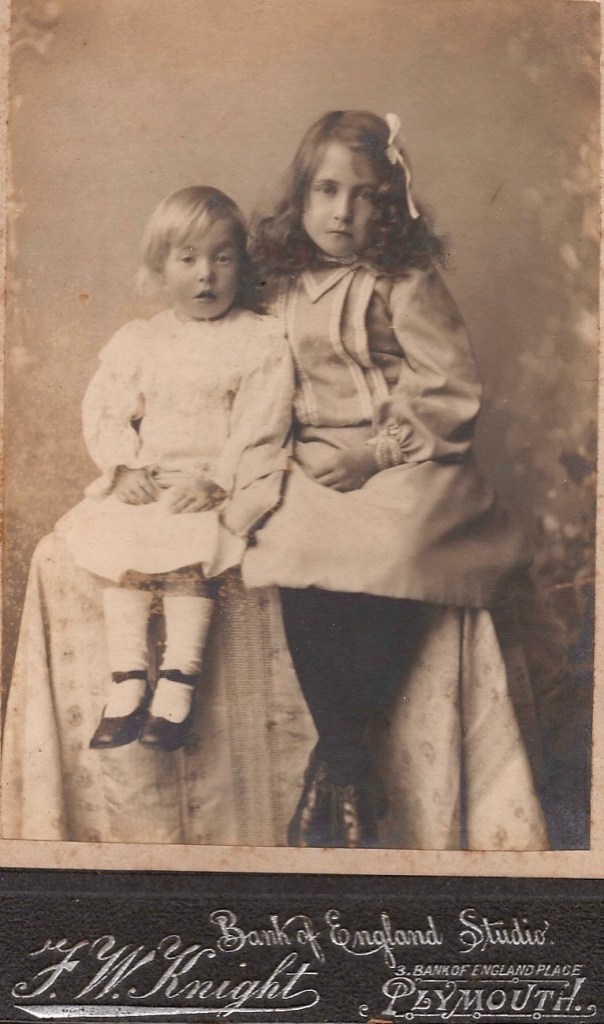
Clearly Thomas and Annie had been very caring parents, but this hints at the ‘delicate’ nature of Leslie. Taken together with the photograph I suggest Leslie had Down’s Syndrome.

Leslie and Lena Finch

In 1866 Dr John Langdon Down first identified a group of patients with certain characteristics. In 1959, it was discovered that it is a genetic condition due to an extra chromosome (Trisomy 21). It wasn’t until 1965 that the World Health Organisation adopted the term Down’s syndrome. I don’t know when the term came into common usage or if the syndrome would have been recognised by a village GP in 1900 – 1910.

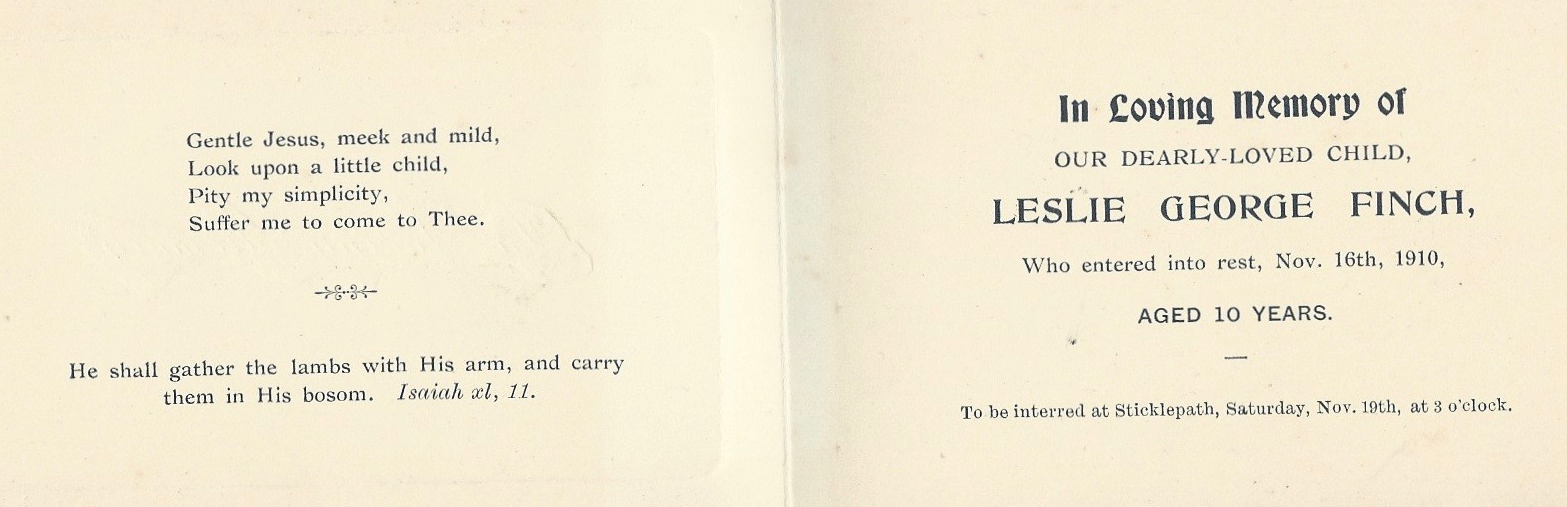
Leslie had been poorly for some time and his death certificate shows he died of consumption, which is TB or tuberculosis. Three generations of the family at least were affected by this disease. This is an image from the memorial card:

The two brothers, Victor Thomas and Leslie George Finch, are buried in the same grave in Sticklepath with their memorials on either side of the short stone.

Move the arrow side to side to see front and back of the gravestone.

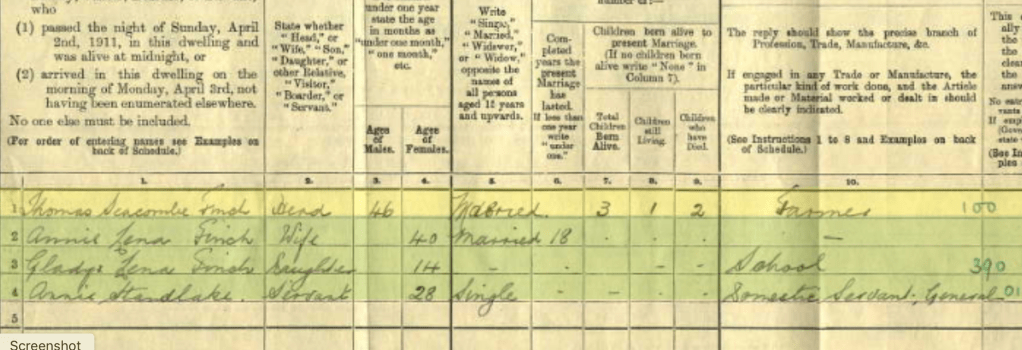
The 1911 census states the facts as cold statistics. Three children born alive, two who have died. One still living. Childhood deaths were still fairly common.  Daughter Gladys aged 14 continues at school.  Annie Standlake domestic servant has been with the family for over 10 years.  

England & Wales Census 1911 accessed through Ancestry
. . . . . . . . . . . . . Gladys Lena Finch

We finish on a happier note –

Gladys survived and later married William Gater Heard and had children.  John Heard, a very tall man in shorts and sandals, came to visit us in Sticklepath when I was young. He brought a family tree he had been working on for us to see.

Western Times – Wednesday 25 May 1921
Marriages

HEARD – FINCH On May 24th at the Parish Church South Tawton, by the vicar (Rev E.F.Ball). William Gater Heard, eldest son of Mrs W.J. Heard, Exmouth to Gladys Lena, only daughter of Mr. and Mrs. T. Finch, Sticklepath, Okehampton.

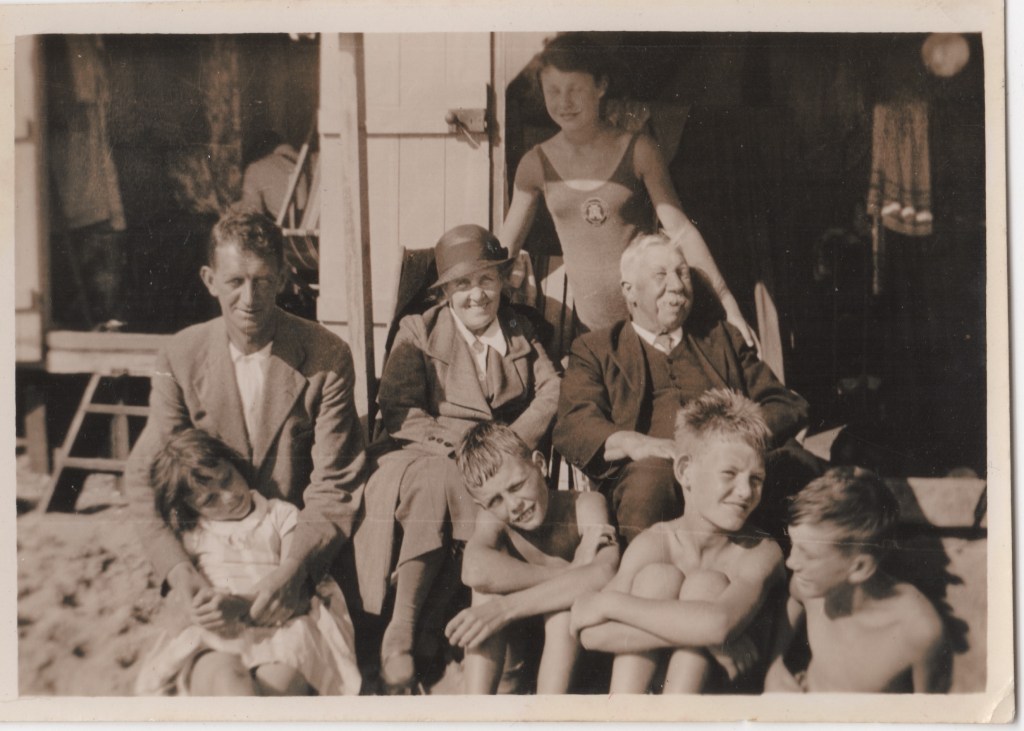
Annie and Thomas Finch on the beach with the Heard Family – Gladys and William, and their grandchildren.

Looking at this photo you can see why Thomas was invited to be Father Christmas for the WI party each year!