Source of information and quotes: HAND-BELL RINGING The living tradition. RINGING FOR GOLD. (Chapter 1) by Peter Fawcett Ed. Philip Bedford. Pub. Donald A. & Philip Bedford 2012
Bells remind us of the end of school playtime and perhaps sleigh bells of Christmas. But have you ever tried ringing hand-bells as part of a band or even church tower bells? Have you researched bell-ringing in your place? Here is a short history to start you off.
Hand-bell ringing preceded church bells. The ‘hand-bell set’ was an instrument developed in England in the Middle Ages “from the earlier ‘organic tintinnabula’ (organisation of little bells of different tonal pitches) and the cymbala (9-16 small bells of different tonal pitches suspended on a cross bar).”
Both of these can be found across Europe well before the middle ages and the pien-chung can be found in China very much earlier. Bells strung across a bar could be tapped with a small wooden hammer. The latin ‘cymbala’ can mean cymbals or bells. Indeed the psalm makes more sense to me as:
Praise Him on the big bells (rather than loud cymbals),
Praise Him on the tuneful hand-bells (rather than well tuned cymbals)
Paulinus of Nola (c.354-431) is credited with introducing bells to Christian worship. Large (tower) bells were moved outside the church building itself in the time of Paulinus (Campania, Italy). Inside the church small bells, stringed instruments, likely recorders, as well as small organs began to be used in worship. Tower bells ringing still call people to worship, to ‘look up’ in awe. It is not only Christian worship that uses bells, and they have other cultural links too. The Bayeux Tapestry shows men with hand bells walking alongside Edward the confessor’s coffin to ward off evil spirits.
Parish records may have reference to bells being rung for celebrations, or a muffled peal or half-muffled peal for funerals. Hand-bells may also be mentioned in an inventory, for example, or on purchase perhaps. The earliest record seems to be 1552 St Leonard’s church, Middleton, Lancashire.
Change ringing (patterns rather than tunes) on tower bells and hand-bells began around the early 17th century. Key technical advances from around 1550 made tower change-ringing possible. The full-circle wheel which means a bell can be held upside-down was one. Also critical was development of foundry methods which enabled the tenor bell’s size to be reduced to only about 3 times the weight of treble (higher) bells. This meant the loudness of the bells became more equal enabling rapid runs of notes to be rung. Previously the tenor over-whelmed the volume of higher treble bells which would hardly be noticed alongside the sonorous lower tones. At this time hand-bells were probably still struck with small mallets as the modern clapper mechanism had not been developed.
Bell’s have had a rather bumpy run through history. Most historians are very familiar with Henry VIII’s dissolution of the monasteries and, in his son Edward’s reign, the dissolution of the chantries. Not only did the monarchies make many thousands of pounds from selling off the silver and other ecclesiastical treasures, but also the tower bells.
In 1653 Cromwell became Lord Protector and Puritan sensibilities did not allow music in worship. Many more church bells were sold for their metal. However, in some areas records show that the bells were still rung for secular occasions. Bell-ringers though were at risk of being accused of being Papist. One can imagine hand-bell ringers meeting in secret with leather tied around the bells’ clappers to muffle the sound so no passing Roundhead would hear them!
In 1660 Charles II was crowned and the Stuarts brought back music and dancing. The Peak District village of Castleton in Derbyshire has held an annual ‘Garland’ celebration ever since. In many places the tower-bells had to be re-hung or replaced (creating records!).
Church records may reflect costs for maintenance and repair of the tower bells as well as income made by the ringers. For example Wallasay St Mary 1658 onwards include items such as new ropes, repairs to the bells, ‘oyle’ and ‘liquour’ to grease the bells and ‘skins’ to hang the clappers, a
“plank for wheel spokes and a pese to mend ye frame”
Transporting tower bells was very expensive and itinerant founders (some being Henry VIII’s displaced monks) travelled around knocking on vicarage doors looking for work or plying their trade at local fairs. Using charcoal and clay or fire-bricks they would cast or re-cast bells on site. By the mid-16th century a revolution in techniques allowed sets of handbells, each with a leather handle, independent of a frame, to be made.
Technical developments include the use of a tuning lathe, perhaps as early as 1738 by the Whitechapel foundry. Developments in the clapper mechanism too were critical to new ringing techniques.
Hand-bell competitions, especially the Belle Vue contests (from 1855), meant that ringers in the North of England updated their bells frequently to facilitate the best possible sound. The oldest set of hand-bells seems to be held in Stratford upon Avon, cast by the Cor foundry in or before 1727. At Aldbourne foundry in Wiltshire, William Cor (1696-1722) was the first bell founder to cast bells in a sand mould. These bells, before use of the tuning lathe were roughly tuned by filing the outside or inside of the bell.
Hand-bells were used to entertain, including in the music hall where George Histon and W.H.Johnson were renowned for ringing ten bells each, 4 in each hand and one on each foot.
When Handel came to England (c.1740) he heard hand-bells often when he was invited to different houses, as well as church bells, so he named Britain “The Ringing Isle”. Bells were also used on draft horses to warn people they were coming, perhaps ringing a chord comprising 4 bells making a distinctive sound for each cart, announcing their presence. (Comparable to ice cream jingles!) Whilst hand bells could be practiced in the bell tower, other bands preferred the local hostelry, perhaps explaining how some were named ‘The Ring O’ Bells’.
There are different techniques for ringing handbells. One bell in each hand came first. Then “4 in hand” where each hand holds two bells with the clappers set at right angles so each bell can be rung independently, by altering the direction the hand is moved. (Presumably the music hall artistes damped their 4 bells so they only rang in one direction, usually bells ring on both strokes of the clapper). Off the table, and Yorkshire method are the other main techniques. Larger bells initially stood on the table. Later the Yorkshire method included lying bells on their side on the padded table enabling a ringer to play many more than 4 bells within one piece.
Note there were no brass bands in these early days, as the valve, so critical to tuneful playing, was not invented until 1815. The emergence of brass bands was probably a major factor in the demise of handbell ringing. However, it is still an art practiced today across the country. Tower bells too – for the Queen’s jubilee it is estimated over 90% of tower bells were rung in her honour.
Do you have, or have you ever had, hand-bell ringers or tower bells in your One-Place Study? What is the earliest mention in records? Don’t forget newspapers may mention people were bell-ringers in obituaries, or tower bells rung for celebrations. Hand-bells too may be mentioned if rung at concerts fairs or other events. Some more ideas for research below.
If this is your first ‘visit’ to Sticklepath on the edge of Dartmoor, WELCOME! Welcome old friends too 🙂
#AllAboutThat Place is now well underway. Yesterday’s Challenge was to find images, maps and photos that tell us more about our place and show how things have changed. Spot The Difference. #oneplacestudies, #oneplacelandmarks
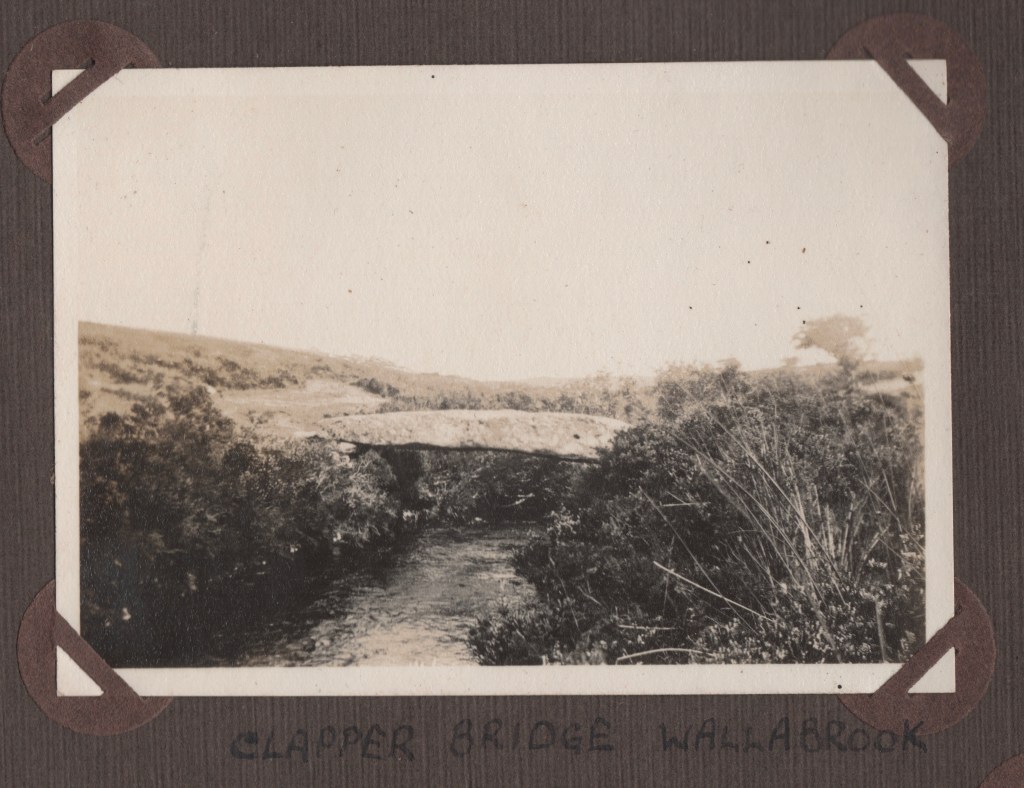
There are many bridges on Dartmoor, primarily constructed of the local stone – granite. The earliest and simplest are clapper bridges, a single piece of granite laid across a waterway or gulley. Wider gaps would have required a central column or pier and two slabs, and so on. Many were (and are) tourist attractions, such as Wallabrook. This first ‘spot the difference’ is more family history than local history … A Clapper Bridge over the Teign, this was a favourite location for a picnic and family day out from Sticklepath in the 1920s, as Phyllis Finch’s album shows. Look at the first picture and try to guess the scale:
Wallabrook Clapper Bridge without people! (1922)
The people certainly give a much better idea of scale!
Finch Family and Friends August 21st 1922 .
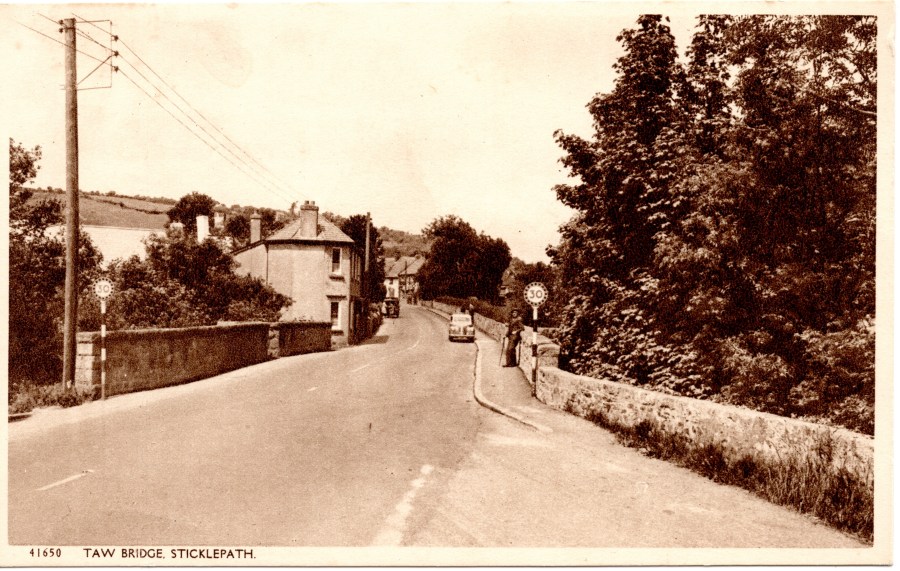
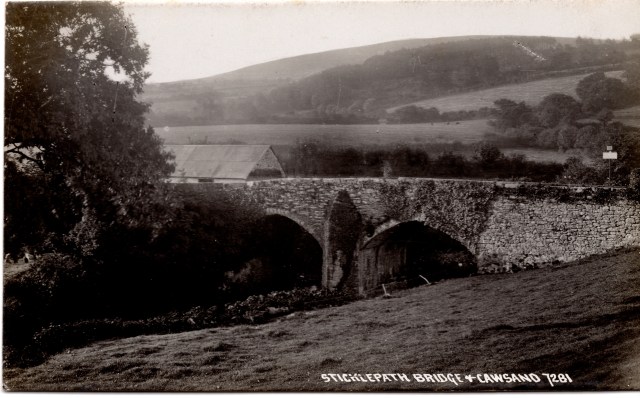
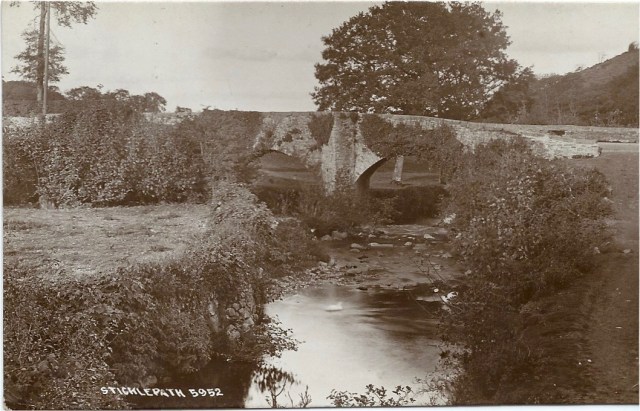
The real ‘Spot The Difference’ here relates to Sticklepath Bridge. Although these are actually taken from different sides of the bridge, the difference in the bridge itself is what we are after, and what that means for those travelling over the bridge.
Sticklepath Bridge early 1900s Chapman (Higher or Southern aspect)
Do you see the difference in construction? The pedestrian refuge in the top image was lost (for a while). Read on for more details and to see more differences as the road was widened and trees felled
STICKLEPATH BRIDGE, sometimes called Taw Bridge, is one of many similar 2 – 3 arched Dartmoor granite bridges with cut waters and pedestrian refuges above. Many are very picturesque, often in a wooded valley with opportunity to fish along the banks and usually somewhere to sit and imbibe refreshments, such as Fingle Bridge:
You can see the cutwaters clearly between the arches helping direct the water under the arches, reducing the water erosion on the piers or pillars of the bridge and preventing debris becoming trapped against the forward facing wall of the piers.
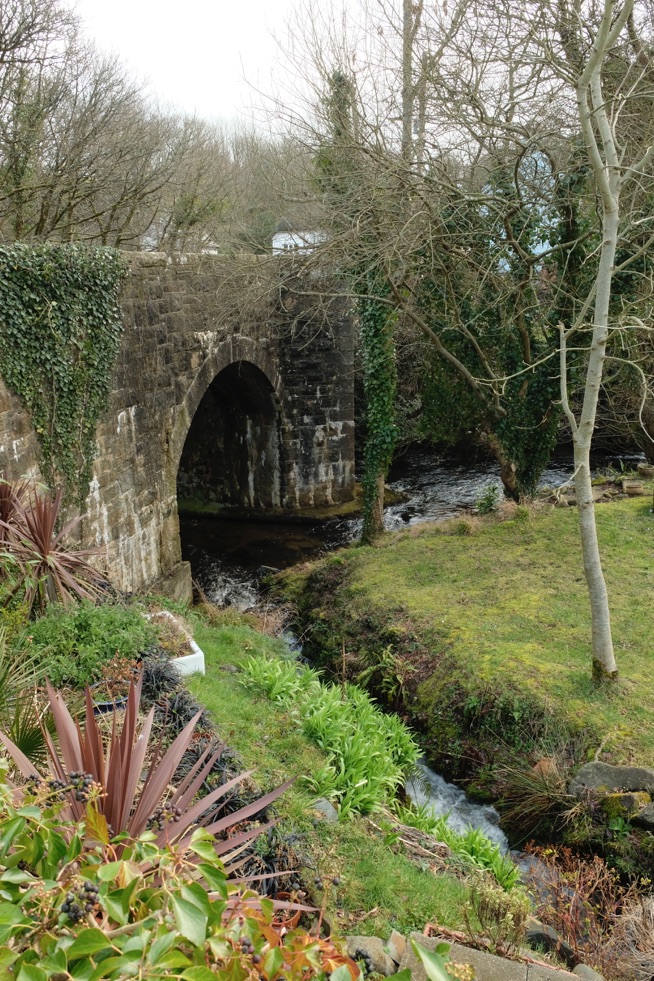
Unfortunately, as seen here, you cross the bridge as you enter Sticklepath almost without noticing, so it doesn’t have this picturesque appeal, especially as the banks have become overgrown (at least when I last visited) and it is now difficult to get a full view from a public footpath.
THE PHYSICAL STRUCTURE – Henderson tells us in 1928:
“ A description of the bridge by Green, the county surveyor in 1809, makes its two arches 17 feet in span and the width of the roadway only 14 feet. “This bridge,” he adds, ” being built upon a rock, though rough, is very strong.” A sketch of the bridge and plan made in 1852 shows that the road had been widened to 23 feet. This widening was done on the northern, or lower side, and the cutwater, with its triangular recess, was obliterated. The upper side remained untouched with its two little arches and massive cutwater between them. Thus the bridge remains to-day, and if the widening could be effected on the lower side no harm would be done. The old part of the bridge appears to date from the 17th century, the arches of a nondescript character, as at Fingle Bridge. It is probable, however, that the bridge has been in existence since the 14th century”. ”
Western Times – Friday 24 February 1928 tells us that Mr T.H. Ormston Pearse and Mr J. Pearse submitted objections to the Devon Main Roads Committee their objections to the changing of the pointed arches to rounded arches in the widening of the bridge at Sticklepath. To maintain pointed arches would be more costly and they had been found to be insufficient to take the load of modern traffic. When pressed for an explanation:
“ Colonel Gracey said the bridge had about the weakest form of semi-bastard Gothic arch, and the sub-committee decided there should be an elliptic arch.” The extra cost of at least £300 was a big factor.
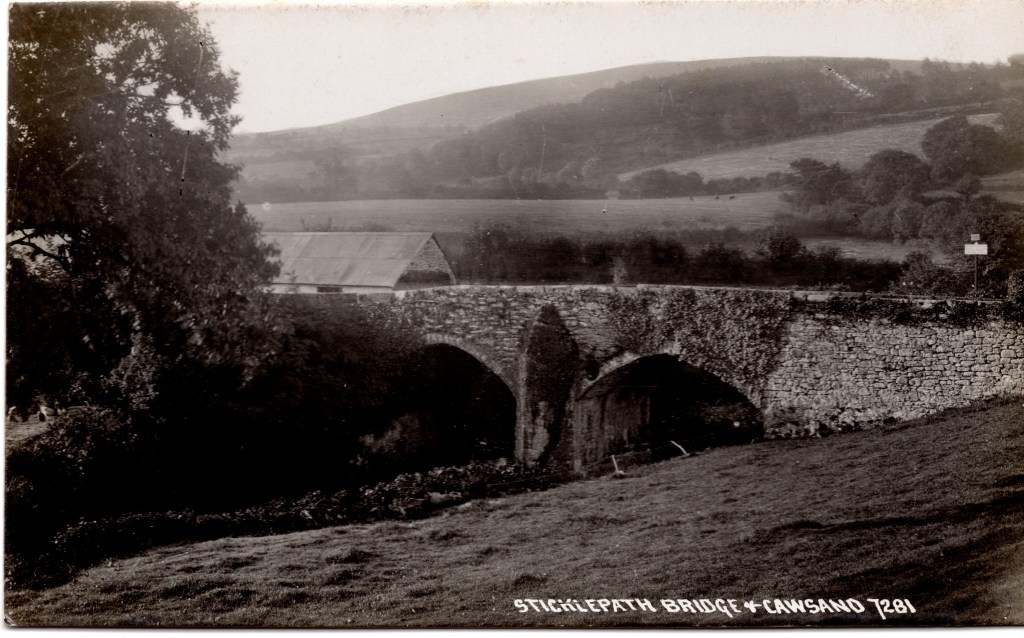
Photos above and below taken from the lower side showing that the pedestrian refuge was obliterated pre-1928
This photo also shows the lower section of Bridge House and Cawsand Beacon behind.
However, the Western Times – Friday 20 July 1934, suggests there was more to the story. Mr. Miller explained: “Here the archaeologists claim that the arch is of curious and interesting design. The increased speed and weight of modern traffic had very nearly caused this arch to collapse. The County Engineer averted this by putting in a reinforced concrete saddle, concealed from view, over the arch, which has the effect of relieving the arch of all pressure, of whatever kind. The widening has been carried out in the same design and manner as the ancient bridge, the same arch being carried through the new portion. The same stone has been used as far as possible in the abutments, and where this was not sufficient the moor was scoured for weathered granite. So that it is now impossible to see that any new work has been carried out.”
The village Conservation Area Appraisal 2017 suggests that the present structure is 18th century in origin. It is Grade II listed. Historic England list entry 1171622, National Grid Reference:SX 64354 94028, the description says:
“Road bridge over the River Taw. Probably C18. Snecked blocks of rusticated granite ashlar. 2-span bridge, each a segmental arch rising from vertical abutments. Between the two a pointed cutwater rises into the parapet to provide small refuges each side of the road. The parapet has plain granite coping. No terminal piers.”
Here I am in 2019 standing in the re-formed pedestrian refuge. Presumably re-instated in 1928.
An unusual feature is that the leat, which ran up to 7 waterwheels, joins the river here on the higher side.
This tells us that the old stonework of the bridge is visible underneath, 4m wide, but otherwise no visible medieval remains are visible. (Alexander, j. J. /dcnq/14(1926-1927)115/early bridges). It also says receipts showing repairs were made to the bridge in 1629 are found in Tavistock Churchwardens’ accounts. (These and other sources from the website should be followed up in the future!).
We can not know for certain when a bridge was first built here. Perhaps a ford existed before that and I am aware there is some evidence for use of different routes through the village. We can however surmise that when first built the bridge would only have been made as wide as it needed to be. Hence several alterations or re-builds have been required since. Tradition states that the carriage of King George III ( George William Frederick; 4 June 1738 – 29 January 1820, King from 1760) got stuck on our narrow bridge and that one parapet (side wall) had to be knocked down before he could proceed. (WI The Story of Sticklepath). This postcard of Holne New Bridge illustrates the need for triangular pedestrian refuges and highlights the need for widening as vehicles grew larger and more numerous:
Mid 1950s?
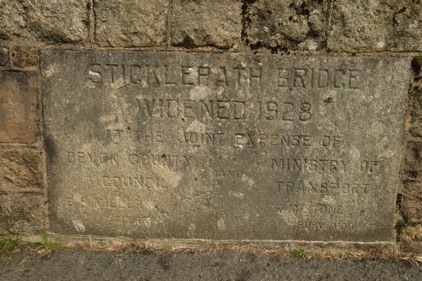
A Commermorative Plaque confirms the later widening in 1928.
Plaque commemorating the Sticklepath Bridge widening 1928 “At the Joint Expense of Devon County Council and Ministry of Transport”. (Photo 2019)
There are two other associated stones of note. The bridge marked the transition from Sampford Courtenay (S.C.) to South Tawton (S.T.) Parish so it is the site of a parish boundary marker. (Photo 2019 showing relationship to commemorative plaque).
The sharp-eyed, walking into the village, will also spot a ‘C’ stone built into the side of Primula House about 75 yards further down the road. Legendary Dartmoor tells us:
“A statute laid down by Henry VIII in 1531 ensured that at least somebody was made responsible for the maintenance of bridges. This statute basically directed that if no landowner, City, Borough, Town, Parish etc. could be proven to be those charged with bridge maintenance then the duty fell upon the County or Shire.”
Such bridges became known as ‘County Bridges’ with maintenance and repair funds coming from taxes levied on local inhabitants.
“The act required that for every bridge, the road over it and for 300ft on either approach should be similarly maintained. In 1841 the Devon magistrates decided that the limits of their responsibility were to be marked by boundstones.” These ‘C Stones’ were about 3 feet high with an incised ‘C’ on one of the faces and placed one on either side of the bridge. (This lasted until 1880 when the newly formed County Councils adopted responsibility.)
‘C’ stone built into the roadside facade of Primula House
Close up of the ‘C’ stone at Primula
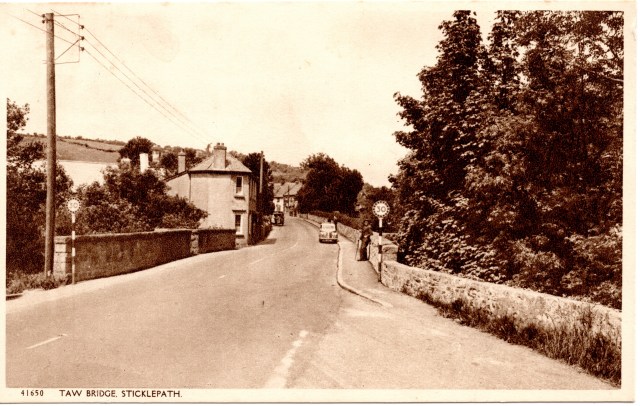
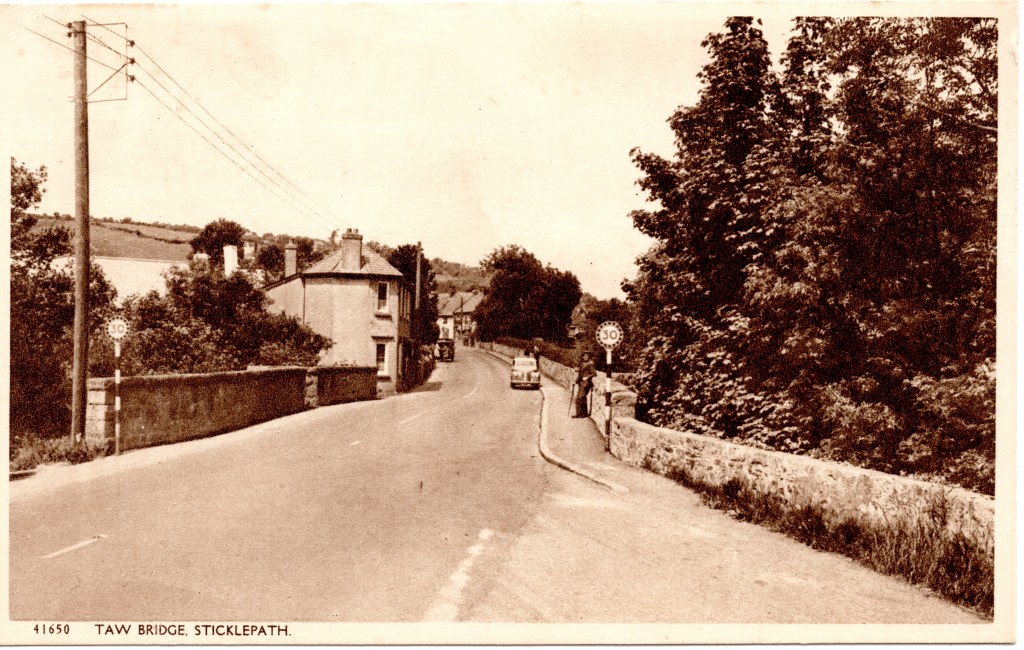
WATERSMEET – Before we leave the physical appearance of the area, it is worth noting that I have seen no evidence that Sticklepath Bridge was ever part of the turnpike system (e.g. Burd, E. P., 1936, Okehampton Turnpikes). Watersmeet, the house immediately alongside the bridge where the leat joins the Taw, has a diagonal facade reminiscent of Toll houses, however, it is more likely the architect took advantage to maximise its footprint, whilst enabling best visibility for vehicles exiting from the Mill situated behind. (Now private dwellings including Albany House and Mill Cottage). Muriel Bowden suggested that Watersmeet was built in the early 1900s and remembered a sweet shop there run by Miss Harriet Worden, very popular with the children. Later a doctor held surgery in the two front rooms, in competition with Dr Sharp. On the other hand very early photographs do not necessary confirm it was originally built with the diagonal facades and raise the possibility that this was a later alteration perhaps after an accidental damage? I wonder if other early photographs exist, or plans for alterations? (Interesting also to see on the following photos how the right hand side of the road changes, the magnificent row of elm trees with their shadows in the first postcard disappear, the wall moves back to allow widening and a pavement and later the entrance to Oak Tree Park appears. Notice the chimney on Watersmeet appears and disappears too!)
Watersmeet, just over the bridge with pale orange tiled roof
Two photos above : Sticklepath Bridge with Watersmeet (White House at the far right side the bridge and the Mill in behind.
Is the footprint of Watersmeet, the white house at the far side of the bridge, rectangular above?
Early 1900s. Watersmeet in foreground. Note the narrow street with magnificent elm trees on the right. (Primula, mentioned above is the dark house facing us)
The road was widened 1926 and perhaps the pavement was added at the same time.
Mid-late 1930s ? Now you see a chimney….
Watersmeet 2019. Now you don’t! But a new turning to the right is an entrance to the c1980s Oak Tree Park housing estate
PEOPLE AND EVENTS – A One Place Study aims not only to consider local and social history, but to connect people with places and events. If the stones of our bridge could speak they would have numerous stories to tell. It was of course a frequent meeting place, and not just for romantic couples about to wander along the Taw. The Western Times reports for example Friday 17 November 1865 that Earl Portsmouth’s Hounds meet at Sticklepath Bridge for “The Chase” on 20th. The report on Friday 04 July 1890 says:
“On Sunday week the members of this section of D. Company 4th V.B.D.R. fell in at Taw Bridge for a church parade and marched to the church headed by the band of the company.” “15 band, 35 rank and file.”
The bridge has been crossed by many people of note: Charles I, with his Army in 1644 pursuing the Earl of Essex in Cornwall, availed himself of the courtesy of the bridge, as perhaps his wretched Queen Henrietta had done a few weeks before, when she fled from Exeter to Launceston. Prince Rupert too rode through to quarter his troops in Okehampton, some we know were billeted at Coombehead Farm (the story is told that fearing detection they cut off the head of the cockerel to prevent it crowing and raising the alarm!).
“Many were the coaches that rattled over the bridge when Falmouth became the great Packet Station of the West, and the most famous characters of the 18th century must have been jolted from their slumbers as their postchaises or coaches took the dangerous bend.” (Henderson)
In 1805 Lieutenant Lapenotiere set out to from his position off Cape Trafalgar, to deliver his vital dispatches to the Admiralty in Whitehall. His journey across the sea in the HMS Pickle, was beset with trials – rough passage such that the guns had to be thrown overboard, then be-calming. On reaching Falmouth, Lapenotiere would have taken the first possible post-chaise express carriage passing over our village bridge on his way with the news of the triumphant battle of Trafalgar and the death of Nelson.
Much more recently, in 1916, it was at the bridge that our village policeman arrested a man accused of molesting young girls (neither he nor his victims from Sticklepath, the constable had been given a description and correctly identified the man). The Western Times of Friday 07 May 1937 reports a lesser crime:
“STICKLEPATH MAN AND PAYMENT OF FINES. Summonses “for failing to observe a Halt” sign at Sticklepath Bridge on April 18th against Edgar Leslie Gibbs, of The Stores, Sticklepath, were dismissed at Okehampton Sessions Wednesday on payment of costs. Asked to show cause why he had not paid 12s. in respect of fines inflicted him on January 13th he said he had been out of work. At one time he drove a lorry and managed his own business. Now his only income was 2s. a week on a paper round. He was quite prepared to pay 5s. per month.” (1934 Road Traffic Acts and Regulations handbook had introduced the ‘Halt at major road ahead’ sign, precursor of the ‘Stop’ sign).
In 1950 (Western Morning News – Monday 22 May) Douglas St Leger-Gordon wrote about people gathering on the bridge to admire the increasingly rare red squirrel which was visiting it’s nut store close to the bridge daily, and had almost become the village ‘mascot’.
Unfortunately there are several “Sticklepath” bridges, and in some other cases it is not clear if all stories relate to ours. The Western Morning News – Wednesday 15 February 1928, points to just such a confusion between what is now known as Grenofen Bridge and our village bridge.
1307 – “BISHOP’S MONEY FOR REPAIRS. Thomas Bytton, cf Exeter, who died in 1307, was prelate renowned for the munificence of his charities. In his will he left a large sum of money for charitable purposes, and desired his executors to journey throughout his Diocese of Devon and Cornwall distributing it as they thought fit. The executors performed their task without sparing themselves, for they journeyed almost to Land’s End. When they returned, in 1310, they made out a long account of what they had distributed. Among other items find the gift of £6 13s. 4d. for the repair, of the Bridge at “Stykelepath” under the “view”or direction of “Robert the Monk there.” This was a large sum for a little bridge, whichever Sticklepath is meant, and we may suppose that Robert the Monk, in his hermitage by the riverside, touched the hearts of the executors by his devotion. Perhaps they had some difficulty in crossing the torrent owing to the ruinous state of the bridge, and Dan Robert, in giving them aid and comfort, was able to point a moral. The incident conjures up a vignette of wayfaring life in the Middle Ages”, and Henderson goes on:
“It is not surprising to find a monk taking charge of the building of a bridge, for in the Middle Ages bridge-building was generally under the auspices of the Church as a work of Christian charity. If the executors had styled him “Frater ” and not “Monachus” one would have regarded Robert as a member of the Order of Pontist Friars, specially formed for the building and maintenance of bridges.”
The Chantry Priest in our village at that time was one Robert de Esse so by my reckoning we have good grounds on which to claim this tale as our own.
ALL COMMENTS ARE WELCOMED.
References / Bibliography (other than those quoted in full above)
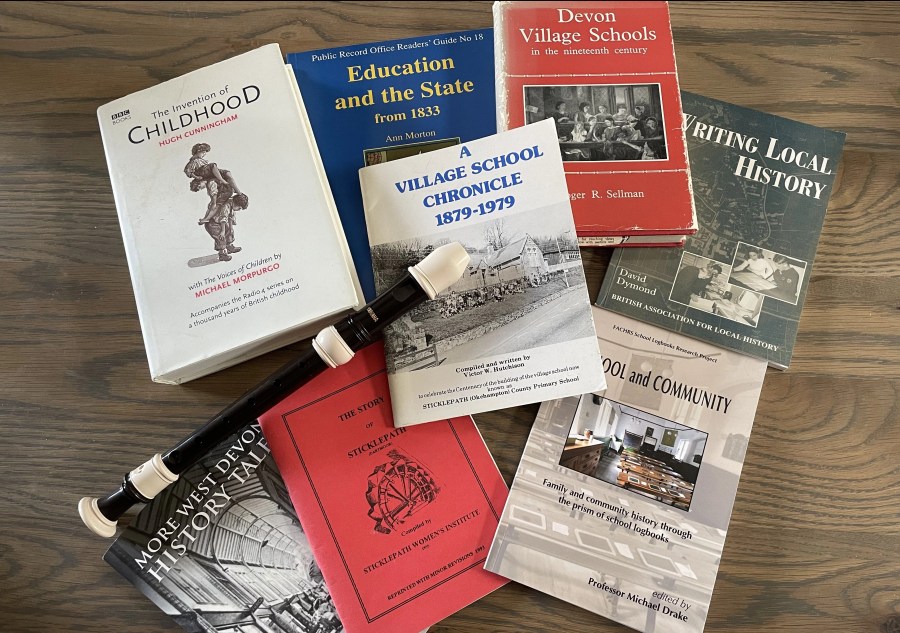
Depending on the school there may be a wikipedia page or for current schools the school website. Some schools still store their old documents and especially old school magazines.
Peter Higginbotham’s Children’s Homes website covers many types of school set up to look after paupers and criminals, check under “All About…” on the left hand side menu, or search for a specific school. Check out this short video for how to explore the website and the range of information shown.
One-Place Studies (OPSs) may have detailed information about a school and its pupils and teachers. Some OPSs focus entirely on the school – for example this study of an orphan school in Hull
Check out some blogs eg Children in Victorian Times, this one on Schooldays or short videos, consider visiting local museums with a focus on education to get an idea of the desks and equipment used in the past.
Newspapers add colour and many different types of information regarding events, fund raising, absences, advertisements for teachers or other staff, regional teachers meetings, retirements, marriages of women teachers (which usually meant they stopped work), appointments of governors or managers, awards won, scandals, changes to the buildings. etc.
The National Archive and county or more local archives may well have more specific advice leaflets regarding how to research the school and teachers in their area and sources available.
The Modern Records Centre, University of Warwick, houses teacher’s union resources and National Union of Students information. Remember to check nearby University Archives too.
What you really want, are school admission registers, punishment books and minutes. These are usually found in the archives. There its usually a ban on accessing those records for 96-100 years.
More specific information about Sticklepath School follows …










 Sticklepath a Village and its People