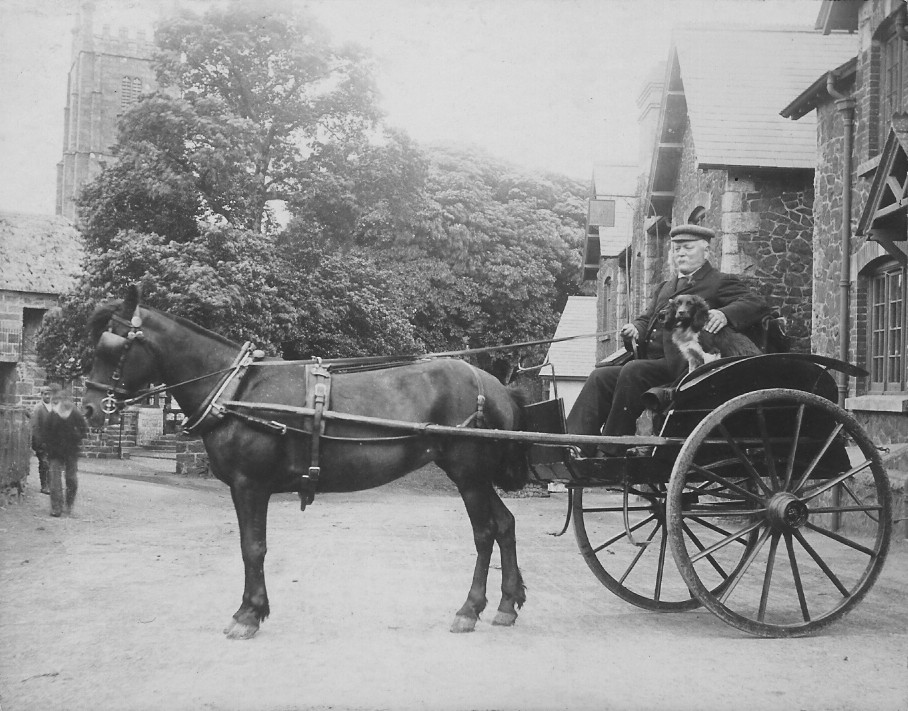
Solon Bowden

One of the #Sticklepath Finch foundry workers was Solon Bowden (1857-1933).

Born in Belstone Parish, like his parents and sisters, we find the little family in the 1861 census living at Tongue End Smithy. Father John Bowden was a blacksmith, then aged 42 and mother Elizabeth (formerly Ellis) was 43. Harriett was 6 years old, Solon 3, and baby Lydia just 10 months.
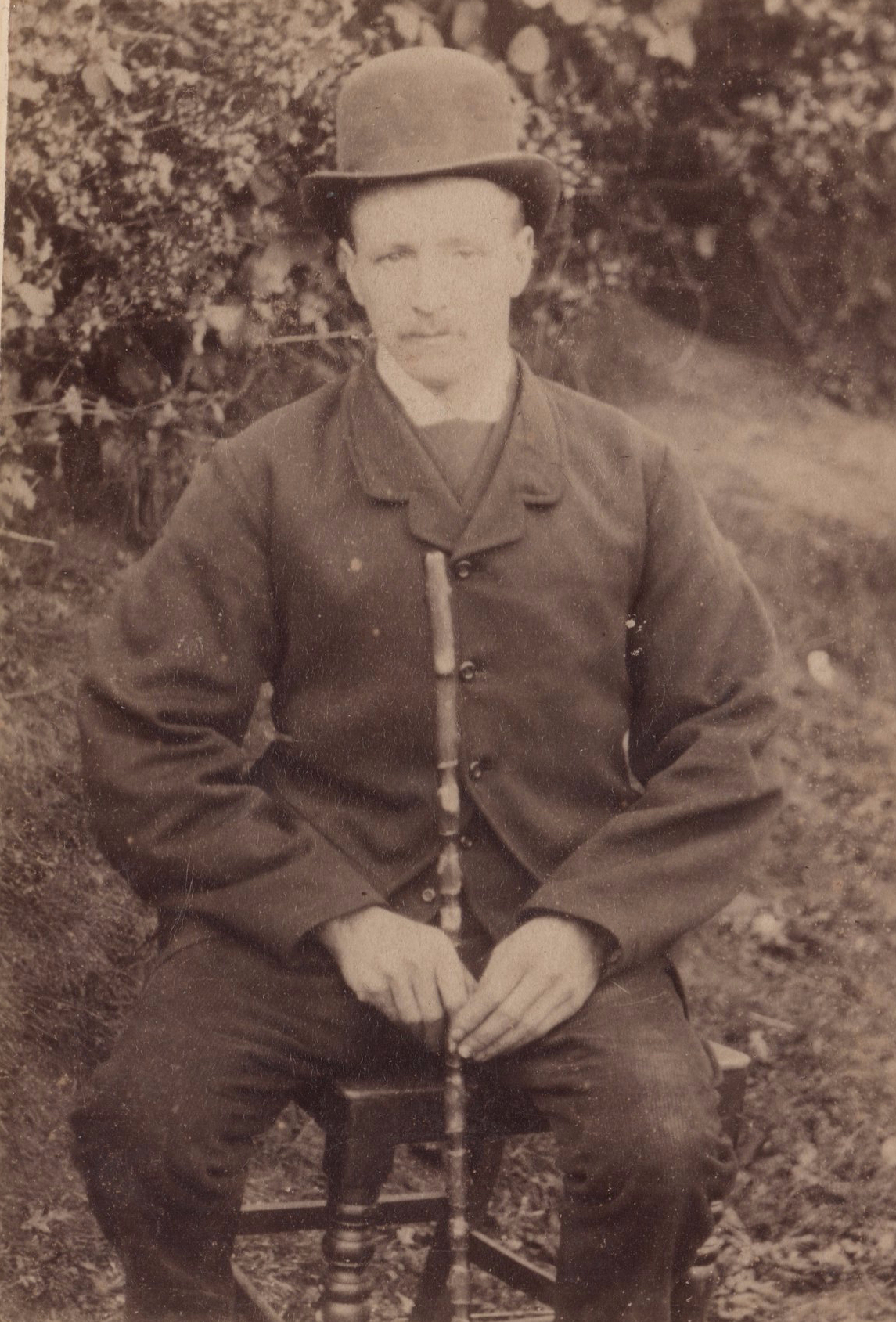
Solon Bowden

Aged 3, the family likely thought Solon was a late talker. No mention of any problem is shown in the disability column. However, by 1871, Solon was described as ‘deaf and dumb’. This was not a derogatory term, as it is today, but simply says the child could not speak due to deafness. Access to speech therapists, hearing aids and other help would have been limited, especially in rural areas. For many, access to education would be difficult, and life’s opportunities severely curtailed. Not only getting a job but the pay may have been reduced. An example of an advertisement in the jobs wanted column of The Leicester Journal Friday 06 October 1882:

‘A Blacksmith, a handy man and good shoer. Being deaf, would take low wages.”

Solon however, was lucky. By the age of 13 the 1871 census tells us he was at the West of England Institution for the Deaf and Dumb in St Leonards, Exeter, over 20 miles from home.  I wonder when he started there. Might he have been there in 1866 when a cholera epidemic hit Exeter. A very worrying time for his parents if so. They had already lost their eldest child, Harriett, at the age of 8 in 1862. Fortunately none of the children at the Institution caught cholera. (Information from South West Heritage Trust shared by Stuart Windsor in a talk for DevonFHS 2021). More surprising, as we scan the next page of the census, we find that his sister Lydia, was also there.  This is strongly suggestive the cause of their deafness was hereditary. It seems highly likely that the Bowden children were funded by the poor law authorities.

The school principal, William R Scott, was 60 y old and he had 3 teachers assisting him (living in) aged 19 – 20.  There was also a work mistress, an upper housemaid domestic, an under housemaid, a cook and a laundress all living in. The adjacent lodge housed a gardener and his family.  There were 65 pupils, boys and girls, aged 8-16y.  Of most interest is the list of causes for deafness –  48 were born deaf and dumb, including Solon and Lydia.  6 were caused by scarlet fever, another 5 by unspecified fever, 2 by measles, 1 by convulsions, 1 by throat disease, 1 from ulcers in the ear, and 1 by a fright in early life. (This paragraph was entirely sourced from the 1871 census accessed via Ancestry. One day I hope to investigate the school records and Belstone Parish records further.)

Childrenshomes.org.uk tells us: “As well as learning communication skills, the pupils were given ‘industrial training’ to enable them to find employment in later life. For the boys, this included instruction in trades such as printing, tailoring, cabinet making, wood engraving and shoemaking, while the girls were taught sewing, dress-making and other domestic skills.

On 21 October 1863, The Institution was authorised to operate as a Certified School, allowing it to receive children boarded out from workhouses by the Poor Law authorities. It maintained this status until 27 September 1909.” (Just in time for Solon to be funded).

Solon was certainly a hard worker and bright intellectually. This photo shows him, and another foundry worker in about 1914 bringing in the harvest at Coombe Head Farm, and later census information suggests he worked at the Foundry in Sticklepath but also helped his father at home in the smithy at Tongue End in any spare time. He married in 1906, a young lady called Hetty Brock I believe. She was working away in 1911, so I hope to glean more from the 1921 census.

Alf Rowe and Solon Bowden helping the Ching twins with the harvest 1914

Deafness was very isolating unless family and employers supported you. Potentially dangerous too, if people couldn’t attract your attention to avoid accidents. I have mentioned before the very smoky, smelly, dirty presence of the Foundry, dominating the heart of Sticklepath, right up to the roadside. Perhaps for Solon the very noisy foundry environment actually meant others could hear almost as little as he could and basic hand signals would often be used between the workers. He would have sensed the waterwheels and tilt hammers working. You can still experience demonstrations today and feel the vibrations deep in your chest as the water-powered tilt hammers thud to shape red hot metal at Sticklepath’s National Trust Finch Foundry.  
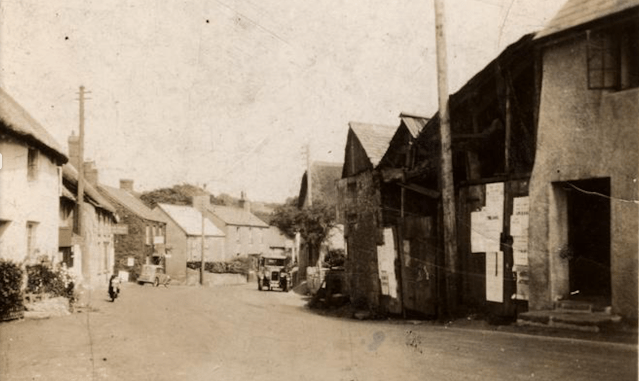
Finch Foundry Sticklepath on right side. Perhaps 1910-20

Bob Barron tells the story recounted by a visitor to the Foundry in the 1970s who recalled an event 40-50 years earlier, which must surely be about Solon:

“about 1925 he was on his way to Cornwall on his motorcycle when the drive chain broke. There were few garages in those days and he called at the Foundry hoping to get help. He said that a deaf and dumb blacksmith made a new link for the chain and sent him on his way. This was work that would tax the skill of a watchmaker, let alone a blacksmith.” (The Finch Foundry Trust and Sticklepath Museum of Rural Industry by R.A.Barron). See photo of Bob at work

Disability results from the interaction between individuals with a health condition and their environment. For example a person with deafness, perhaps also mental health issues arising, as well as personal and environmental factors including negative attitudes, lack of accessible education and other opportunities, with limited social and financial support can really struggle with that disability. Short sightedness, for example, without suitable glasses potentially becomes a big disability affecting ability to read, limiting job applications, types of work, and lots of other consequences. Given the right support it is not a disability. In his #OnePlaceEnvironment, Solon it seems was not greatly limited by his potential disability.


SMALL-POX has broken out in the large village of #Sticklepath

That certain would be a headline grabber today! But no, this is a single sentence hidden in the middle of page 2 amongst other unrelated titbits. The Western Times 28 Oct 1871 tells us an heir is born to a Lady in London, then states:

“It is said that small-pox has broken out in the large village of Sticklepath near Okehampton, and that the wife of a miner has died from the disease.”

The paper then moved straight on to a one sentence advert for hair restorer and an unrelated item re the takings of the local railway. I wonder how many people spotted this sentence? (Spotted -rash! No pun intended).

I found this ‘newspaper clipping’ after looking at the death certificate for Jane Osborn, wife of miner William Osborn. This is the third burial in my #SticklepathQuakerBuryingGround series.

Image from BritishNewspaperArchive, originals at British Library. (Accessed July 2021)

According to the burial register Jane was buried on 24 October 1871 aged 27, and was burial No. 180. The funeral ceremony was performed by Thomas Seacombe, a Methodist local preacher who performed a great number of the burial services.

The General Registry Office Register gives a slightly different date, saying she died on 25 October 1871 (the day after she was reputedly buried!). The cause was certified. It was not a legal requirement at the time for all deaths, however the local doctors kept a close eye on infections and fevers. It does not tell us who certified the death. I suspect that any smallpox victim was buried very soon after death, to prevent spread of infection. The death was registered on 26 October by informant John Austin of Sticklepath, ‘in attendance’.

Informants are often relatives, sometimes a ‘nurse’ helping care for the person. I have not found a connection (yet) between Jane Osborn, born Coombe, and the Austin family. The only John Austin on the 1871 census, taken just a few months earlier, was the 15 year old apprentice to Mr Cook the wheelwright and undertaker. I wonder if he was the one sent to register the death? Perhaps part of the undertaker’s service, though legally he should have been ‘in attendance’ during the last days of life. On the other hand, people who had already had smallpox and survived were the ones asked to care for a new sufferer. Is it possible this could have been why he was in attendance?

I have more questions than answers!

As usual I would love to hear from anyone with more information. shields_h_f@hotmail.com

PC Joseph Labdon, Carpenter and Undertaker

We started last time with a burial, William John Labdon in Sticklepath.  Will’s father, Joseph as a FAN (friend, associate and/or neighbour) of #Sticklepath #One-Place Study,  warrants investigation in his own right. 

Introduction

Joseph Labdon was born on 22 August 1842 in Bradninch, Devon, youngest son of William, aged 47 and his wife Jane (born Stoyal) age 37.  He married Susan Ireland in Wellington, Somerset on 1 May 1866 and they had 11 children together. At least 3 died during childhood. He became a Police Constable in Bratton Clovelly, Chillaton and then in South Zeal. 18 months after Susan died he married Elizabeth Knapman on 25 July 1889. In his later years he was a carpenter and undertaker in South Tawton. Joseph died in March 1915 at the age of 72. 

I use Ancestry to create the family tree for each resident and managed to make contact with several members of the #Labdon Family through the website.  I was delighted when they generously shared their research and some photos and scans. Many thanks especially to Patrick Mitchell for information about Susan Labdon’s death and all the images in this post, which he has kindly allowed me to use.  Thanks too to the British Newspaper Archive where I accessed the newspaper items (July 2021). 

PC Labdon. Photo supplied by Patrick Mitchell

Joseph’s early life and career

In 1851, aged 8, Joseph is living at Higher Trinity, Bradninch, with his mother Jane, father William, a carpenter, and 3 older siblings. 

By the age of 18 he and his brother were journeyman carpenters living with their parents. Mother is dress-making and father now calls himself a Master carpenter. (Journeyman suggests they had completed an apprenticeship or training within the family and are now gaining experience. Literally day worker, from the French ‘jour’). William’s grand-daughter, likely Joseph’s niece, Sophia aged 8, is staying with them.  

We don’t know how Joseph, aged 23, met Susan. He was still living in Bradninch and working as a carpenter at the time they married.  One of the witnesses was a Sophia Labdon, who may have been his niece at age 13 it is more likely his older sister of the same name. The family moved around Devon quite a bit.  How did they come to move to our villages? 

Between 1866 and 1871 Joseph trained as a police constable, and by 1871 he was appointed Constable in Bratton Clovelly.  He probably trained in Exeter but their first two children: Mary Sophia aged 3 and William John aged 2 were born in Cullompton.  This suggests the family may have been living there at the time. There were certainly Labdon relatives in Cullompton who may have employed him. The youngest child on the 1871 census, aged 8 months, was born in Bradninch. Could they have been staying with his parents at the time? 

By 1881 the family are living in Chillaton, Milton Abbot Parish, perhaps in a police house, with several more children.

Daughter Elizabeth Jane died in 1881, this death was registered in Okehampton, so they may have already been in South Zeal.  Son William John, subject of the last blog post, died in March 1882, when we know the family were living in South Zeal. 

The migration path has been mapped by an @FACHRS project. (Scroll down to bottom of link page.) Many thanks to researcher Martin Allen. Amazing what you can find online!

The Devon Constabulary

For many years, up until the mid-19th century, in rural areas Parish constables were appointed usually as volunteers.   The County Police Acts of 1839 and 1840 initiated change and in 1856 Devon Constabulary was finally formed.  Initial recruits were largely Devon men who had joined the Bristol City Police but now jumped at the chance to return to their home county.   

In February 1857. the Constabulary consisted of 108 Constables, 12 Sergeants, 2 Inspectors and 4 Super-intendants all under the watchful eye of Gerald de Courcy Hamilton. Classroom tuition for new recruits was provided at Exeter Ragged School, with practical swordsmanship skills taught at Exeter Castle.  Uniforms by Messrs Hibberd & Son, army contractors in London.  The Constabulary gradually absorbed the boroughs and areas of Devon, including Okehampton in 1860 and Bradninch in 1866.  Joseph Labdon must have completed training at some point between 1866 and 1871.  

In 1871 constables wore a low brimmed hat with chin strap and long frock coats. They often carried their essentials in haversacks whilst they walked their long beats. A truncheon (not a sword) hung from their belt.  From about 1879 the new ‘Pickelhaub’ helmets were used, but by 1903 these were deemed too similar to the Prussian military helmet, and the Boar War bush hat (‘slouch hat’) was brought into use. (See photos)

The old Parish Constables came from within the community but the new Devon Constabulary moved their Constables frequently to avoid too much fraternisation. This largely explains his moves.  They were paid and often a specific ‘Police House’ was provided.  In Sticklepath there was a Police House near the Bridge until Pixie Nook, on the way towards Okehampton was specially built.

PC Joseph Labdon – the Policeman

Policemen were required to attend court, and petty sessions were often reported in the newspaper.  For example, several times PC Labdon arrested John Martin, landlord of the Devonshire Inn, Sticklepath for drunkenness and disorderly behaviour.  In 1882 John Martin and William Mugridge, a farmer, were summoned for assaulting P.C.Labdon whilst in the execution of his duty, a quarrel arising when they were drinking after hours (Express and Echo 2 Nov 1882). 

John Martin didn’t change his ways, he was summoned for being drunk on the highway in Sticklepath in April 1883 by PC Labdon. We find him in court yet again in August 1883:  at Crockernwell Petty Sessions PC Labdon summoned John Martin, landlord of the Devonshire Inn Sticklepath for being drunk on licensed premises at South Zeal – he was fined £1 and costs. In the same session PC Labdon confirmed the state of a sheep which had been ill-treated by a farmer’s son of South Tawton. On another occasion he was the first policeman to a suicide. It was not an easy job.

Torquay Times, and South Devon Advertiser – Friday 06 October 1882 SAVAGE ASSAULT ON THE POLICE

 “Jas. Glanville, a mason, of South Zeal, was brought up in custody charged on a warrant with assaulting Constable Joseph Labdon, whilst in the execution of his duty at South Zeal. Whilst the constable was on duty he heard a disturbance, and some one remarked, “Here comes the — let him have it.” The prisoner was very violent, tearing the constables uniform and scratching his face. He was remanded in custody till Saturday.”

He was also involved in the crime scene investigation when Ellen Gillard was assaulted in 1884. 

Later Career and personal life

Joseph stopped being a policeman at some point during the mid-1880s. No evidence has been found to suggest he qualified for a pension or that there was any specific incident leading to his change of career.  His father William died in 1881. As the youngest son perhaps Joseph inherited some tools and well seasoned wood from his father. (I have not found any evidence of a will.). We have seen Joseph was assaulted at work twice during 1882, I wonder if this combined with the family deaths noted above and, perhaps most importantly, his wife’s illness, led him to make a change in his career. Susan died of long standing heart disease and dropsy for 4 months. Joseph described himself as a retired police constable when he register her death in December 1887.

We can follow Joseph in the census, and the newspaper gives us some information about both his business and personal matters. In 1891 the family are living in South Tawton, at Shelly House. Joseph describes himself as a carpenter and builder. Son Samuel, also a carpenter, is living with them, aged 20.  Joseph is on the local villages Cottager’s Show committee that year, and we can see that he wins prizes for his parsnips, cucumbers and other vegetables in different years.  We can also find him attending political meetings, for example for the conservatives in South Zeal 1895 (Exeter and Plymouth Gazette July 9th). 

Letterhead Scan provided by Patrick Mitchell

In 1898 Okehampton District Council accepted the tender by J. Labdon (South Tawton) to supply posts for staking stone depots. (Western Times May 2nd).  By 1901 Joseph, carpenter, and his wife Elizabeth live alone in a cottage in South Tawton village. Richard Knapman, blacksmith is their immediate neighbour.  (The relationship if any to Elizabeth nee Knapman is unknown.) The addresses are not given, but they are on the same page as the houses by Sticklepath Bridge so may have been close to Sticklepath, part of which was in South Tawton Parish.  The neighbours may not have been on the best of terms.

East & South Devon Advertiser on Saturday 06 June 1896 reported the Crockernwell Petty Sessions:

” Richard Knapman, blacksmith, of Southtawton, was fined 20s. and costs for assaulting Joseph Labdon of the same place. On the Ist May the parties had an altercation on parish matters and politics, and the blacksmith “swinging his arm round,” the complainant’s teeth were knocked out.”

The Western Times reports 25 June 1901 that

“Messrs. Burd, Pearse and Mr Prickman, solicitors, Okehampton, made an application on behalf of Mr. Labdon, the undertaker, for the payment of a sum of £1 4s, being the cost incurred in the burial of a pauper. It was alleged that the relieving officer had given Mr. Labdon instructions to make coffins without waiting for official orders.”

This was not held against him as the Western Times 17 March 1905 tells us that Okehampton Board of Guardians accepted a tender for coffins from J. Labdon for South Tawton. 

Joseph Labdon in South Tawton. Photo supplied by Patrick Mitchell

In 1911, at aged 68, Joseph described himself as a carpenter and undertaker. Several funeral reports from the early 1900s name him as the undertaker. In 1911, he and Elizabeth  had been married 23 years and had a live in servant and general labourer, Ernest Gillard aged 14.  Joseph died in 1915. 

Joseph Labdon (with stick) at his daughter Millicant Rhoda’s wedding to Richard Dimond Mitchell 1909. Photo supplied by Patrick Mitchell.

Link to son

Please let me know if you can add any further information for this family or any others with links to Sticklepath. Investigating a number of different families I may get some information wrong, please do let me know.

All comments welcome! shields_h_f@hotmail.com Thank you.

COMMENT FROM Patrick Mitchell: I think Susan Ireland met Joseph Labdon as a result of her brother Thomas being stationed at Bradninch in the 1860s. He was a railway policeman on the Bristol and Exeter Railway, who later moved to Bedminster near Bristol as a signalman.