Kate continues to tell us about her life: Once I was married it was my job to make our little house into a home and do all the housework. Nice to be working for yourself though, making the choices. We had various tradesmen calling, like Fishy Holman, the fish man. He came twice a week from South Zeal. The butcher never came til late in the day, the midnight butcher we called him!
Then there was Mr Wonnacott’s groceries. He came with a covered wagon, horse drawn of course, with a tank built into the back for Paraffin. My sister Gina made sure I was not to buy that, ‘cos of course her husband Finch sold paraffin, and coal.
The baker, Marks from Okehampton, also came with his big square basket. Ooo such lovely bread, cottage loaves and so on. Sometimes he had a second much shallower oblong wicker basket, with lids that folded over each side, you know. Contained special treats, a jam tart or piece of cake. Wasn’t very often. Course you then you would have to pop down the road to the dairy for half a quarter of clotted cream. William would often give the girls a penny to spend at one of the sweetie shops – several ladies ran a little shop in the village to help make ends meet.
Waters Meet House
Like Miss Harriet Worden down by the bridge at Waters Meet, and Mrs Ada Tucker up at number one Ska View Cottages.
William loved to be part of any social events. Either in one of the local village halls or related to church or chapel. He even helped with making banners for the church parades. It was a lovely time in my life.
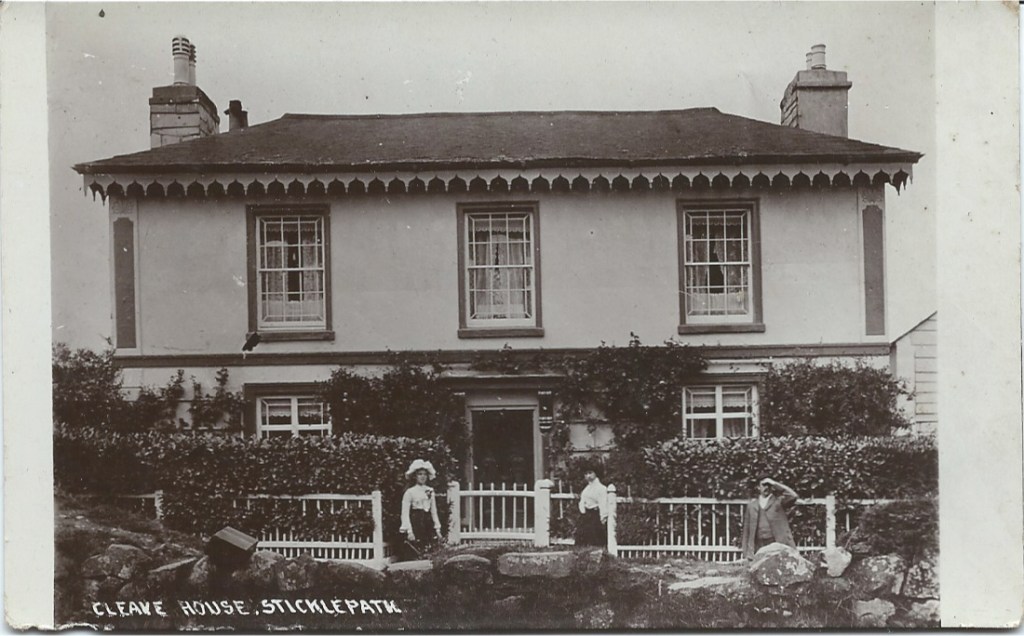
Sticklepath is a pretty village and attracts tourists to Dartmoor. When Gina was too busy with the guest house at Cleave House I would offer my help.
Cleave House Sticklepath
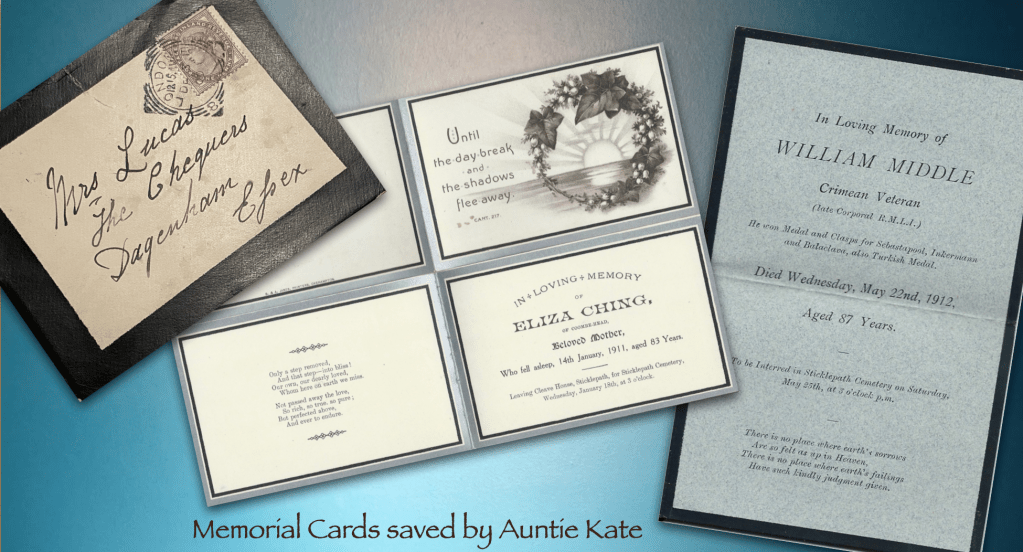
Sadly mother died in 1911 and William soon after in 1912. I always saved the memorial cards, a real source of remembrance when I lived away. Of course, you always knew bad news was coming when one of those letters arrived in an envelope with a black edge.
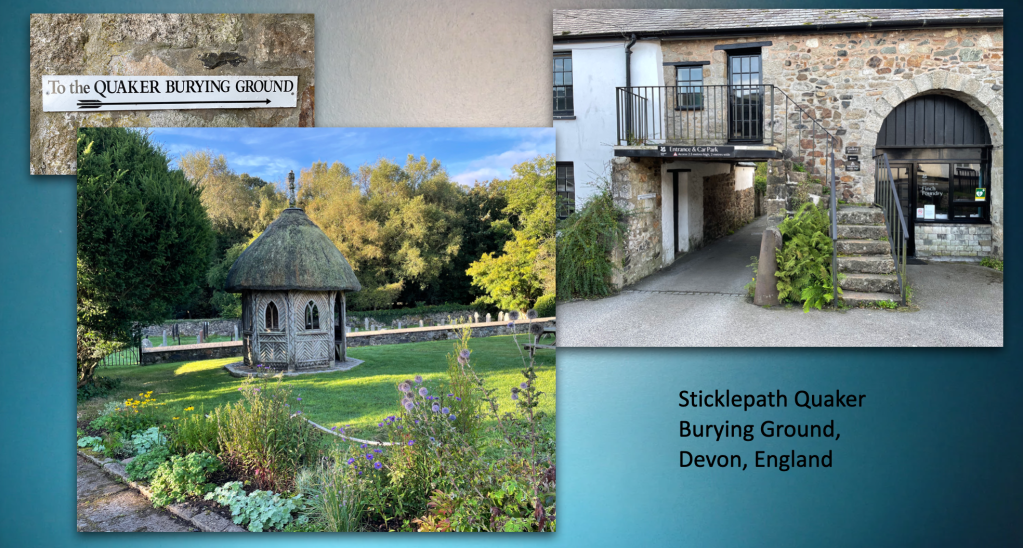
William was buried in the Sticklepath Burying Ground. We always call it the Quaker Burying Ground though it had been ecumenical for 100 years by then. Hidden down behind the Finch Foundry, it is a peaceful place where you can sit and contemplate the world with the gentle gurgling of the river Taw in the background.
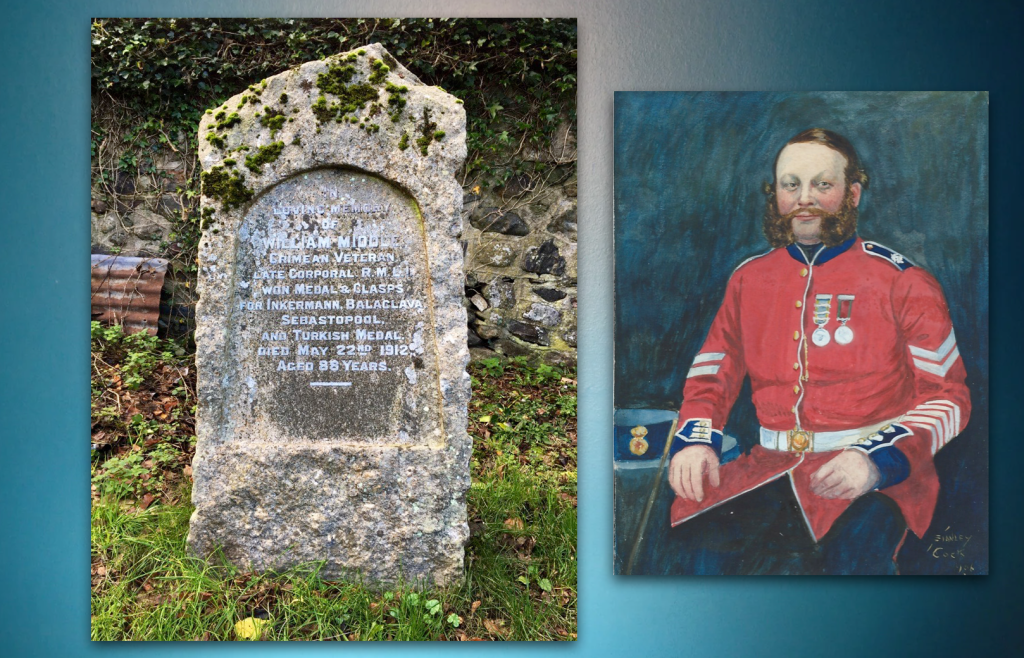
A rough hewn granite headstone, really suited him. Boasting of course of his Crimean adventures.
Shortly after William died, of course, I lost his war pension. Having no source of income, I found a house-keeping position down in Cornwall – Tywardreath, near Parr. So that’s where I married the second time…
Don’t miss Auntie Kate telling tales of Sticklepath School:
This is the next instalment of the life of Kezia Ching, also known as Auntie Kate. Auntie Kate is my alter ego and she will be talking at the #AllAboutThatPlace event to celebrate our great genealogical and local history societies and the 10th anniversary of the Society for One-Place Studies.
You will have to imagine Auntie Kate’s Devonshire burr. “Now then me dearies I be going’ to tell ‘ee someat ’bout me firs’ ‘usband…”
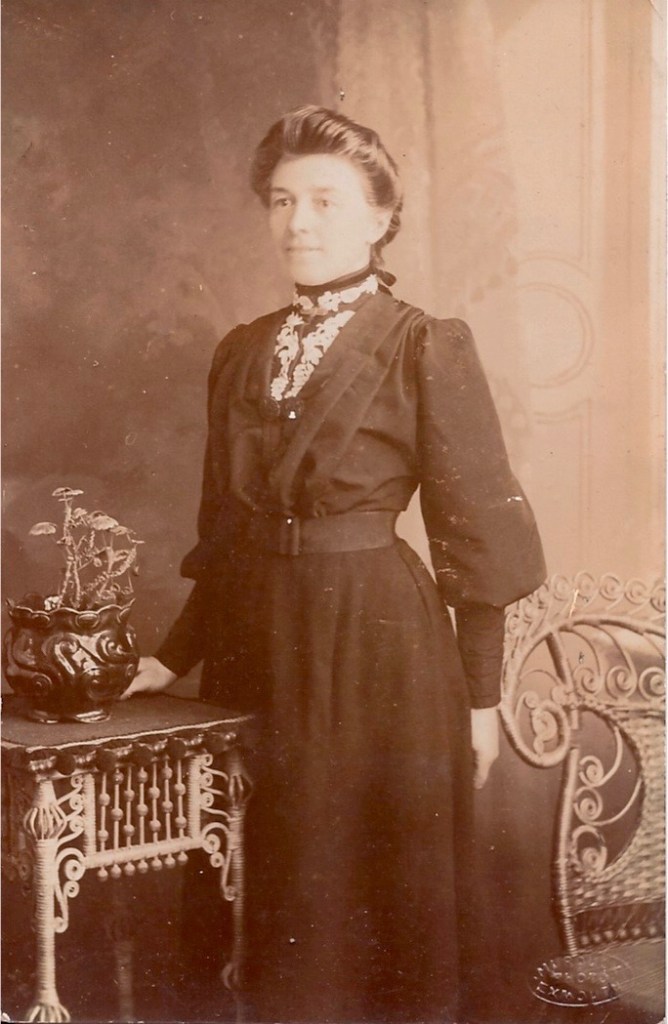
Ooh, I loved them hats, I could alter the decorations and make it new for each occasion. Usually did it myself but for real special occasions I took it to Miss Finch who kept the milliners in Okehampton, on Fore Street there. I dare say that’s where I bought that one you see on the right.
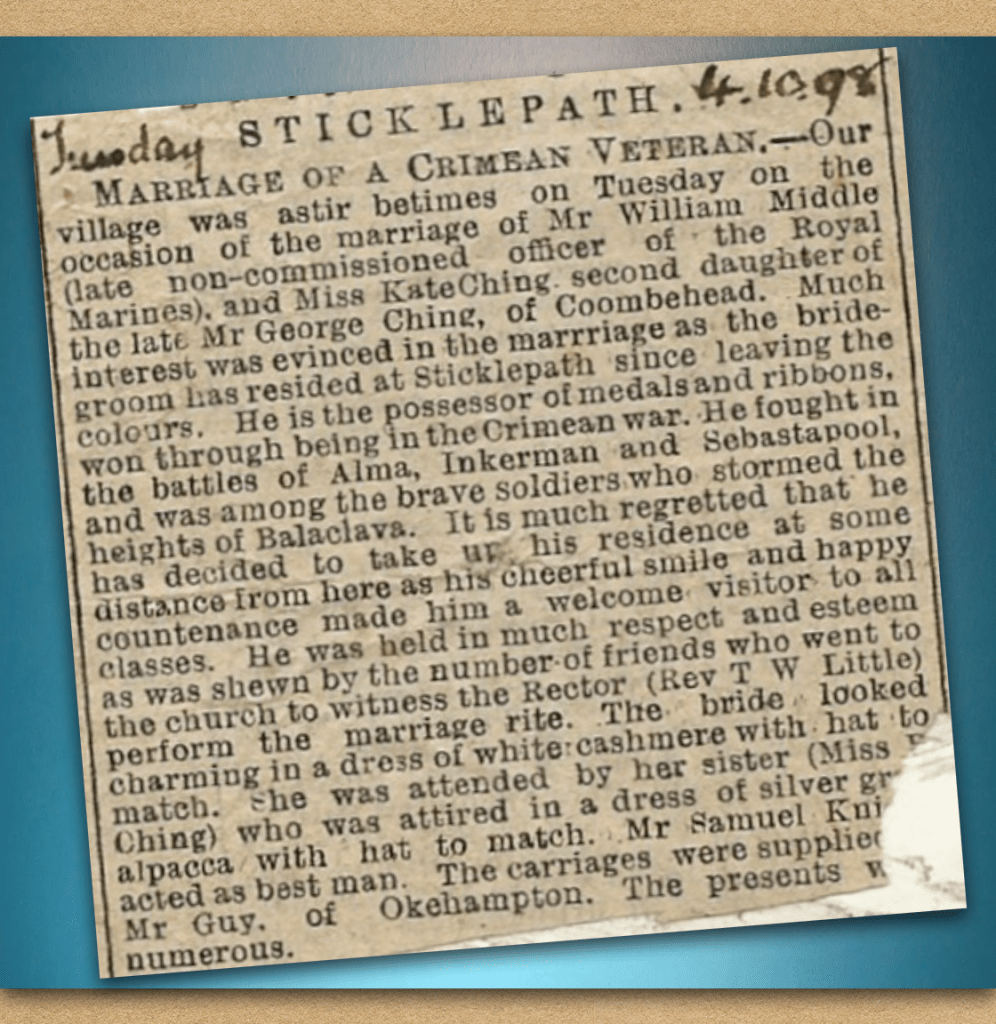
This here soldier is my Crimean war veteran, Private William Middle.
We were married in 1898. There were murmurings of course – he were 40 years older than me. Older than my father indeed. Twas practicality and companionship really. I couldn’t have looked after him as a single woman, lived with him without being his wife.
Anyhow being married gave me a bit more respectability, and of course I had to give up my position and come home closer to Sticklepath. Eliza was my bridesmaid and William had Samuel Knight as his best man. So many gifts, twas very useful. William had lived in lodgings and I was in service, so we needed most things for the kitchen and so on. We went to live down Exbourne, rented a little place t’other side of Okehampton to start off, but that didn’t last long.
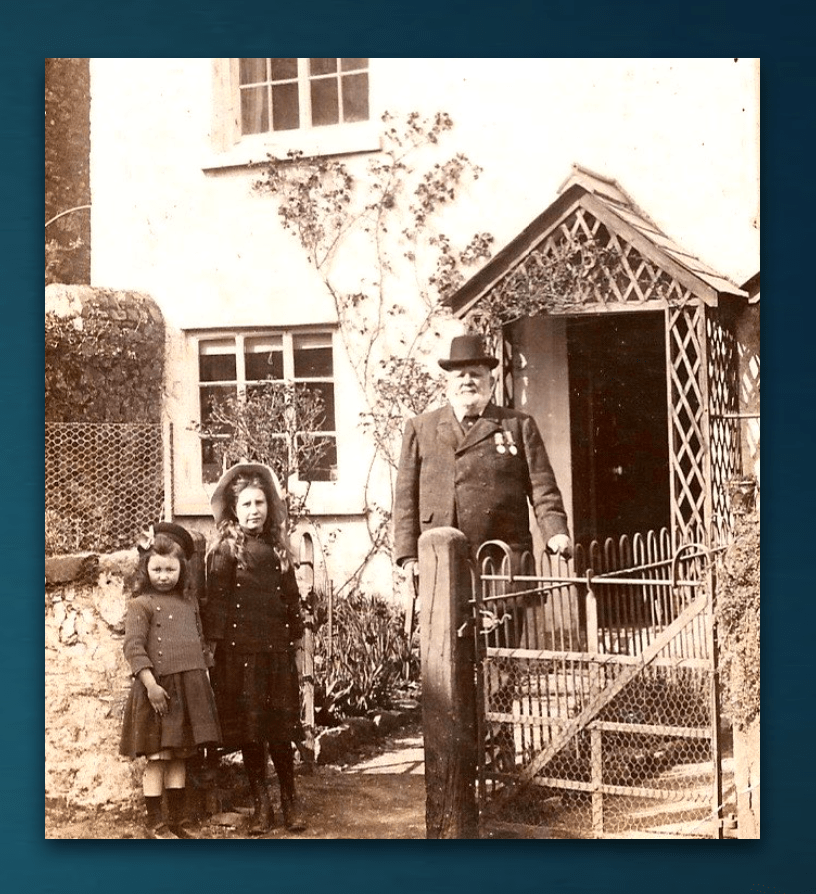
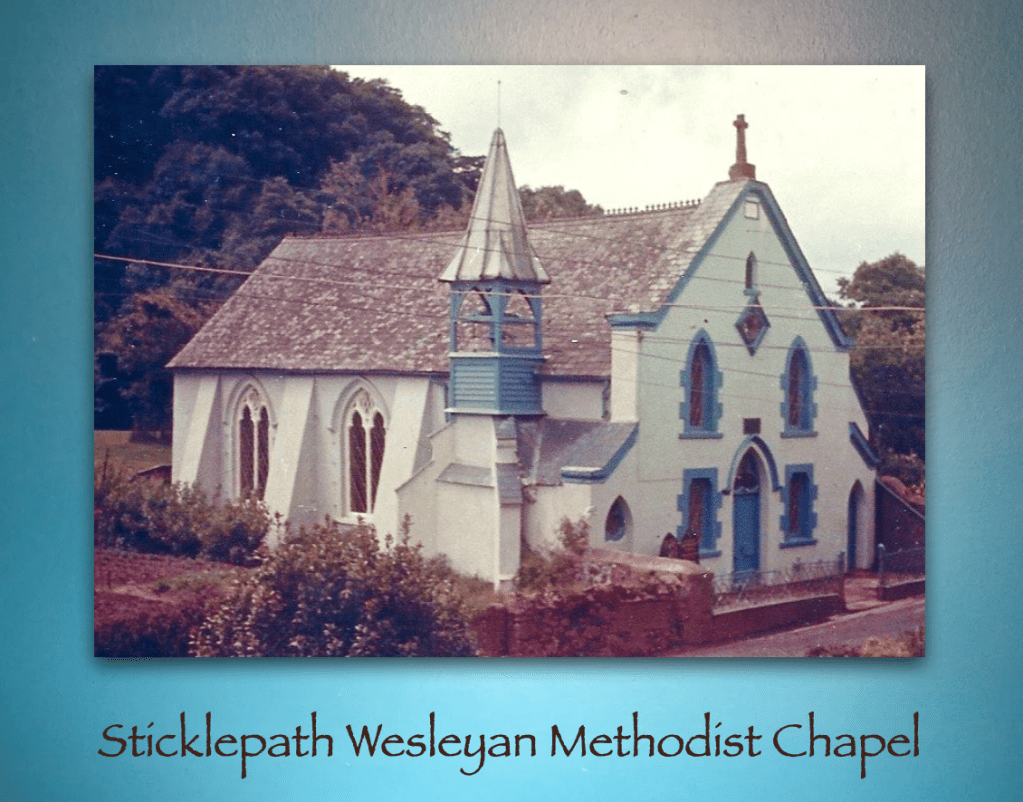
We soon came back to Sticklepath. We had a lovely little garden there next to the chapel – see me, a lady of leisure, sat there taking tea next to my husband, with a visitor!
Yer be our house, Farley Cottage, jus’ opposite chapel. That’s William, with our nieces – Phyllis and Muriel. Uncle Middle and Auntie Kate they called us. Well I suppose, being of senior years, using his surname showed the proper respect. He would have been ‘Uncle’ before we married cos his first wife were a Finch, a relation of the girl’s father. I, of course, sister to their mother Gina.
On high days, holidays and every Sunday, William would don his Crimea medals. People gathered each week before chapel or church and walked up and down the village greeting each other and chatting, sharing their latest news. William loved that, an audience for his stories of the war and how he helped with laying the first telegraph wire to America. In those days chapel was nearly always full and about 30 or 40 children would be there besides.
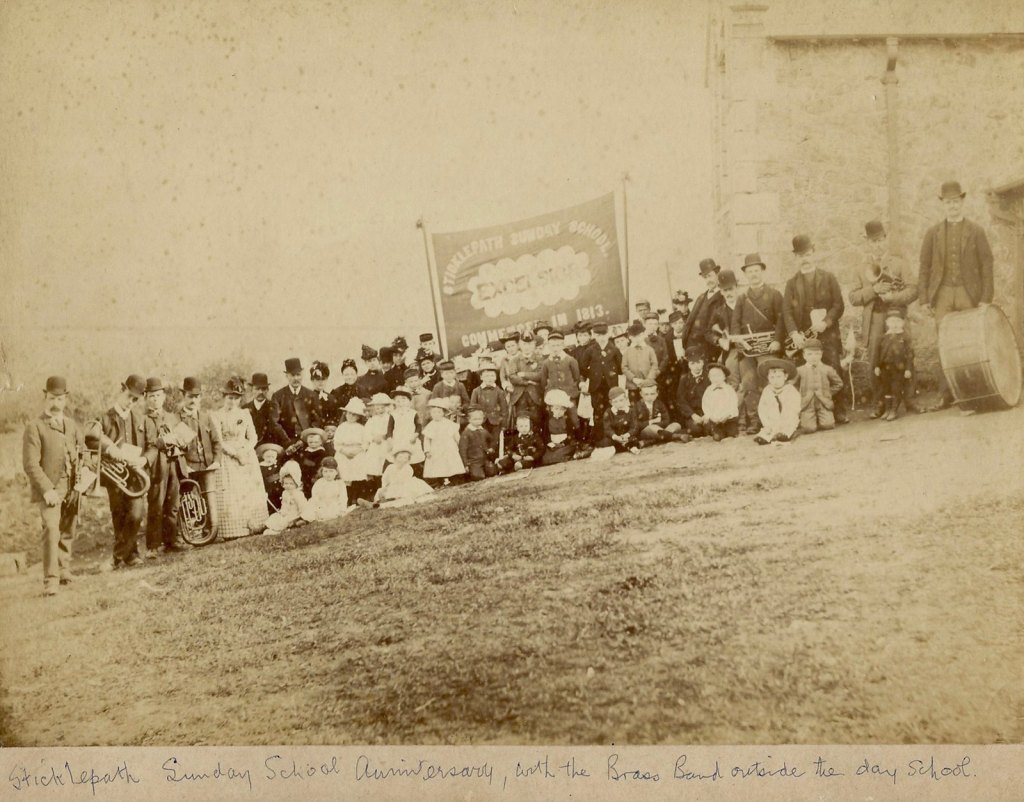
We all looked forward to the annual chapel outing and Sunday school anniversary. We had started having a few family picnics on Dartmoor by then too. And a bit later, 1920s we would all go in one of them Charabancs to Ilfracombe or Bude.
Talk of servants still brings to mind Mr Hudson (played by Gordon Jackson) and Mrs Bridges (Angela Baddeley) in Upstairs Downstairs, an ITV drama which ran 1971-1975. For younger genealogists Downton Abbey similarly.
Having servants seems so decadent, but servants in the past weren’t so much a luxury as a necessity. There was no running water, definitely no hot water unless it was painstakingly heated. The day’s water had to be fetched from the well or river. Food needed far more preparation and some was often grown by a household, requiring digging, watering, storage and regular checking. At times of plenty drying, bottling, salting etc was needed. No fridge, so milk was fetched daily. Clothes were made by hand, materials far less forgiving, necessitating washing, drying, mending, starching and ironing. There were no vacuum cleaners but unmetalled roads created far more dirt and dust everywhere. Carpets and mats needed regular beating, houses sweeping and mopping daily. In many places the front doorstep was scrubbed daily too. No cookers let alone central heating or electric heaters, so fires needed to be laid, lit, tended and cleared. Wood and coal needed fetching. The smoke of course adding to the daily grime.
Housework was never finished and was very, very time consuming. At the same time a man’s employment often involved long hours, 6 or more days a week, so he needed a wife or a servant. As the family grew, more servants were needed, or the children joined in with the chores.
For many Sticklepath folk of the lower and middling sort, being ‘in service’ during teenage years was almost a rite of passage. Some boys as well as girls. For a poor family having even one child boarded out in service meant one less mouth to feed, a little more space in the house, and perhaps a small supplement to the household income. Later in life unmarried women often continued in service, and widows commonly sought a housekeeper position with board and lodging provided. From 1871 to 1911 about 4 in every 10 women were in service. Even in 1931 a quarter of working women were still servants(1). The majority would be working in modest households probably as the ‘maid of all work’.
During the 1800s the main alternatives for Sticklepath women were farm work, domestic service, or working in the local woolen mill. It is hard to know how many women worked on farms from the census as most family workers were not documented. About equal numbers of women were in service or working in the wool mill or ‘factory’ in 1851. Taking in laundry, dress-making or other handicraft work in the home, such as glove-making, was another possibility. Some women, especially married women or older spinsters, ran a little sweet shop or grocery from their house.
Although there were hiring fairs many domestic servants would have answered an advert in the local paper, or taken a job through ‘word of mouth’.
“Wanted – an experienced PARLOURMAID, good needlewoman”. Adverts commonly used words like steady, respectable, thorough, or trustworthy. For cooks the request might be ‘a good cook’ or a ‘plain cook for a gentleman’. Sometimes the wage offered was stated but often it was “apply stating wages and full particulars”. References were usually needed.
As Methodists there was a likelihood that the Chings would have heard through Methodist contacts of a post, and similarly been recommended through the Methodist network, with a reference from the minister. Live in servants were often expected to join the family for church and the many church related events, so it was helpful if they were of the same religious persuasion.
Equally a local acquaintance may have put them in touch. William White’s Directory 1878-9 tells us that Miss Margaret James, one of 9 children of Mr John Haddy James who had been a renowned surgeon in Exeter, lived in Belstone. (See his portrait and obituary). It is likely Miss James recruited Eliza Ching as a respectable and hard working teenager. Two of Miss James’s sisters were living at a house called Southerleigh in Lympstone, Devon. It is in that household that we find Eliza Ching working as a housemaid in 1881 at the age of 24. Sister Georgina aged 17 is also working for Miss Lucy and Miss Mary James in Lympstone as a cook. It would seem only natural if a post became vacant to suggest her own sister. As well as the two ladies there is a boarder to look after. You may recall that the Ching family were in financial difficulties in 1878 and this was perhaps when at least one the Ching sisters were sent into service.
Working for higher social classes could be a very different experience. Servants in the Victorian period became increasingly specialised. Some would travel with their master or mistress or perhaps be moved from one grand house to another or perhaps to a relative’s employment. From the 1850s it had became fashionable for servants in these wealthy households to wear a uniform. Often the servant had to purchase this themselves.
We don’t know how Auntie Kate started out in service but in 1881 she was in a much grander house than her sisters. Right on the seafront at No 8 Powderham Terrace in Teignmouth. Kate was parlour maid to Major Henry Bourchier Toke Wrey J.P., Major in the 1st Devon Militia. On census night there were 13 further family members and 7 live-in servants in the house. The. servants were a cook and kitchen maid, the nurse and nurse maid, Kate the parlour maid, the housemaid and a page. A big house for Kate and one housemaid to keep clean with a basement and 3 full floors. Image
Whilst a parlourmaid and housemaid’s duties were somewhat interchangeable, as parlourmaid Kate would have answered the door, served tea, and done the lighter cleaning. She perhaps had some authority over the housemaid too. The housemaid would generally be the one to rise at dawn and light the kitchen fire, beat the rugs and black the grates, laying and lighting fires and heating water. Later in the day they would move upstairs, emptying bedpans and sorting the bedrooms. The Wrey family had properties around Okehampton, within a few miles of the Ching family home. It is likely Kate started as a housemaid with the family there and was moved to Teignmouth, perhaps with a promotion. She would have needed to scrape her hair back tidily and no doubt wear a white cap. It would be interesting to find some photographs of the Wrey family households to see how their servants dressed. This picture of Kezia in her Sunday best gives some idea of how she would have looked answering the door at No 8.
Today’s challenge is to think about servants in your ancestry or place of interest. What exactly would their role have been? How would they have been recruited? Would it have been an annual contract? What were the wages like? Did they get accommodation or clothes provided?
In the past the Society for One-Place Studies used #OnePlaceServants and some articles can still be found to show what can be done to gain a different perspective on servants in your place, for example “Keeping up with the Ashworths“. For a summary of the blog prompt, more examples and a possible reading list see here
FACHRS have also looked at different roles eg Governesses, and more details of the Parlourmaid’s duties can be seen here.









 Sticklepath a Village and its People