Helen Finch Bowden about 1964 Taken by C Roger F Bowden
Rather self indulgent but this photo of me was taken by and developed and printed by my Dad. He had a keen interest in photography from his time at Shebbear College, I suspect encouraged by his physics teacher Mr Barfoot, a life long friend. He took many photos of the school and later had his own dark room in Cleave House (Sticklepath). The desk would be cleared after dark, the shutters (internal wood ones) unfolded and secured, and out came all the equipment. All was done in near darkness, only a dim red glow. Much more of a procedure than editing on a laptop today! The chemicals had distinctive smells. The timing had to be just right or the result was too light or too dark. The papers floated in each chemical bath in turn, transferred using tweezers, then had to dry before the resulting print could be handled and enjoyed. Fascinating to a little girl who was occasionally allowed to watch.
Can anyone explain the shadow? I presume added during the initial exposure of the photographic paper for artistic effect?
52 ancestors prompts are designed to help us put something in writing about an ancestor each week (though there is no come back should you miss a week! All voluntary, meant to be fun!). The words help us record more than just dates and facts.
Namesake made me think about my great grandfather, parent of my paternal grandmother. He was called Albany George Finch (28 Nov 1863 – 29 Aug 1945). We all know where a surname comes from, no real choice there. George was his father’s name. But Albany? That is a bit of a mystery. There is an Albany House in the village of Sticklepath, which I guess is named after AGF. (He often refers to himself as AGF just as my grandmother called herself MCB in writing). So why Albany?
My best guess is that there was a local MP called Albany Savile from 9 May 1807 – 30 June 1820. ( https://www.theyworkforyou.com/mp/24255/albany_savile/okehampton ) Whilst I do not think our Albany was in any way named after him, it will have raised the profile of the name in the local area.
As is often the case, delving into the life of this man took me in a new direction (a diversion!) – the complete change in social structure during the 19th century. E.W. Martin reflects on the change from ‘Squire-archy’ to democracy, using Albany Savile and Okehampton, the nearest town to Sticklepath, as an example. He says –
“the squire and his kind manipulated local life with the effortless skill of a puppet-master.” “Very little could be done without their sanction and nothing was achieved without their approval.”
( “The Shearers and the Shorn – A study of Life in a Devon Community” 1965, one of the Dartington Hall Studies in Rural Sociology).
The list of families he mentions as “’embalmed in the musty grandeur of Burke’s Landed Gentry” is headed by the Saviles and includes Luxmoores, Woollcombes, Burdons, Calmady-Hamlyns, Holleys and Wreys.
Albany Savile (1783 – 1831) married into wealth in 1815 when Eleanora, daughter of Sir Bouchier Wrey, squire of Tavistock Court in Tawstock near Barnstaple, became his wife. He purchased the manor and castle of Okehampton in 1820. There were only 180 freeholders of sufficient status to vote in elections for the two MPs Okehampton had at that time. (Population 2,033 in 1821). Albany ‘served’ alongside his father Christopher and later his son also became MP. Albany Savile had major input to the appointees for mayor and vicar and recorder, and the Burgesses came completely under his influence. He could elect as many freemen (voters) as he wanted. Magistrates appointments were influenced by him too. He was essentially the owner and ruler of Okehampton. Even following his death his nominees continued to run the Corporation, and the Municipal Corporations Act of 1835 didn’t really come into effect in Okehampton until 1885.
My interest here is not to vilify Mr Savile but rather to begin to understand how the ruling classes had such power over individuals and the way the society our ancestors lived in was run. Martin mentions that one witness described Mr Savile as
Doing a #OnePlaceStudy it is easy to lose sight of my own family history. Whilst the two overlap, creating databases of residents and investigating Sticklepath’s local history can ‘take over’. I therefore decided to use some of Amy Johnson Crow’s prompts for a weekly note about my own ancestors. Largely these do have a #Sticklepath connection too. The prompts are usually one word which can be used however we wish, to trigger recording something. If you are struggling to get your family history written down, why not sign up – make 2021 the year you make a start? https://www.amyjohnsoncrow.com/52-ancestors-in-52-weeks/
Week 1: (New Year) Beginnings – We are all advised to start our family history with ourselves. Perhaps for our own great grandchildren should they be interested in family history, but it helps us see what facts are possible and to realise that the facts alone do not sum up who we are! My New Year’s resolutions included a new beginning on writing up my own life story and, in the process, enjoying and then disposing of much of the memory paraphernalia I have collected over the years in many boxes!
Week 2 (Jan. 11-17): Family Legend – Most families have passed stories down through the generations. Commonly these are grandiose such as being related to Royalty. (Royalty in turn wanted to prove their connection to Adam and Eve and such ‘family trees’ can be found). No such aspirations in my family, though there was a whisper of being related to one of the four knights who killed Thomas a Beckett on 29 Dec 1170! My family tree is no where near that date as yet.
The family story or ‘legend’ that I want to look at is that a Finch is said to have walked from Sticklepath to Tavistock with a load of iron tools to sell when heavily pregnant, to have given birth and then walked home.
William Finch moved from Tavistock to Sticklepath in 1814 to set up the Foundry. William born in 1779, in Spreyton, a little village not far from Sticklepath as the crow flies. The son of Isaac Finch and his second wife Elizabeth Harvey or Hardey, we know little of his early life, but when William married Ann Rowe in Tavistock in 1803 he is described as a whitesmith. Whilst this can mean working with white metal such as tin, I think in our family context it meant working with cold metal ie finishing the tools made by the blacksmith. Sharpening and polishing, adding handles and so on.
William was living in Tavistock with his wife Ann, and likely working in the iron foundry there. They had three sons, William Rowe Finch, Isaac and Joseph. By Joseph’s baptism in 1809 in Tavistock, William is a blacksmith. When William moved to Sticklepath he brought his three sons with him and chose Silverlake as their home. I suspect Ann died in Tavistock between 1809 and the establishment of the foundry in 1814. William married his second wife Susanna, and their three sons, John, Samuel and George, all born at Silverlake, who became the Foundry edge tool makers.
Census 1841 household of William Finch
William Finch 60y Susanna Finch 46y Maria Finch 21y Susanna Finch 12y Harriett Finch 9y John Finch 18y Samuel Finch 15y George Finch 7y James Finch 5y Samuel Woodley 22y
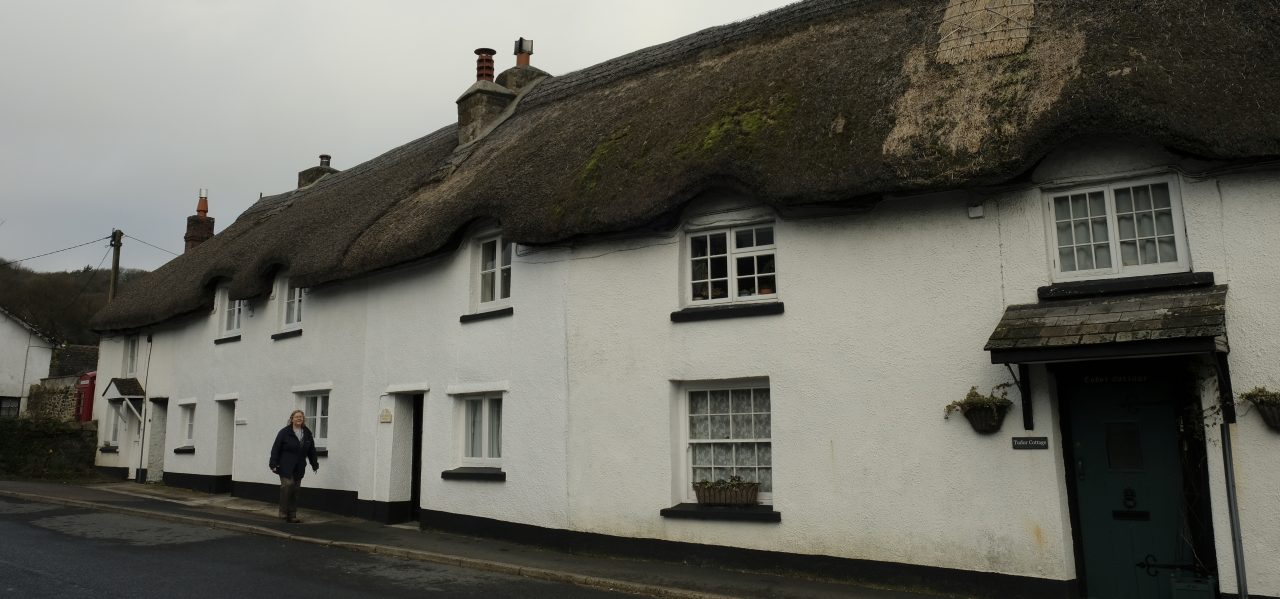
Silverlake is the third house on the left
There is some hint of a family scandal here, as on paper Susanna appears to be William’s half-sister, sharing the same father, Isaac Finch, but I am sure there is a good explanation. My guess is that her mother Mary was pregnant by her previous husband or perhaps had actually had the child before Isaac Finch married her. It may be possible in the future to find out more exact dates for these events to clarify.
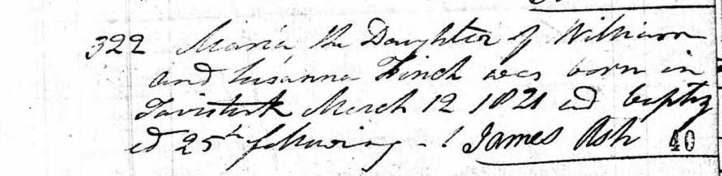
Back to our #52 ancestors Legend – it is highly likely that Susanna Finch was the women who walked from Sticklepath to Tavistock carrying a bag of tools for sale in the market there whilst heavily pregnant. Their first child Maria, was born in Tavistock on 12 March 1821, (two hundred years ago), long after William moved to Sticklepath. Tavistock must have been at least 20 miles, a full day’s walk. No one would consider walking to Tavistock these days let alone when heavily pregnant and certainly not with a load of tools!
The implication that she walked straight back again however is unlikely given that we have Maria’s baptismal record, showing she was baptised by James Ash in Tavistock 25 March 1821:
England & Wales Non-conformist and Non-parochial Registers 1567-1936. Piece 0341 Tavistock Wesleyan 1808-1837 accessed via Ancestry.com Jan 2021
William had connections in Tavistock so it may have been that Maria chose to go to Tavistock for some reason, such as a relative or highly respected mid-wife. She may well have had a hand cart and perhaps did not go alone. I suspect we will never know any more details.

 Sticklepath a Village and its People