
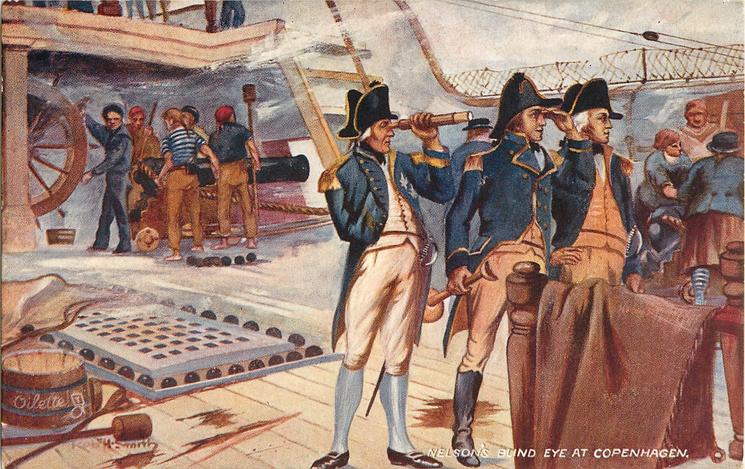
As children we went to visit friends in Gosport, and the highlight of the trip was an adventure on board HMS Victory. I seem to remember being horrified that sailors needed to tap their biscuits to clear the weevils, hated the idea of slings for sleeping, and trying to imagine being Nelson, one eye, arm in a sling, trying to handle a telescope with the other. (The horrors, other than a dread of sea sickness since even car journeys were a challenge for me at the time, clearly didn’t invade my romantic adventurer’s head).
Perhaps the most famous British sea battle and Vice Admiral, the battle of Trafalgar took place on 21st October 1805 off Cape Trafalgar, lasting about 5 hours. Contrary to usual practice Nelson divided his 26 ships into two rather than make one line to face the Spanish and French. His famous message, signalled from the flag ship was ‘England expects that every man will do his duty.’ Many lives were lost both in the battle and the storm that followed. Napolean’s fleet of 33 was virtually annihilated with 17 of the ships captured. Reports suggest 4,400 opponants dead, 3,300 wounded and 450 dead with 1,250 wounded on the British side out of about 50.000 men involved. A sniper mortally wounded Nelson in his chest/shoulder and he was forced to retire to his cabin, but is said to have known that it was a great victory.
So how did we in England get the news?
No email or even telegram. As already mentioned a great storm followed the battle so it wasn’t until 5 days later that Vice Admiral Collingwood was able to order Lieutenant Lapenotiere to set out to deliver his dispatch to the Admiralty in Whitehall. Expediency was necessary. The HMS Pickle, a fast schooner, was beset with trials – rough passage such that the guns had to be thrown overboard, then be-calming. On reaching Falmouth, Lapenotiere would have taken the first possible post-chaise express carriage, perhaps throwing another booked passenger out of their seat.
His route across land, 271 miles, now commemorated as “The Trafalgar Way”, would have involved many stops – every 10-15 miles to replenish the horses and perhaps change carriages. Travelling non-stop it would have taken some 38 hours, passing through many beautiful and historic places. And … yes you have guessed, Sticklepath was of course one of those. The total cost of the journey is said to have been £46 19s 1d, equivalent today to more than £4,500! His journey from Devon 215 years ago took place on 5th November – perhaps he will have witnessed some bonfires along the way? He presented his dispatches at 1 am on 6th November – a great victory but he was also reporting the deaths of Lord Nelson and so many men.
Sticklepath’s Trafalgar Way Plaque with painted celebratory flags can be seen on a small building opposite the Devonshire Inn. This building apparently used to be the village candle factory, using tallow from the bone mill to make candles, many of which were used by Ramsley Mine.
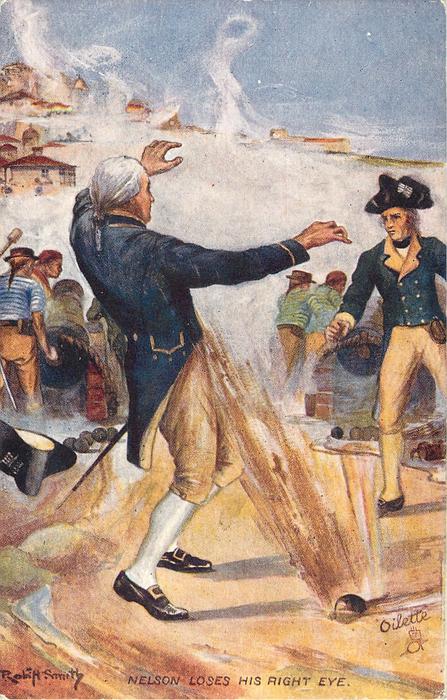
Horatio Nelson was born in in 1758 and joined the Royal Navy at the age of 12. He lost the sight in one eye in fighting off Corsica and his arm in an attempt to conquer Tenerife. The 20 year old Nelson had been stationed in the West Indies, in Jamaica, and was befriended by powerful slave owners. More than 25 years later, like many Naval officers, Nelson was out of step with the growing abolitionist views. Sadly, in 1805, well before his great battle, Nelson wrote to a wealthy slave owner of his strongly anti-abolitionist views from that same cabin on board the HMS Victory.

In 2020 we are powerfully aware of the horrors and injustices of the slave trade (or perhaps we are just now beginning to see ‘the tip of the iceberg’ of slavery and its on-going impacts?) Not only have my own views about the many gruesome aspects of wars ‘grown up’ but a very different, more balanced and perhaps more nuanced view of history, our ‘heroes’ and victories is long overdue.
The National Archive’s Trafalgar Ancestors database lists all those who fought in Nelson’s fleet at the Battle of Trafalgar. This includes about 1/6th of those serving in the Royal Navy and Royal Marines at the time. It includes Jane Townshend, the only woman shown to have served at Trafalgar and men who it is noted were born in a wide range of countries of Africa, America, West Indies, India, and most countries in Europe. It also explores in more detail the “complex and contradictory personal character traits and qualities” of Nelson.
Illustrations
tuckdbpostcards.org shows a huge range of historic postcards, reflecting both the technology and attitudes of the time. Those used above are from a set of 6 oilettes “Eventful Nelson Incidents” from 1906. Information about the postcards is copyright hence individual references. The three used here are: https://images.tuckdb.org/postcards/images/000/120/906/extra_large/20110826153048.jpg Nelson’s Blind Eye at Copenhagen
https://tuckdbpostcards.org/items/68684
https://tuckdbpostcards.org/items/68679
References


 Sticklepath a Village and its People