How family trees grow to forests! Following Francis Hellier through the census and beyond…

One of the first things I am doing for my ‘One Place Study’ is following people through the censuses and trying to understand the relationships.  I particularly like it when I knew the more recent family members or can find something to bring the family to life.  The focus here is on Francis Hellier. It is very much a work in progress…

Francis Hellier was born in 1873 in Sticklepath.  In 1881 we find he is a ‘scholar’ aged 8, living with sister Elizabeth aged 3, brother William aged 5, sister Mary aged 11, brother Joseph an 18 year old working at the Edge Tool factory.  His father Joseph aged 53, is an agricultural labourer and mother Ellen Smith, originally from the New Inn, Drewsteignton, aged 46.

Following the census through we find 9 children of Joseph and Ellen. However the 1911 census tells us that Ellen had 15 children of whom 5 had already died. Further investigation is needed!
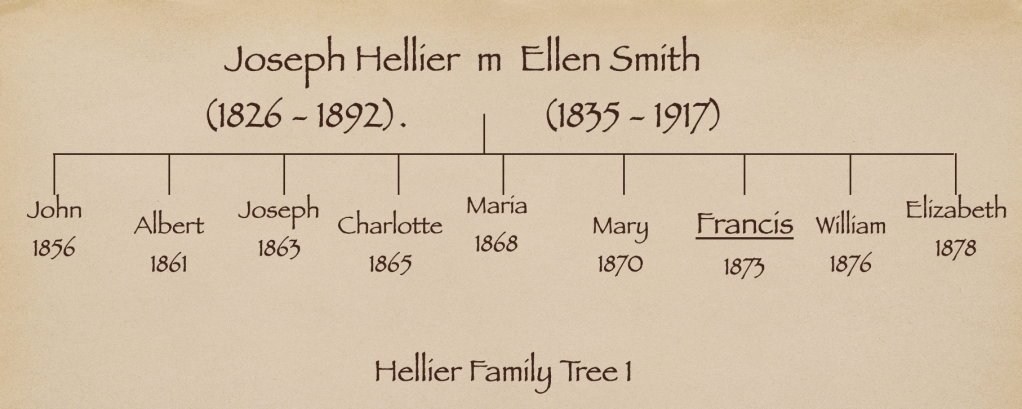
Hellier family tree so far from census information

By 1891 both Francis and his father Joseph are copper miners, and brother William, at 14, is a stone cutter.   Brother Joseph, still a blacksmith, has married Alma Grace Curtis of Northlew and lives 3 doors down the street. The census suggests the two households are living either side of Sticklepath Methodist Chapel. Joseph and Alma go on to have two children, Joseph and John who both emigrate to America.  Joseph (junior) returns to marry Mary Ann Hamlyn Counter of South Zeal and whisks her away to America, but sadly dies in 1926.  Mary Ann has returned by 1939 when we find her living with Elizabeth Blanche Counter – later Blanche Wonnacott.
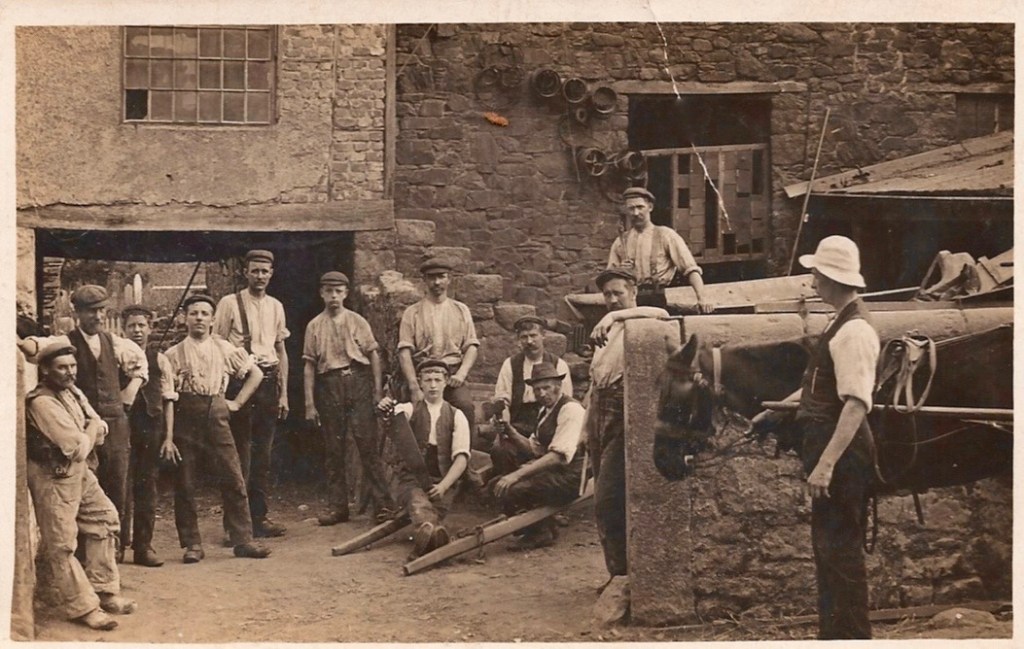
Joseph Hellier blacksmith is one of these Finch foundry workers.

1897 brings major life events for Francis with marriage to Ellen Louisa Coaker and the birth of their first son Frank. On census night 1901 their 2 room house in Sticklepath has 6 occupants.  One of Ellen’s 11 siblings, Alberta aged 12 is staying and two more children, Ernest and Ellen Louisa have been born.  Francis’s work is still copper mining ‘below ground’.
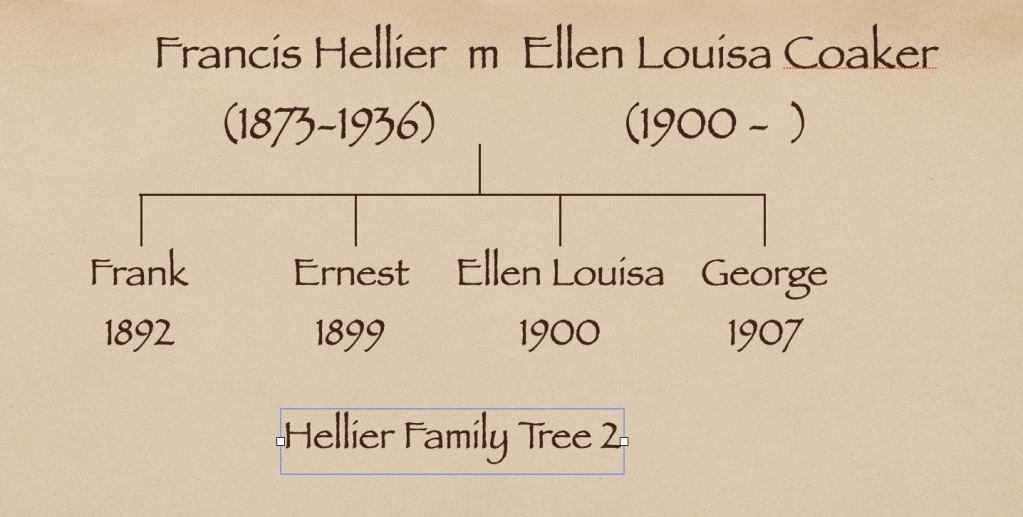
After a gap of 7-8 years another son George is born, bringing their total to 4 children.  It is helpful that the 1911 census tells us that they had not had any other children or infant deaths. The family by then are living at Skaigh Cottage in Belstone, Francis is working as an agricultural labourer again, and the 13 year old Frank is a jobbing gardener. We await the 1921 census for more information about Francis prior to his death in 1936. 

Sons Frank and Ernest both went to war. Frank returned but Ernest, a Private in the 3rd battalion, Norfolk regiment, died aged 19. He was drowned when his transport ship HMS Aragon was torpedoed in Alexandria Harbour on 30 Dec 1917.  I think Frank married Nora Helen Cooper of Willey ( a hamlet close to Sticklepath) and by 1939 they had moved elsewhere in Devon. Their younger brother George Hellier, a farm labourer married Dorothy Wilkes in 1933 and they are living in Skaigh Cottage in the 1939 census with their son Francis G Hellier a 5 year old already at school. 

Turning finally to Francis and Ellen’s daughter, Ellen Louisa Hellier.  She married a young man who was originally from London – Albert Thomas Stead, later Sticklepath’s postman, known as Tom.  I wonder how they came to meet?  In 1939 Ellen is living opposite the Methodist chapel in Farley Cottage, I presume Tom had already gone to war and their son Bert’s entry (presumed) is not yet visible. They lived at White Rock Cottage on Back Lane Sticklepath opposite the Finch Coal yard in the 1960s when I knew them.  
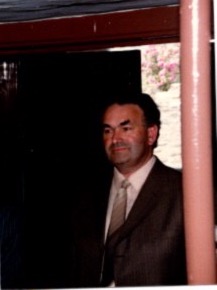
Bert 1986 (at my wedding).

Census documents give us so much information but a little personal knowledge brings their story to life, and reminds us how much we miss with only a 10 yearly snapshot. In 1935 Bert was living in Skaigh Cottage Belstone with his Grandfather Francis.  It was the year he started school in Sticklepath.  I would like to quote his words from “The Book of Belstone”  p162 he says about Francis and Skaigh Cottage:

“He worked at Vitifer and Golden Dagger tin mines, then at Ramsley copper mine before coming here from Cleave Mill Cottages.  If he forgot to dig vegetables for Sunday he wasn’t allowed to get them on the day.  When we had a joint, the meat was always for the men, veggies and gravy for the children, then maybe a piece of suet pudding with treacle. There was a copper at the side of the house, a cauldron with a wood fire underneath where the washing was done.  That water came from the old Greenhill Mine leat which ran through the garden; Uncle George fitted a wire mesh over the pipe to stop the sticklebacks getting through.  I collected drinking water from Lion’s Mouth.” The Book of Belstone Chris and Marion Walpole 2002

Starting with one individual, Francis Hellier, in the 1881 census, we have rapidly linked the Hellier family with the Smith, Curtis, Counter, Wonnacott, Coaker, Cooper, Wilkes and Stead families. With Francis one of nine siblings it is easy to see how one family is quickly related by marriage to many others – we have only looked at a few of them. What is also striking is the connection to so many surrounding villages and hamlets – Willey, Belstone, South Tawton, South Zeal, Drewsteignton etc. Next time – a Hellier-Bowden marriage.
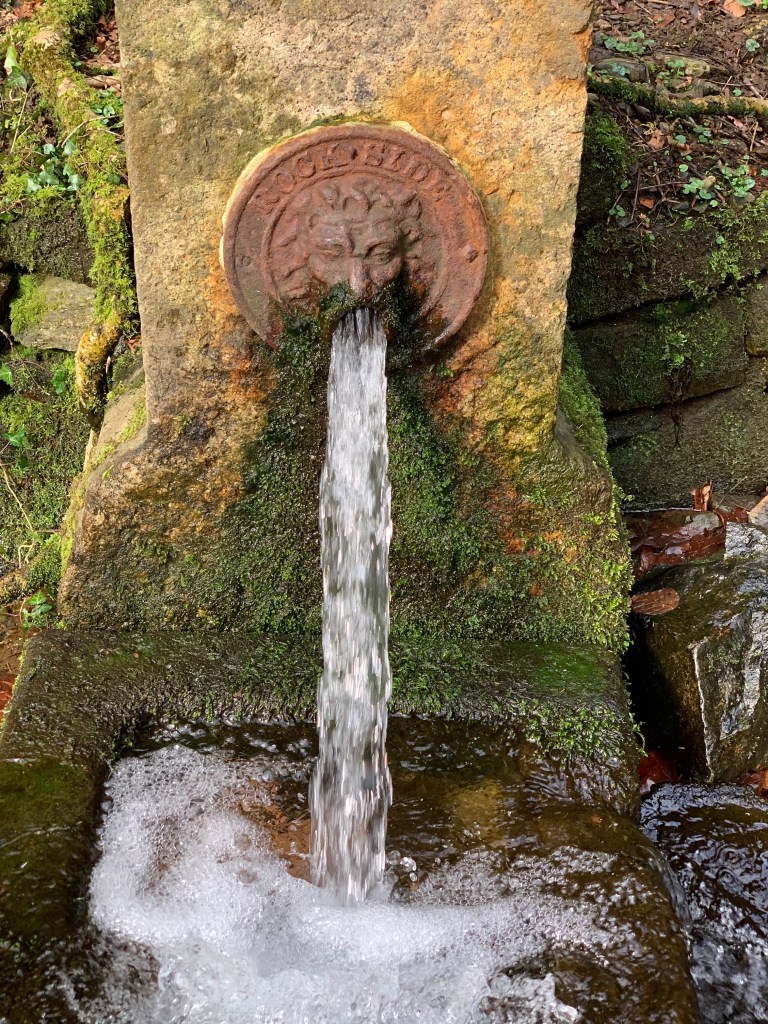
The Lion’s Mouth

If you spot any errors or have any further information, especially documents or knowledge of sources that can help me further or photographs, please do get in touch!

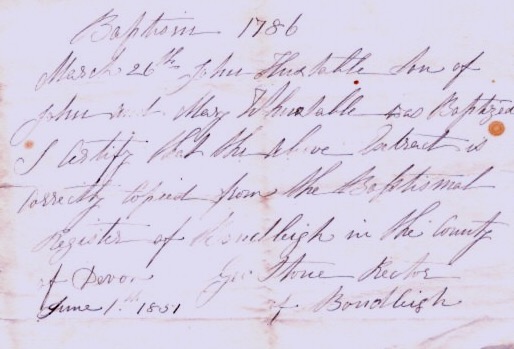
Precious Papers

How old are the most ancient baptism certificates you possess?

I have two certified copies of baptisms, one baptism was in 1818 and the other in 1786. So what you say – we can all order certified copies. These however were written in 1882 and 1851 respectively. Why I wonder might they have needed them?

John Huxtable my 3x Gt Grandfather was baptised on 26 March 1786 in Bondleigh, the son of John and Mary (?W) Huxtable, certified copy of the register entry written out by Geo Stone Rector of Bondleigh 1 June 1851.

It seems very likely this was to prove his age in order to claim his pension. That was 5 shillings for a single person or 7 shillings for a married couple.

The certified copy baptism certificate for his daughter Kezia Ellis Huxtable born 18 Oct 1818, daughter of John and Kezia Huxtable, and older sister of my 2x Gt Grandmother Eliza Ching was written out in 1882. I would suspect this was also acquired in order to prove she was above pensionable age.

Note the one penny stamp given in payment to validate it, signed by the rector Edw R Theed. He clearly took considerable care to draw the pencil lines with his ruler to keep it neat! He gives the page number (17) and the entry number (129).

I suspect it was the third Kezia, Kezia Huxtable Ching, Eliza’s daughter who carefully preserved and passed them on.

What is the oldest original (or almost original) baptism certificate you have in your possession?

Please note I would love to see family trees and copies of any certificates or documents relating to anyone who has ever been a Sticklepath resident. Certificates are very helpful for constructing and proving family connections, and looking at prevailing causes of death.

Letters paid for in Bacon! Sticklepath’s Post Office Dynasty

Studying a village and its inhabitants is rather addictive. There are lots of possible avenues to explore. I have made a start looking at households in the 1841 census. However I also have started a list of some of the burials in the Quaker Burying ground. Some people appear in both. One of those is John Cann, buried 25 October 1868 aged 61. This is ‘Part One’ of the story of John and Mary Cann, focussing on the post office:

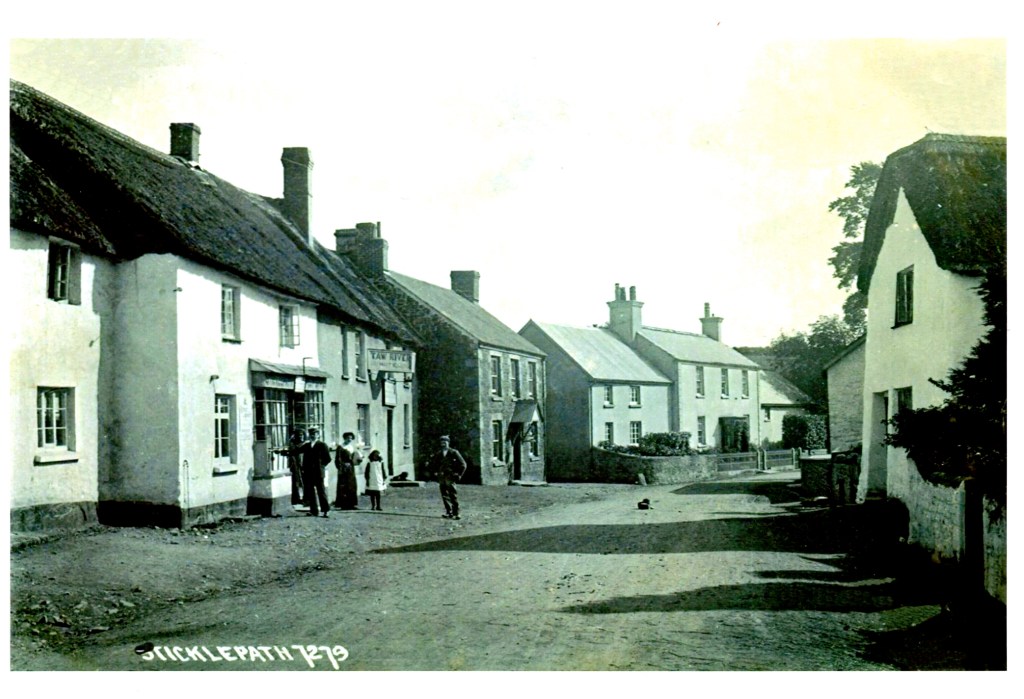
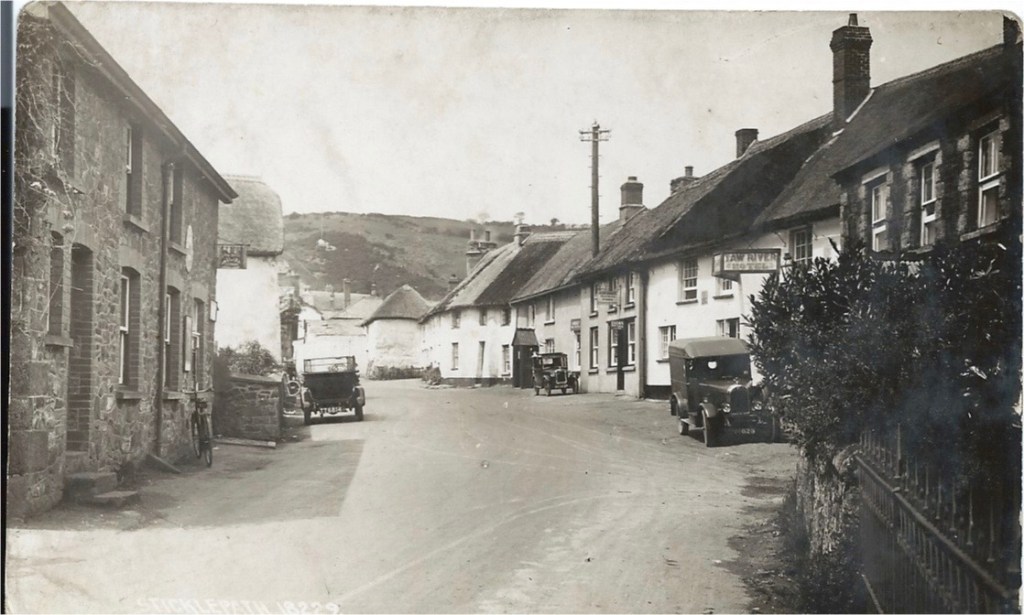
Chapman postcard ?1900-1903 Yew Tree Cottage is the first white cottage on the left side

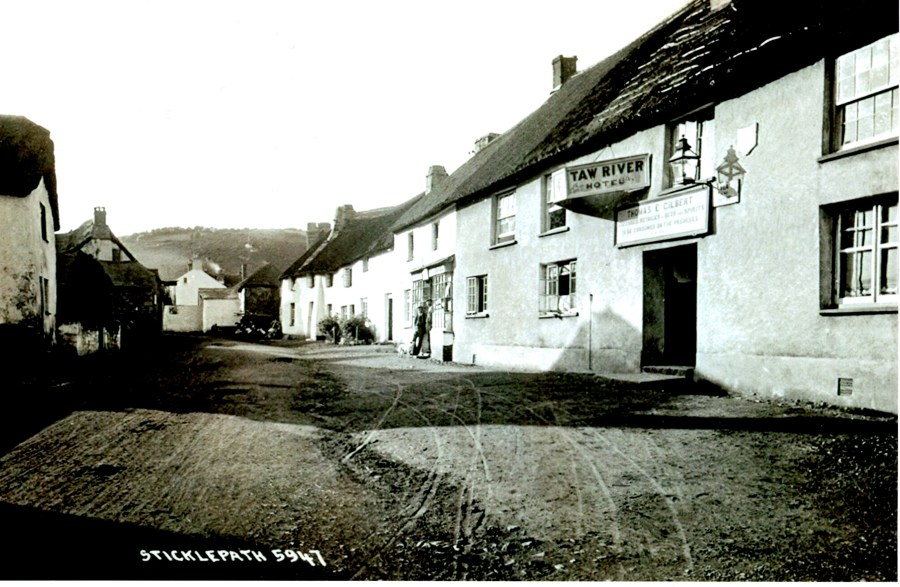
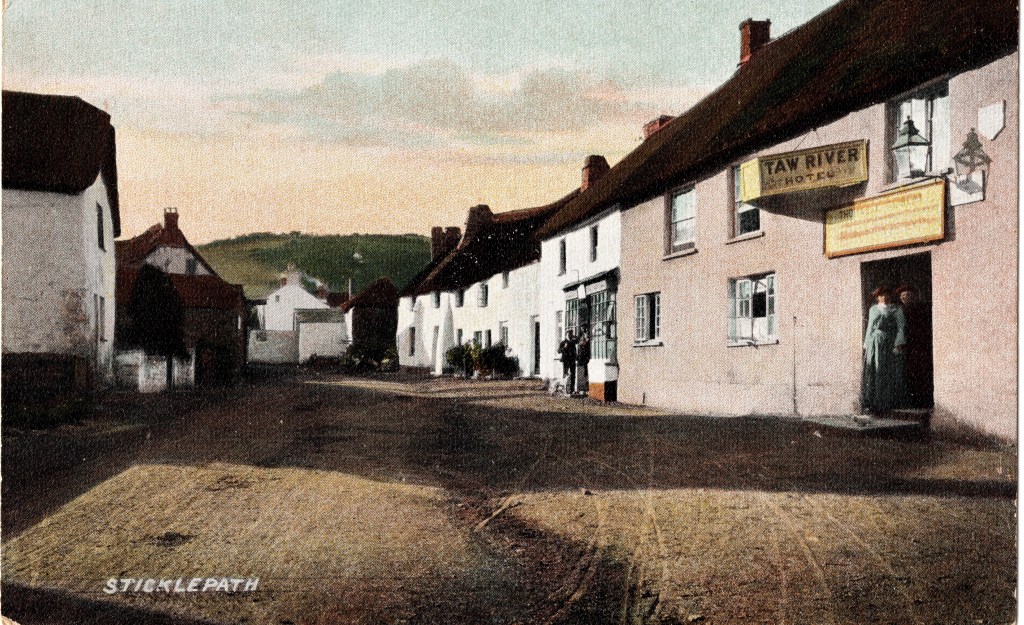
John Cann, a blacksmith, and his wife Mary opened a Post Office in Yew Tree Cottage, Sticklepath in 1828, then a 4 roomed thatched cottage, opposite what is now the Taw River Inn. The same house had reputedly belonged to Bill Brewer previously (of ‘grey mare’ fame), and at some point was a bake house, as large ovens were removed in the early 1950’s.

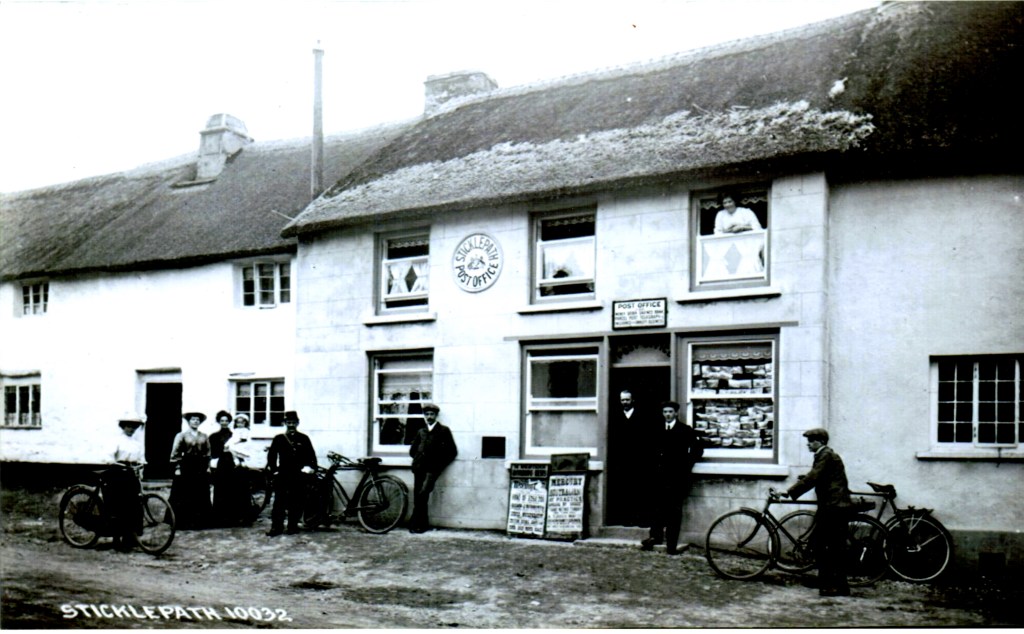
Chapman Postcard. Thatched cottage on the right is the Cann’s post office, the people are standing in front of ‘Sunnyside’ the next post office. Later moved to the two cottages further away on the right and later was in the village shop on the left side of the road again, the dark
building in the centre of the photo. Photograph around 1905?

Uniform pre-payment for letters was not introduced until 1839 and the famous penny black stamp in 1840. Before that, when it came to receiving mail, not everyone could afford to pay cash for the letter they received. Payment in kind was possible – bacon is mentioned as an option. Otherwise the letter would be sold to a neighbour who would no doubt enjoy being first with the news!

The Western Times newspaper tells us that Sticklepath sent and received post daily via the ‘Falmouth Mail’ coach from Exeter during the 1840s. Mary would hand the letters through the bedroom window or hang the sealed bag outside the window, where it would be picked up and exchanged for any in-coming mail.

In 1955 Sticklepath women’s institute booklet ‘The Story of Sticklepath’ reports that one day Mary “inadvertently sealed up her snuff-box in the out-going bag, but it was rescued in Exeter and returned to her.”

Chapman Postcard, Sticklepath Postoffice at Sunnyside perhaps 1910-1915

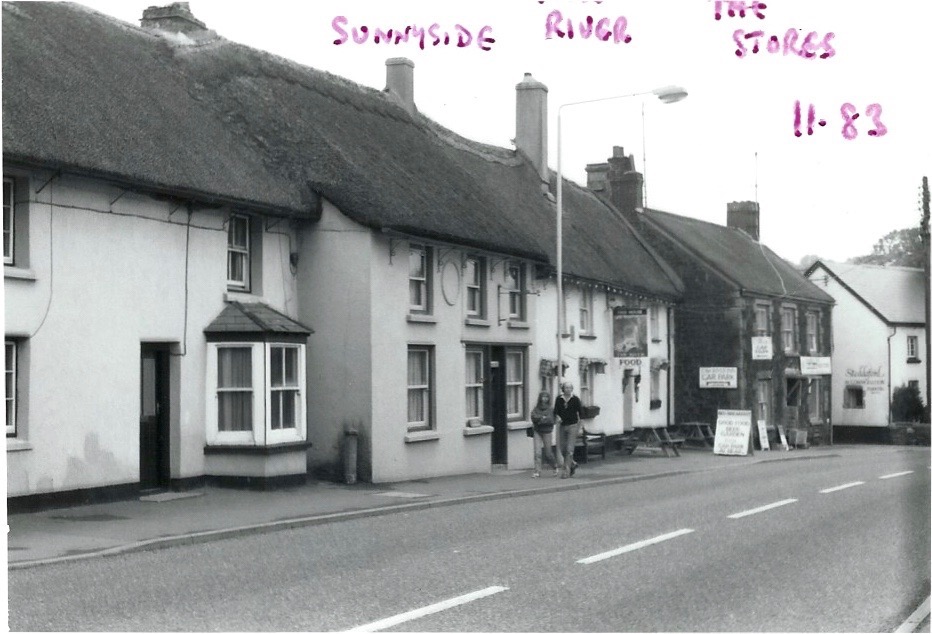
Sticklepath Post Office was run by their descendants for 112 years, often with family members as postmen. John and Mary’s son-in-law Richard Yeo took over as sub-postmaster, at Sunnyside on the opposite side of the road, followed by his son John who I suspect had the post office back at the other side of the road in one of the two cottages belonging to Steddefords, opposite the present village shop. Shop signs can be seen there on postcards of the time.

The Post Office moved between the two cottages immediately on the left.

The Exeter and Plymouth Gazette, Friday 20 September 1940 reports that Miss Mary Yeo, (known as Pollie), postmistress for 17 years and one of the oldest residents of Sticklepath at the time, was retiring. Her brother Sidney Yeo, rural postman was also to retire after 25 year’s service. I suspect they were the last of the family in Sticklepath to bear the Yeo surname too.

Sunnyside 1983

For those researching family history, there are no post office records of sub-postmistresses or even postmasters, though they had to be formally approved. However, there is a chance postmen, direct employees of the post office, will have surviving employment records.

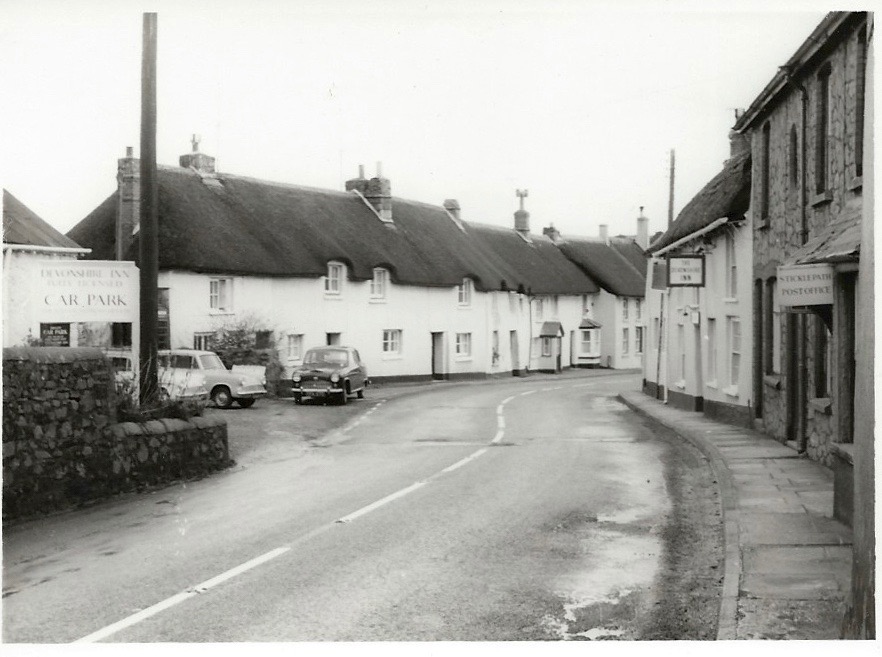
Eddington Cottage as post office, before there were pavements on the left. ?date

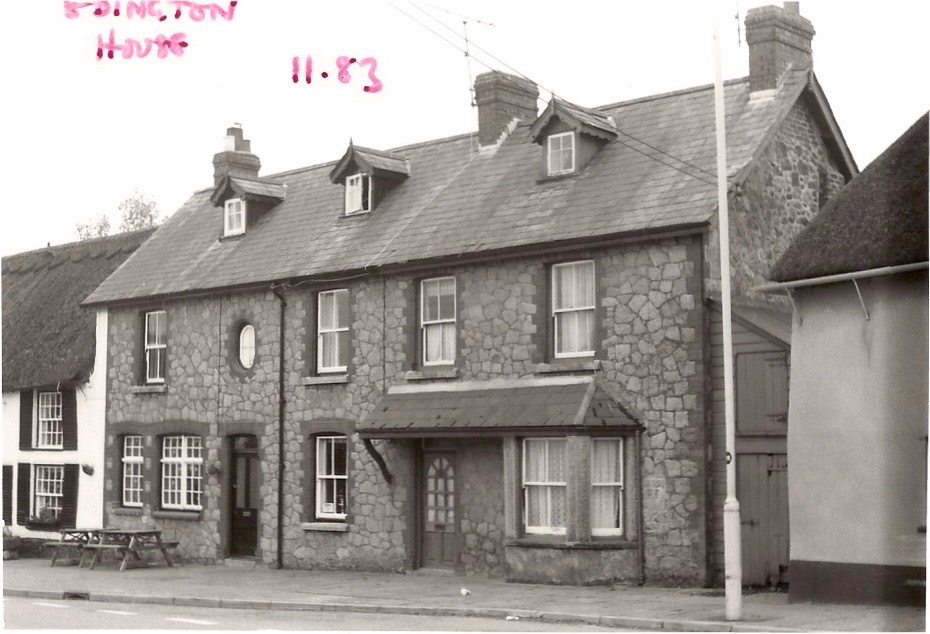
Sticklepath post office then moved to Eddington Cottage under William Brock. In the 1960s-70s the post office and general store was run by Miss Gladys Ogilvie, from the front room of Eddington Cottage. Perhaps someone can fill me in on it’s movements since then?

Eddington Cottage 1983 (with bay window)

Part 2 will follow the family through the census and find out more about Mary and her history…

Photo Village Shop 2018

This ‘One Place Study” of Sticklepath is just starting. Anyone able to contribute stories, photos, facts or documents would be welcomed. (We avoid mentioning living people other than as sources of information or photos). Comments are welcomed, here or on facebook or email: shields_h_f@hotmail.com