Week 10 of Amy Johnson Crow’s challenge to write something about an ancestor each week (OK for you keen-eyed I have got a bit out of order!)
Jessie Finch was born on 3 December 1860, to George and Rebecca Finch (mother’s maiden name White), George was 26y and Rebecca 36y. She was baptised in Okehampton Wesleyan Methodist on 10 December 1860 (transcript seen on FindMyPast). The birth was registered in Okehampton in January 1861 (Vol 5b p397). She was 4 months old on census night 7 April1861.
Her brother Albany George was born on 28 November 1863 in Sampford Courtenay, Devon, when Jessie was almost 2 years old. In total she had two older brothers and two younger, one older sister and one younger. By 1871 she is a scholar aged 10. In 1881 she is still living with her parents and is a dress maker.
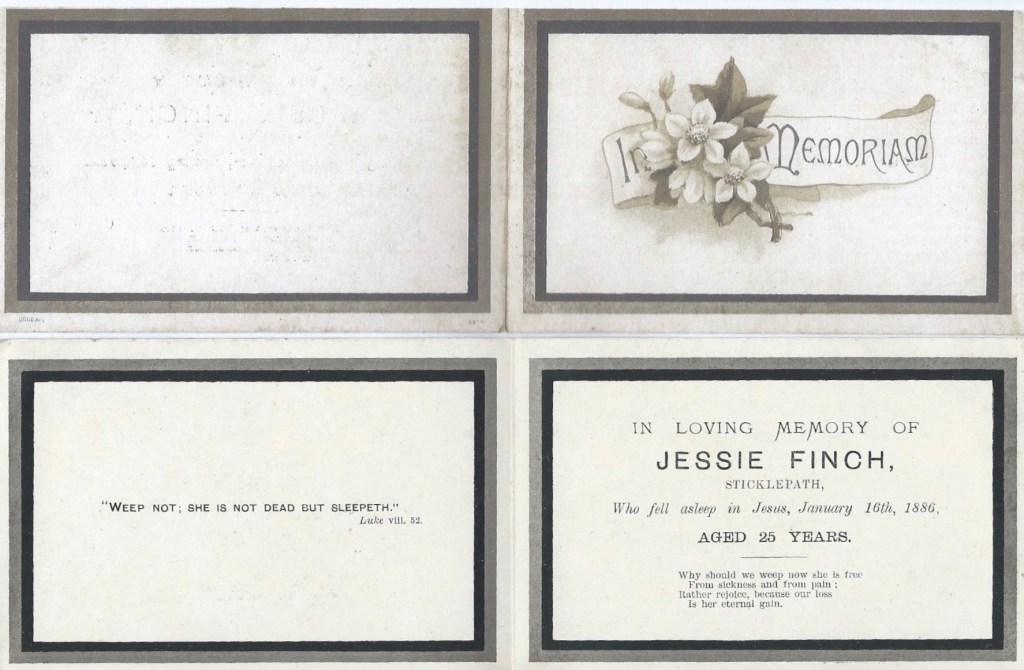
Sadly Jessie died of consumption (TB) in 1886 aged 25 when her niece and namesake little Jessie was almost 1 year old. For some reason two different memorial cards were produced:
Certainly the little verse used suggests she had a fairly difficult time during her illness.
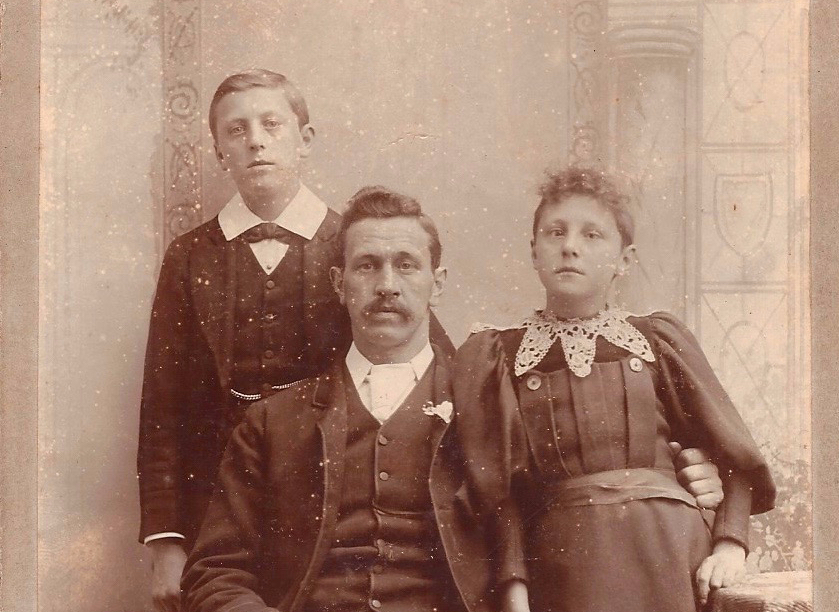
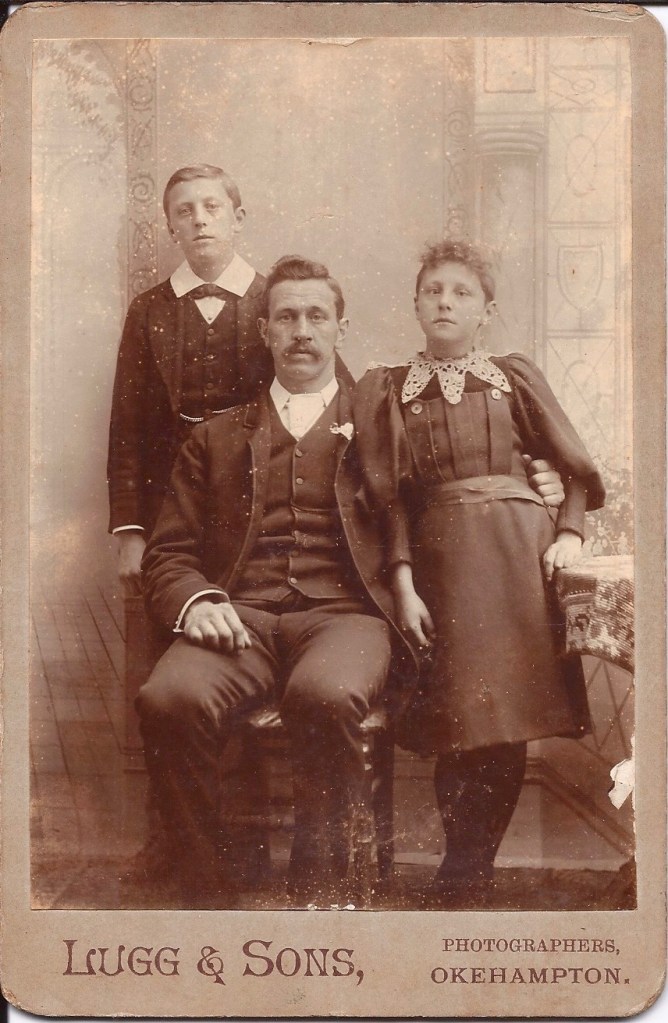
The second Jessie Finch was Albany’s daughter. Born in January 1885 she was the daughter of Mary Trace, Albany’s first wife. I wonder why she was named after her Aunt? Was the Aunt already sick by then? Here is a picture of Jessie Emma Finch (later Barron) with her father Albany and brother. This Jessie led a long and fruitful life much of which was spent in Sticklepath. She died in 1973 aged 88y.
My #OnePlaceWednesday contribution for #OnePlaceStudies at #Sticklepath #SticklepathOne
Thanks to a fellow One-placer I was prompted to search the Red Cross website for the names of Sticklepath volunteers. One of the two found is Amy Beatrice Prickman. That made my ears prick up (sorry!) because I have come across that surname many times before, though not as a resident of Sticklepath. Rather the visiting Coroner who held inquests in the Taw River Hotel or Inn. My aim is to research each resident of Sticklepath from about 1750 to 1970. So I set about finding what I could about Amy Beatrice.
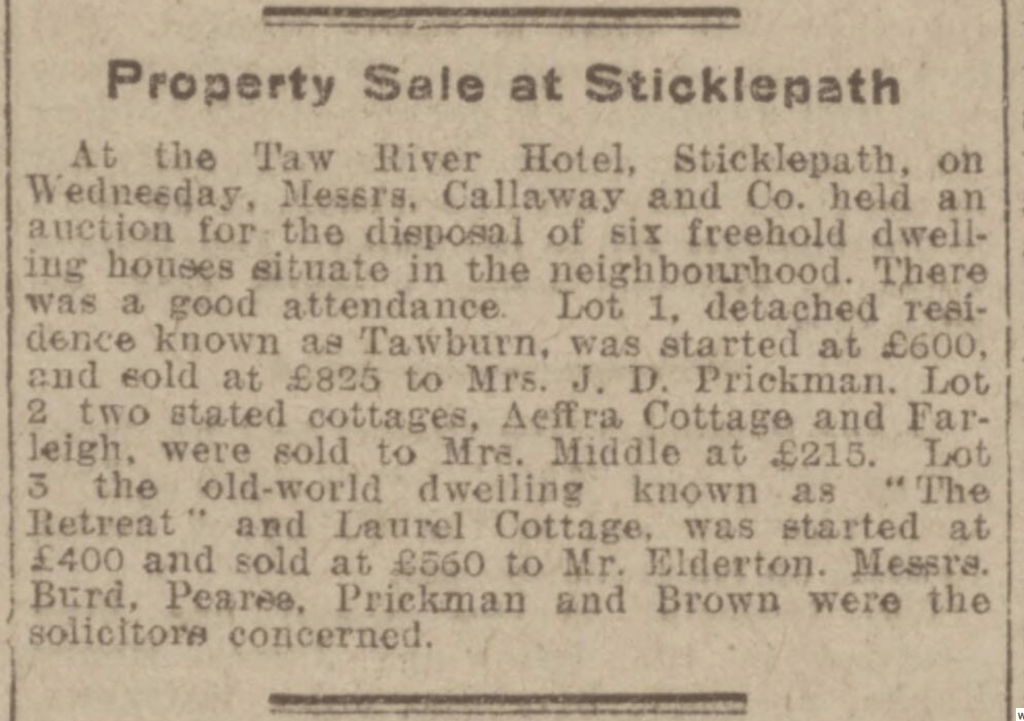
Research shows she was indeed the wife of John Dunning Prickman, Okehampton Solicitor and Coroner of Devon. His second wife in fact, with no children (his first wife Mary Hatton died in childbirth). J.D. will feature in future posts. Here, I will just comment that as a married woman the husband’s income, wealth, and status made a great difference to the opportunities offered to a wife or widow. Amy Beatrice was a woman of considerable wealth following her husband’s death in 1913, demonstrated in her purchase of Tawburn House in Sticklepath. Advertised on Thursday 5th April 1917 in The Western Times (Exeter) as a Stone-Built Detached residence in the occupation of Mrs Mesney, with “3 reception rooms, 7 bedrooms, bathroom and the usual offices, ample out-buildings and large gardens”. We get an update on Friday April 13th 1917:
and when she came to sell her belongings, just 3 years later, it was clearly an amazing auction!
Advertised widely, including in the North Devon Journal – Thursday 22 April 1920 (all newspaper reports accessed via the British Newspaper Archive) For sale on ‘Wednesday next’, 28th April:
TAWBURN HOUSE, STICKLEPATH. CALLAWAY and CO. have been favoured with instructions from Mrs. J. D. Prickman to Sell by Auction, the Valuable FURNISHINGS, including Mahogany Music Canterbury, Arm Chair in Morocco Leather, Chesterfield, Couch Crotonne, Oak Table with Brass Drop Handles, Axminster Carpet, Bookcase, Water Colours, Engravings, Old Oil Paintings, Bronze Candlesticks and Horses, 2 Oriental Jugs, Sideboards, Buyer’s Tray, Handsome Inlaid Sheraton Drawing-room Chair, Antique Stuart Writing Bureau (dated 1662), Oak Linen Press, Beaten Brass Trays, Oak Bookcase, Oak Book Trough, 4 Oak Chairs with Rush Seats. 3-tier Inlaid Walnut Whatnot, Rosewood, Walnut, and other Occasional Tables, Walnut Armchair in Silk Tapestry, Oak Card Table, Wicker and other Arm Chairs, Copper Coal Vase, Iron and Brass Ditto, Oak Hall Chairs, Carpets, Rugs, Tables, Bedroom Suites, Curtains, Baskets, Bedroom Ware, Dinner Services, very fine Jug by Martin Bros., Antique Doulton Teapot, Venetian Bowl and Vase, Zolnay Vase, quantity Pattern Dishes, Blue and White Tea Service, Minton Jug, quantity of Cut Glass and other Glass Ware, China, etc quantity old Pewter, including Inkstands, Salvers, Plates, Measures, Mustard Pot, Salt cellars, etc.. Plated Entree Dishes, 5 Pair old Brass Candlesticks, 2 Pair Copper Ditto, Plated Spirit Stand with Cut Glass Bottles, Inkstand, centrepiece, Plated Fruit Stand, Egg and Toast Rack Silver Inkstand, 2 Plated Butter Dishes. 2 Silver Mounted Decanters, Silver Plated Strawberry and Cream Dish with Doulton Ware Dishes, fine collection of Books, songs and Music, quantity of Antique and other China, Quantity of garden Tools and Plants, and several other lots. Catalogues. 6d. each. Sale at 12 noon.
The electors registers says she lived at Burnside not Tawburn but I suspect she perhaps called it by the different name. I am not aware of another house in Sticklepath called Burnside. Unfortunately she only lived in Sticklepath between census recordings. I think it is unlikely she was still there in 1921 though she may have lived in Sticklepath prior to her purchase of Tawburn.
Her life has been researched using records from Ancestry and Findmypast. Amy Beatrice was one of the daughters of Rev William Mutrie Shepherd (b.1832 Abingdon) and Caroline Anne Strange (b 1840 Liverpool). The GRO index confirms her mother’s surname. The Newton Arlosh Parish Register, Cumberland, shows she was baptised 16 Jun 1872. Records including 1939 register confirm her date of birth was 22 May 1872. Aged 8 she was living in St Cuthbert without Harraby, Cumberland, where her father was the vicar of St John’s, Carlisle. She had brothers Cresswell N Shepherd aged 4 and Ernest E Shepherd aged 3 years. She was a student at Carlisle and County High School for girls in 1886. By 1891 she was living with her uncle John Taylor, clergyman in Holy Orders and Schoolmaster Christchurch Parish, Tunbridge Wells, Kent along with Rev Taylor’s wife, 6 daughters, 2 sons and 9 male boarders/scholars. In 1901 she is a ‘Governess’ living at St Barnabas Bexhill, Battle, Sussex, aged 28, teaching school. In 1908 26 November, she was married at Croydon St John, apparently by her own father the assistant curate, to John Dunning Prickman. She was 17 years younger than him. In 1911 they are living at 21 Fore Street, Okehampton, with a cook and female servant from local villages. She was widowed on 13 March 1913.
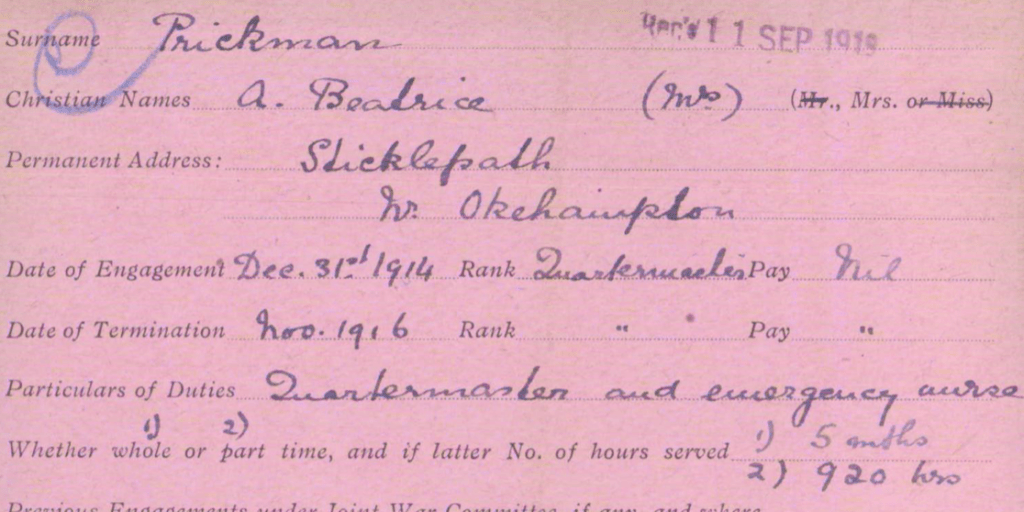
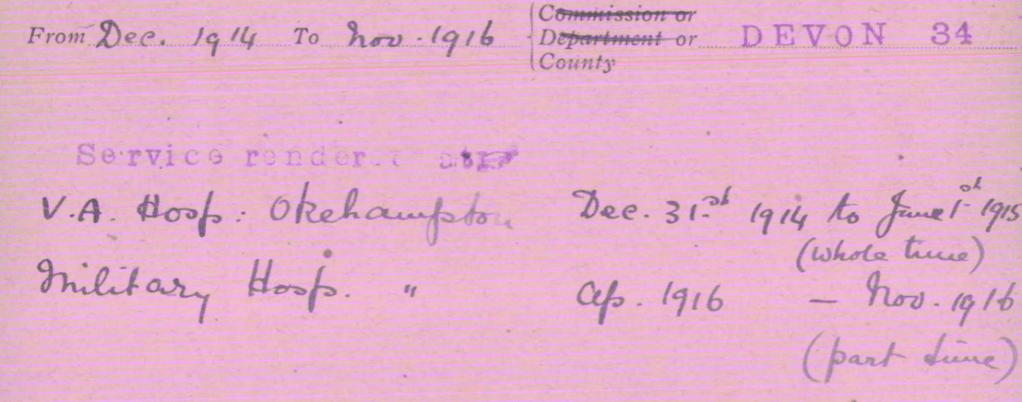
So we come to the Red Cross records, a record set I had not used before. The work of the Red Cross during World War One included running Auxilary Hospitals for convalescent soldiers and Military hospitals. Auxilary hospitals usually had a commandant, who was in charge of the hospital except for the medical and nursing services, a matron, who directed the local VADs (Voluntary Aid Detachment volunteers), who were trained in first aid and home nursing, a visiting GP, and a quartermaster, who was responsible for the receipt, custody and issue of articles in the provision store. Mrs A. Beatrice Prickman was quartermaster for the Okehampton VA Hospital from 31st December 1914 to 1st June 1915 on a full time basis. This was based in Dartmoor House Belstone.
In February 1915 the War Office proposed that volunteers could help at Military Royal Army Medical Corps (RAMC) hospitals. These had previously been staffed exclusively by army nurses and orderlies from the RAMC.
The Okehampton Military Hospital was based in Okehampton and volunteers needed several weeks training and to pass exams as well as practical experience. Mrs A. Beatrice Prickman became an Emergency Nurse at Okehampton Military hospital in April 1916 until November, completing 920 hours as a volunteer in this capacity. It seems likely that a significant amount of the time between these two roles was spent in training.
On census night 1939 she is living in a boarding house in Royal Tunbridge Wells, ‘Private means incapacitated’. We lose track of her then until her death 14 September 1964 and probate 17 November 1964 when her address is given as Rockmount Hotel Ephraim Road, Tunbridge Wells. The value of her estate £374.00.
Week 11 and still going strong, though I confess week 10 is still on its way! Over a fifth of the way through the year, so quite an achievement. This week’s post was inspired by a presentation for #OnePlaceWomen at the #OnePlaceStudies Society Webinar, by Janet Barrie, who looked at two philanthropists in her place.
That set me thinking – what philanthropic deeds have my ancestors performed? Indeed what have #Sticklepath people left behind as their ‘legacy’? Philanthropy is the desire to promote the welfare of others, expressed especially by the generous donation of money to good causes. This implies wealth such that you have spare cash ‘lying around’ to donate to worthy causes.
Unfortunately there have been few Sticklepath residents in the ‘has a fortune’ category. (There is also the question of where that money came from. I have not yet established any link between Sticklepath and Slavery other than the chapel sending a petition to parliament to support abolition). Indeed when money was raised by the village to pipe water down the street to stand pipes they held many fund raising events and mention is made that they appealed to philanthropists outside the village, as there was not an extremely wealthy land owner in the village, no Lord of the Manor to turn to.
Thomas Pearse, woollen merchant, generously bought and donated the burying ground to the village. His daughter Ellen gave the land on which the village hall was built. Donations were given to build the chapel and certainly Mr Cook the butcher contributed to the church building. Many chapel and I suspect church members gave generously in their wills as well as regular giving during their lifetime. Others gave similarly to ‘the poor of Sticklepath’, no doubt during life but also in their wills.
How else might we measure not just a desire but action to promote the welfare of others? I would argue that time is at least as valuable commodity and often ‘costs’ the giver more, with little thanks or kudos. My own relatives are among the School Governors, and certainly, whilst head of governors, Mr Cook gave a shilling to each child who had attended school regularly throughout the year and not missed a day – quite an incentive to do well! Others gave apples or milk to the school children, or provided extra lessons. Many folk looked after neighbours who were ill or in need. Others cared for the long-term sick and disabled. Bert Stead visited widely and did what he could for many. Douglas and Ruth St Leger Gordon promoted Dartmoor, including Sticklepath, in their writings, helping those in tourism as well as promoting the great outdoors which we now know is healthy. Dick, Bob and Marjorie Barron made the Finch Foundry Museum into what it is today. It is tempting to think of doctors, the clergy, policemen and magistrates who gave above and beyond the call of duty, but equally each person has the opportunity to give that extra bit for the community, Nellie Harris as school caretaker or Geraldine Marks who kept both school and chapel spotless, or earlier Ann Mallett, who my grandmother recalled would be seen daily walking up to the school with her own broom. I understand Mrs Tucker was awarded an MBE for her work in the war, but do not yet have any details.
All this of course begs another question – what do we as individuals do to benefit others outside our paid roles? Does researching and recording our history provide some sort of lasting legacy? A good question! I hope to finish a #OnePlaceWednesday blog about someone, a resident of #Sticklepath, who volunteered during World War 1 shortly… watch this space. (Also for #OnePlaceWomen).
Please do respond, or nominate others who gave for the benefit of others in whatever way. I am keen to hear of other examples and views.


 Sticklepath a Village and its People