Divination on St Valentine’s Eve – Superstitions in the West Country.

On Thursday 8th February 1934 the Western Morning News carried a column by Ruth E St Leger Gordon of Sticklepath concerning plants and flowers and their association with festivals and religious days.  Nestled between Candlemas (2nd Feb) and St Valentine’s Eve she mentions both:

“the festival Candlemas, or the Feast of the Purification, on the second day of this month, besides being rich in quaint weather lore and ” prophecies,” brings to mind at least three familiar plants. 

Snowdrop purest white arraie 

First rears her head Candlemas Daie;

and as this first of our spring blossoms, so white and spotless-looking in contrast to the still bare, dark earth, begins to be in evidence at this time, its double association with the date is plain. 

“Down with the rosemary and baies”

wrote Robert Herrick in his poem for “Candlemas Eve”, which has the effect of connecting these evergreens in our minds with Candlemas, though actually it was to their final disappearance as “Christmas decorations” to which the poet referred.” 

We still sing of the Boar’s head bedecked with Bay and Rosemary in our Christmas carols.

Regards removing Christmas decorations: in the North custom suggests it must be done by New Year or risk the wrath of Goblins; in the West Country decorations are removed by Twelfth night, 6th January, which was my childhood ‘rule’; and still others remove them by Candlemas.

As readily available evergreens, rosemary and bay were associated with weddings and funerals (Rosemary for remembrance), and were probably used on many other festive occasions too, possibly covered with scented water to enhance their pleasant smell.   She tells us Sir Thomas More said : “As for Rosemarine, I lett it run alle over my garden walls, not onlie because bees love it, but because ’tis the herb sacred to remembrance. ” 

She also mentions 

“one economically-minded individual who, upon the death his first wife, was anxious fix his wedding day with the second in order that the sprigs of rosemary and bay used for the funeral might function again in the wedding feast! “

“Rosemary and bay are coupled again in an old Devonshire charm against witchcraft. Certain herbs were to collected upon auspicious dates and times, after which, 

The paper ‘arbs is to be burned, a small bit time, on a few coals, with a little Bay and Rosemary, And, while it is burning, read the two first verses of the 68th Psalm, and say the Lord’s Prayer after.”

Bays and rosemary were also employed for divination purposes on St Valentine’s Eve.   Water of course was an essential of daily life and did not come piped. Divining where one could find water was important. She does not tell us whether this was for prophesy, divining the future or for water.  There certainly is folklore about seeing your future true love in dreams or down wells in the reflections on St Valentine’s day!  The Pastons (medieval letters) and various poets mention choosing Valentines, for example by casting a name into the fire to divine which is the one for you. The Cambridge library collection blog suggests other methods of divination:

“you could try fastening a bay leaf to each corner of your pillow, and one in the middle; then boil an egg, take out the yolk, fill the space with salt, eat (including the shell) and await developments.”

Whilst these herbs were mostly plentiful and cheap Ruth St Leger Gordon tells us that 

“the year of the great plague prices rose such an extent that “Rosemary, which had wont to be sold for twelve pence an armefull, went, now for six shillings handful”.  I wonder, have we missed a trick with Covid?

Happy Valentine’s Day!

3 Coronations and a Christmas card   #OnePlaceCelebrations in #Sticklepath 

#OnePlaceStudies Society has monthly blogging prompts. #OnePlaceCelebrations is the prompt for December 2021

In 1953 the Coronation of Queen Elizabeth II was celebrated throughout the Commonwealth. Sticklepath had a television in the village hall so all the villagers had the opportunity to watch the innovative broadcast.  

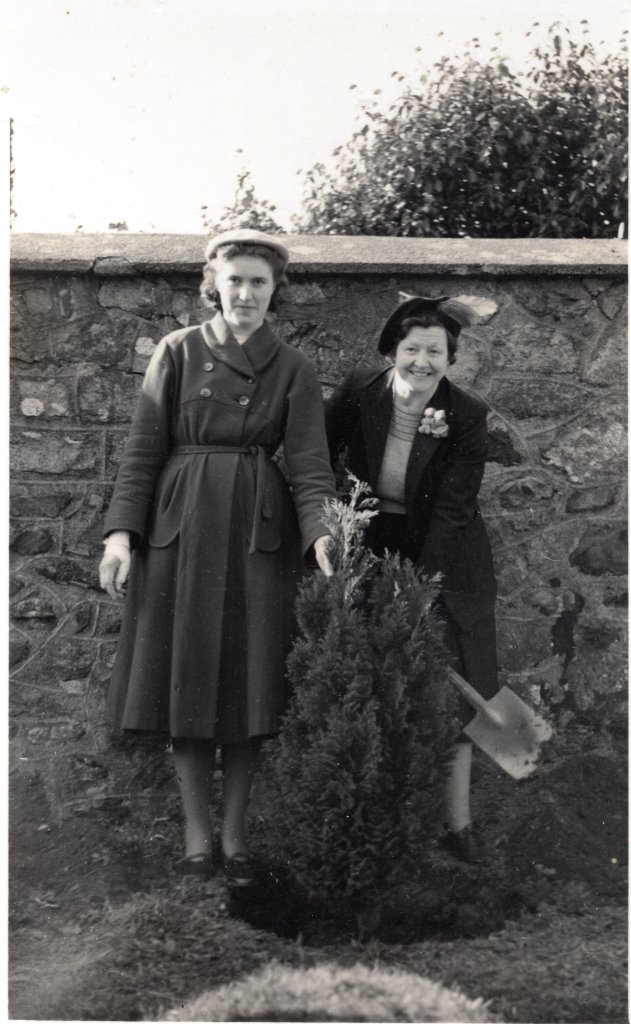
Gracie Fildew and Muriel Bowden Commemorative Tree Planting 1953

I believe there were two trees planted to commemorate the coronation.  One in front of St Mary’s Church, which was lost when the road was widened, plus this one in the burying ground. Muriel Bowden, president of the Women’s Institute (WI) is holding the spade and the youngest member of the WI, Gracie Fildew, is helping.  Unfortunately this tree was also lost, destroyed by fire.  

Church bells would have been rung in the villages all around and the sound carried to Sticklepath on the wind. For certain something would have been done for the children as well as everyone else to celebrate, perhaps a lunch or tea.  I remember my Grandmother and Great Aunt making huge muslin tea bags to go in the extra large teapots used for such events.  All the extra sugar bowls would have been washed and polished in advance, alongside crockery and cutlery.  Elaborate plans would have been in place for sandwiches, cakes, and scones with clotted cream and jam, mainly by the ladies of the Women’s institute. 

Sticklepath WI tableau of Queens – Can you name them?

This tableau would have been part of an afternoon or evening entertainment, with readings and poetry, singing and other musical interludes as well as the National Anthem whilst everyone stood to attention. I can recognise some but not all of the queens and the actors!

It would have been a happy and exciting but long and tiring day.  You can imagine all the washing up, clearing and cleaning and moving of chairs and tressle tables afterwards.  

Tressle tables set up for a Christmas party in the Village Hall, perhaps late 1950s

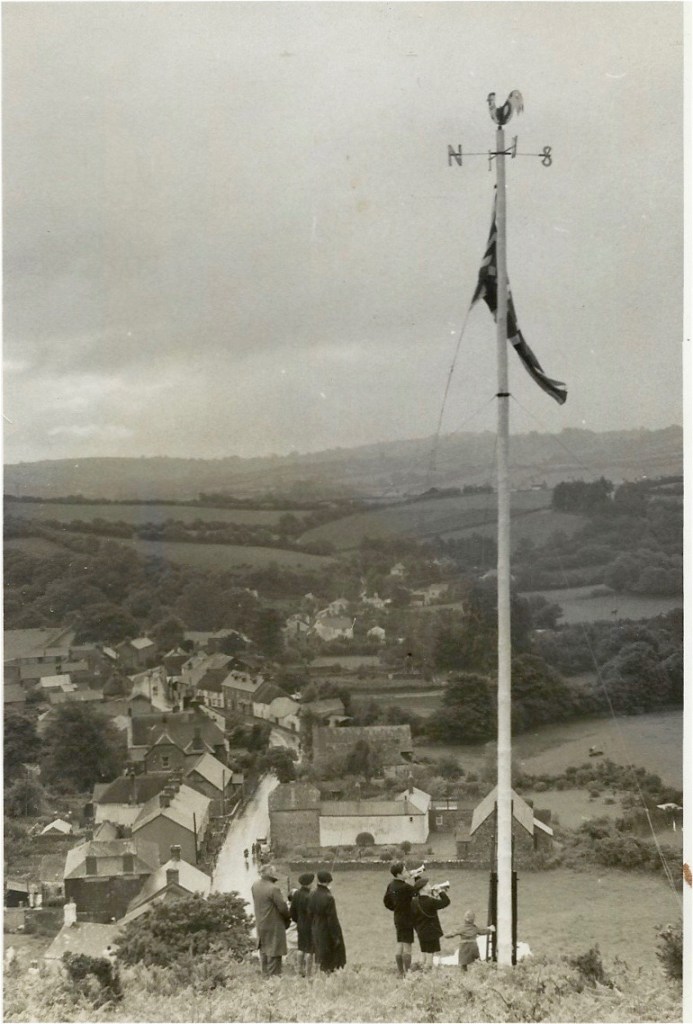
The flag on the hill looking down over Sticklepath, next to White Rock where Wesley preached, would have been flying high.

The Flag Pole above white rock looking down over Sticklepath

Looking back to 1937 the Exeter and Plymouth Gazette tells us in April that permission had been given for a bonfire on the common above White Rock to celebrate the Coronation of George VI and his Queen Elizabeth.  Latex balloons became popular in the 1930s so it is likely there were balloons at the village celebration.  I wonder if anyone has any photographs?  This was the first coronation to be filmed live for television and the first outside broadcast. However no cameras were allowed inside Westminster Abbey.

For the third Coronation we take a step further back in time again: 22 Jan 1901 Queen Victoria died.  The Coronation of Edward VII and Alexandra was planned for 26 June the following year.  Local events too were all planned and booked, but at the last minute the King got an appendicitis-type problem, so everything had to be delayed until 9 August.  Imagine the committee members stress and the concerns for the King!  Many sued for loss of rental income from those who had booked at high prices to stay in London for the event. 

On 12 August The Western Times reports that the Coronation celebrations in Sticklepath were carried out in “loyal manner”, commencing with a service in Sticklepath Wesleyan Methodist Chapel conducted by the Rev James Finch at 2.30. I am sure the children would have all sat still under his beady eye!

Rev James Finch just 5 years later when Superintendant Launceston Circuit.
Originally a Sticklepath boy, this photo was a Christmas greeting card, documenting all Rev. James Finch’s chapel appointments as a minister.

The itinerary at Sticklepath continued: At 3.30 there was a distribution of Coronation medals to all children under 14 with tea for them at 4pm.  All adult parishioners also had a free tea at 5pm.  At 6pm a wide range of sports took place.  Finally at 9pm the large bonfire was lit and a grand firework display finished the evening in style. I am sure there would have been parades and the very successful Sticklepath Brass band would have been in demand for events across the area.  Decorations for the celebrations may have included flags, banners and bunting. 

I was interested to learn that a staged representation of the coronation was filmed.  Following the postponement however, some of the planned details of the day itself had to be altered. 

A few days after the actual coronation, the film was screened for the King.  Edward VII is said to have commented: “Many congratulations! This is splendid! What a marvellous apparatus cinema is. It’s found a way of recording even the parts of the ceremony that didn’t take place.”

Many thanks to Wikipedia and The British Newspaper Archive for background information.

Quote is referenced on Wikipedia as

Ezra, Elizabeth (2000), Georges Méliès, Manchester: Manchester University Press, pp. 66–68, ISBN 0719053951

FROM DEVON TO YORKSHIRE – a migration story

South Yorkshire Times and Mexborough & Swinton Times – Saturday 30 March 1940 (Transcript adjusted by Helen Shields November 2021, with thanks to British Newspaper Archive)

TOGETHER IN DEATH 

BITTER-SWEET END TO WOMBWELL COUPLE’S ROMANCE 

FROM DEVON TO YORKSHIRE

Mr. and Mrs. A. T. Osborn: A life partnership of forty-odd years founded on the background of a boy and girl courtship in Devon reached a bittersweet ending yesterday when the couple were laid to rest, side by side in Wombwell Cemetery. 

The couple were Mr. Albert Thomas Osborn (66), and his wife Lucy Osborn (67), of 25, John Street, Wombwell. Mr. Osborn died on Saturday and his wife on Monday. Mr. Osborn formerly worked as a deputy at Mitchell Main Colliery where his brother, Mr. William Osborn, of 23, John Street. Wombwell, is also employed in a similar capacity.  In August, 1938, however, he met with an accident In the mine, and had not worked since. 

The inquest was opened at Wombwell on Monday. Mrs. Osborn had made all the arrangements for her husband’s funeral, and had chosen the spot in Wombwell Cemetery where, in the ordinary course of events he would have been interred on Wednesday. Within four or five hours of the opening of the inquest she was dead, and Mr. Osborn’s funeral was deferred a day so that they could be buried side by side in the same plot. 

A GREAT SHOCK. 

Mrs. Osborn had been in poor health for some time, but it is said that her husband’s death was a great shock to her. The news was conveyed to her as feelingly as possible by an old friend, Mrs. Williams. Mrs. Ada Osborn, wife of Mr. William Osborn, told a “Times” reporter: “On being told of her husband’s death she was broken-hearted and gradually sank.’ Mr. and Mrs. Tom Osborn were known as a very devoted couple and with their death a shadow of personal bereavement has fallen on the district in which they lived. Mr. Tom Osborn was born in the little Devonshire village of Sticklepath, near Okehampton, and his wife, whose maiden name was Lucy Hill, in the neighbouring hamlet of Thrawley. As a boy, Mr. Osborn was employed in a tin mine, ‘ his father also being a tin miner. 

It chanced that during a period of slack trade a James Friend and his son left the Devonshire village to try their luck in Yorkshire, and worked first at the old Lundhill Colliery and later at Mitchell Main. Apparently Mr. Tom Osborn was impressed by their stories of big money to be earned in the Yorkshire coalfield, because when Mr. Friend’s son was returning north from a holiday in Devon, Tom Osborn was persuaded to come back with him, as also was Tom’s father, who worked at the sinking of Cortonwood Clliery. The Friends ultimately returned to Devon, but Mr. Tom Osborn and his brother, Mr. William Osborn, remained in Yorkshire. 

Mr. Tom Osborn was a deputy for eleven years, but for the greater part of the time prior to that was a contractor in stone. Mr. William Osborn has been a deputy at Mitchell Main for 23 years. 

AS BOY AND GIRL 

Mr. William Osborn told our reporter that Mr. Tom Osborn and his wife Lucy had been sweethearts since they were boy and girl and, true to promise, Tom made a home for his bride as soon as possible. On his 22nd birthday, he returned to Devon, married Lucy, and brought her back to Yorkshire. “They have always been lovers,” he said, “and have always lived for each other. As a youth. Tom never wanted anyone else.” Mr. Osborn spoke of many touching evidences of the deep devotion the couple entertained toward each other. 

Mr. and Mrs. Osborn leave nine Children (five sons and four daughters), seven of whom are married. Their youngest son. Albert Osborn, whose photograph was published in the “Times” last week, is at present serving with the B.E.F. in France, and it was stated during the week that if he could be got home in time the whole of the nine children would be present at the funeral yesterday, together with five grand-children. 

For 34 years Mr. and Mrs. Osborn have lived in the same house in John Street, Wombwell, and prior to that they lived in Melville Street, Wombwell, Mr. Osborn has been a member of Wombwell Reform Club for many years, but apart from that association his interests have been centred in his home.  His mother, Mrs. Martha Osborn (84, is still living at Sticklepath, Devon. For a long time she lived with her two sons at Wombwell, but being on holiday in Devon at the outbreak of the war she decided to remain there for the duration. She was too trail to travel to the funeral. 

The family circle of Mr. and Mrs. Osborn was completed in pathetic circumstances at Wombwell Cemetery yesterday, when all their nine children followed them to the grave where they were laid to rest, side by side. The ninth and youngest child, Private Albert Osborn (22), turned up at the last moment after a dramatic dash from France. where he has been serving since January. He had come home to attend the funeral of his father, not knowing that his mother had since died, and that it was to be a double burial. The method of burial was unique for Wombwell, and had been achieved by the reservation of a double grave space near the Summer Lane entrance to the Cemetery. 

Large crowds gathered along Barnsley Road, at the entrance to the Cemetery, and at the graveside. Mr. R. Rowley, of Barnsley Road Methodist Church, Wombwell, conducted the service. The ages of the nine children present at the funeral ranged from 43 to 22. They were Mrs. Minnie Palmer (and Mr. Oswald Palmer), Wombwell; Mr. William Osborn (and Mrs. Osborn), Sticklepath, Devon; Mr. Irving Osborn (and Mrs. Osborn), Wombwell; Mrs. Lydia Read (and Mr. V. Read), Wombwell; Mr. Wilfred Osborn, Wombwell; Mrs. Florence Wolsey (and Mr. Harold Wolsey), Brampton; Mr. Edgar Osborn, Cornwall, whose wife could not attend because of another family bereavement; Mrs. Lucy Utley (and Mr. Herbert Utley), Wombwell; and Private Albert Osborn. 

Other family mourners present were: Mr. and Mrs. William Osborn, Wombwell; Mrs. Thornhill, Miss Joan Osborn, Miss Florence Osborn. Miss Dorothy Read, and Miss Marian Wolsey. Among the numerous wreaths was one from Mr. Osborn’s mother, Mrs. Martha Osborn. of Sticklepath, Devon: and others were from Mrs. Osborn’s twin sister, Mrs. F. Harper, of Bishop’s Taunton, N. Devon, and another sister Mrs. Annie White. South Zeal, Devon. Mr. Osborn’s sister, Mrs. Hilda Endacott, who lives in Toronto. Canada, cabled for a wreath to be sent. There was another from Mr. Willie Endacott. of South Zeal. All the children, and the families of the married ones, sent wreaths. 

Workmen and deputies at Mitchell Main Colliery were bearers for Mr. Osborn, while members of Wombwell Reform Club acted in a similar capacity for Mrs. Osborn. The former were Messrs. A. Mosley and R. Honing, representing the Yorkshire Deputies Association; J. Sykes. W. Bashford and A. Wood (deputies): B. Sherridan, W. Thomas. J. Haywood, W. Chapman and C. Cooper (workmen). 

Mrs. Osborn’a bearers were Messrs. Walter Turner. George Oldfield, Horace Schofield, Charles Cooper. George Martin. Frank Salter, W. Stenton and Harry Moore. The funeral arrangements were in the hands of Messrs. M. Charlesworth and Son, funeral directors. 3. York Street, Wombwell. (‘Phone. Wombwell 208).