Keen to find out more about your house history?

I have been contacted by a number of people who are asking about their #Sticklepath House. I recommend the book “Tracing Your House History: A Guide For Family Historians” (Tracing Your Ancestors) by @GillBlanchard

For those willing to splash out a bit more there is the Zoom House History Show and follow up lectures (it looks like the 15th May show will be recorded for those signing up who can’t make it on the day). Watch out for free zoom lectures too! IF you are on Twitter join #househistoryhour on Thursdays 7-8pm.
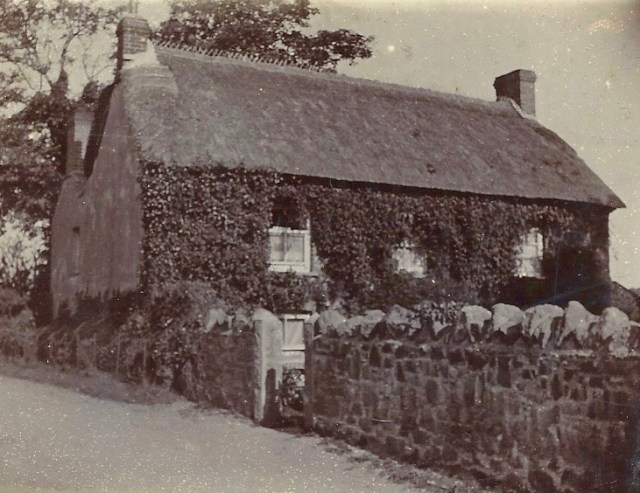
Higher Coombe Head

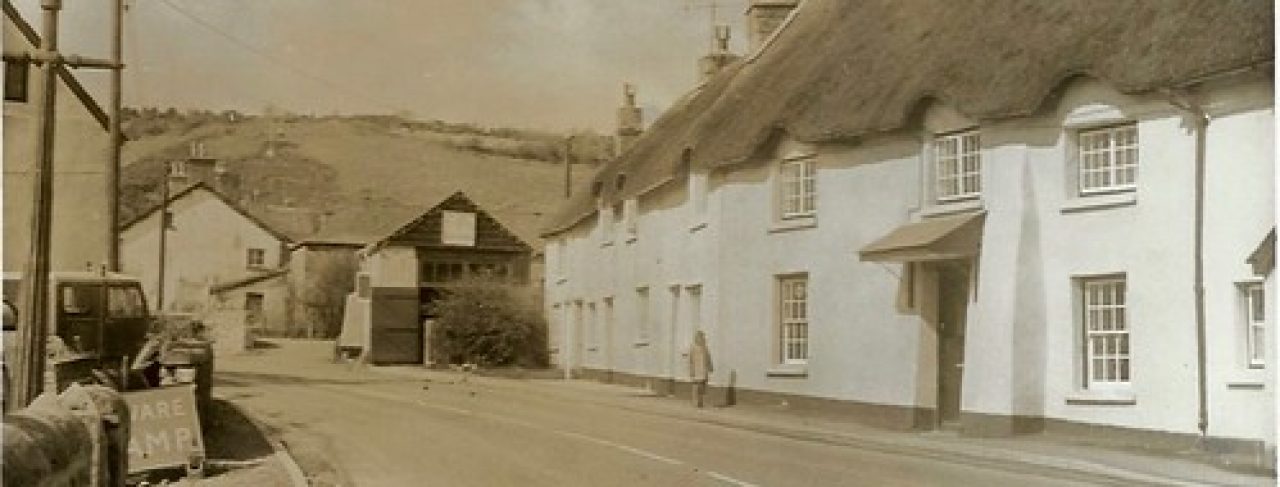
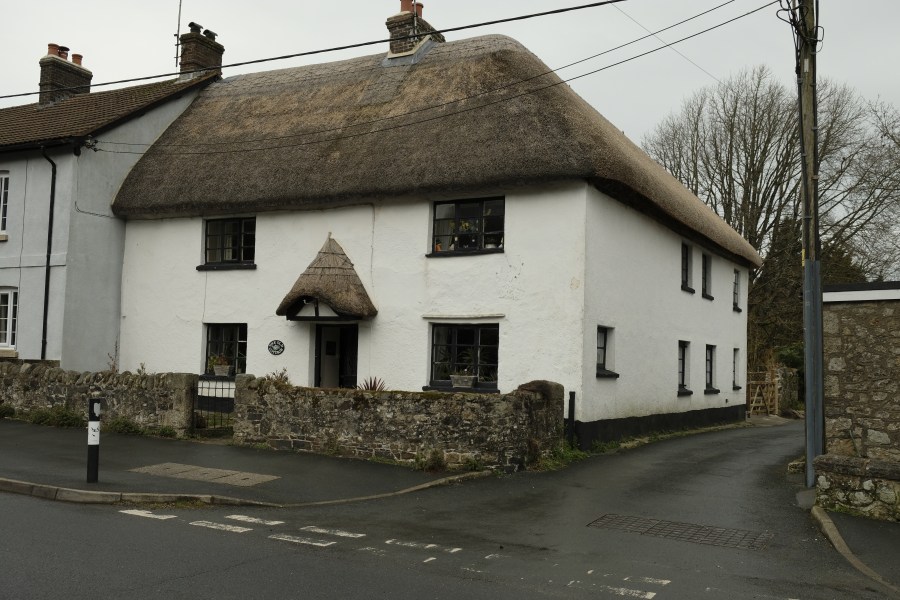
YOUR HOUSE – There is so much to explore. What can you learn from the construction – bricks and mortar, granite, or wattle and daub. What are the windows like? Some old ones in Sticklepath slide sideways to open. Thatch or slate? What gutters are there? (It is unusual to have gutters with thatch but several Sticklepath houses have them). What evidence is there of extensions or other changes? Can you find old photographs or postcards showing your house? Are there some in your family album if you have lived there for a while, that show old decor or changes to the rooms? What are the names of people who have lived in the house? What can you find out about them? Is your house shown on old maps or can you start to date when the house was built from maps?

Trying to find your house site on old maps is a good place to start – try the National Library of Scotland Ordnance survey 25 inch to mile and other maps on that site. They make great illustrations for your file too:
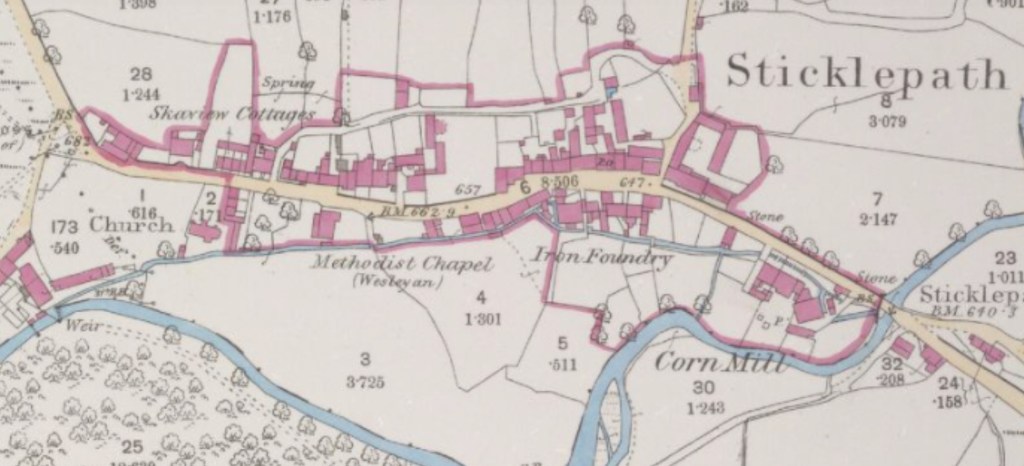
Satellite images too can be useful, from the same website or Google maps etc.

Try a simple Google search using your house name and Sticklepath. You may be lucky! If your house is listed some details will be found online. In any case reading about those listed houses (the ones in our Sticklepath!) and the conservation area character appraisal 2017 can add other background.

Do you have your house deeds? If so go through each document to see what names and dates and changes to the building/garden you can find. If you don’t have the deeds, try to locate them, ask the previous owners. Try putting your house name into Devon Archive search or The National Archive Discovery search – you never know if something might pop up. A key part of deeds are the Wills or administration of those owners who died and state in their Will what is to happen to the property. IF you don’t have access to the deeds but have names of owners, search the above archives online or Gov.uk for the Wills and Probate of known owners Note there are tabs for different dates and for soldier’s wills (small charge).
You can research previous owners or occupiers lives through the census records or newspapers. What was their occupation? Did they have servants? Reports of funerals or obituaries can be especially helpful. There are many free genealogy sites, see Cyndi’s list for example. Some allow you to see there is a document but charge for seeing them. Make a note of the reference. Libraries often have free access to subscription genealogy websites. (During lockdown some were giving access at home if you had a library card).
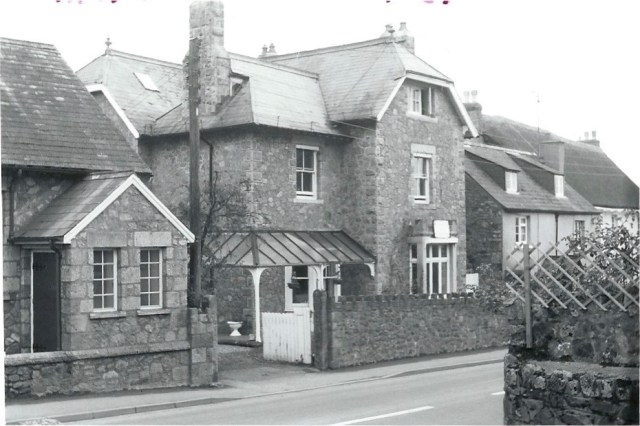
Tawburn

House sale details – modern ones may still be found online. Again photos and plans can be useful images in your ‘report’. Auction details in old newspapers may be found, both for the building and lists of furniture for example. Planning documents can also be interesting and provide more details.
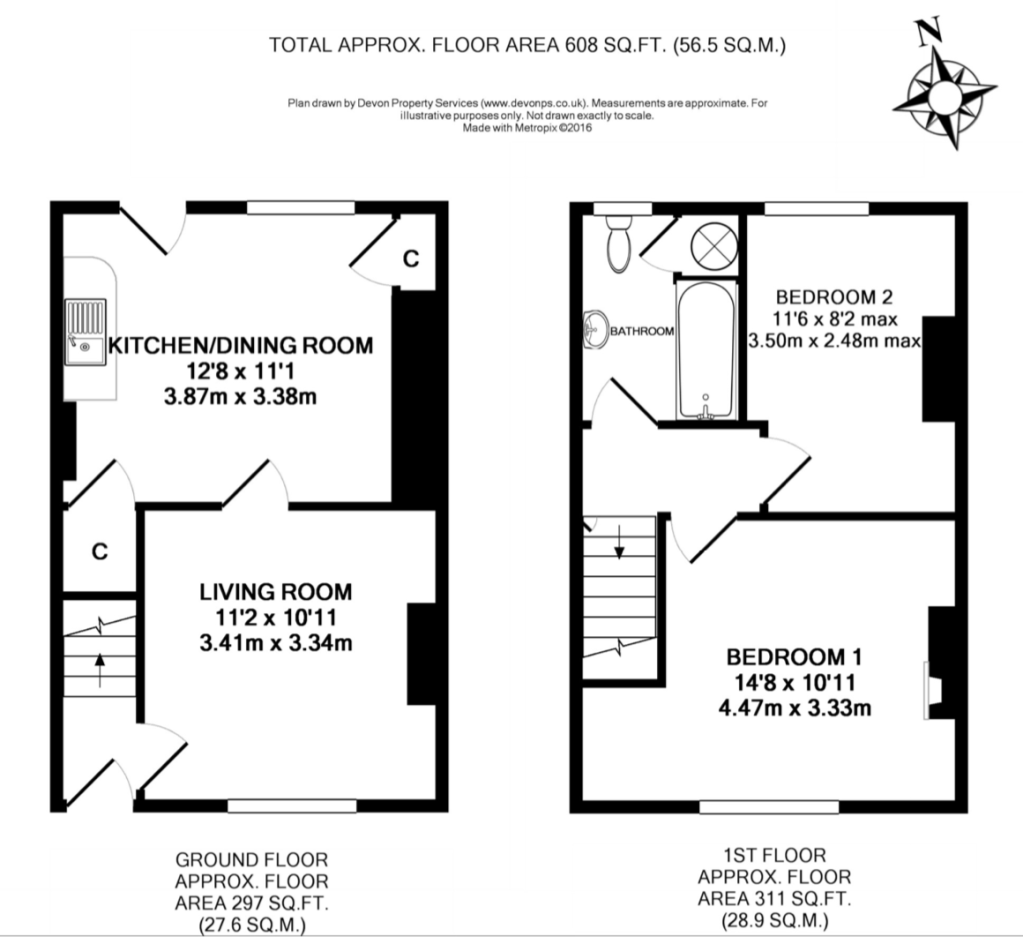
The Experts recommend starting from today and documenting who lives there now. Perhaps make a note of who was there on census night 2021! How long have you lived there? Where did you or your family come from and why? Are there any particular features of your house? Photograph and explain them. Or make a note to try to find out about them later if you are not sure what their origins were – showing photographs to interested people might get you answers. Photos of your rooms and garden today will certainly be interesting in 5, 10, 50, 100 years! Perhaps keep a piece of wallpaper if you change it or make a note of any structural changes you make or have made for future reference.

The Heritage

You can work backwards through the 1939 register and census records 1911 backwards every 10 years. (Check for the 1921 census in a year’s time!) The house may not be named though so occupier’s names may be needed. You also need to know which Parish to search, and can find helpful links on Genuki – Sampford Courtenay for most of Sticklepath, South Tawton for those on the Exeter side of the bridge, Belstone Parish for those up Skaigh Valley. The Sampford Courtenay enumerator for Sticklepath seems to have largely kept his papers in the order he visited the houses. This is not true for all. Trade Directories can also state names and addresses (look under Sampford Courtenay or the Parish as above).

Chat to current neighbours and long standing members of the community. Do they know who lived there before you? What do they remember about them? Would your close neighbours be willing to let you look at their house deeds? Deeds often note information about party walls, access rights and names of then current neighbours.

After lockdown, chat to members of Sticklepath Heritage Group who may have more ideas. Many Sticklepath houses were photographed in 1983 and the photos are in the Village Hall archive. There is also a roll of wallpaper on which most house names were written in that year, with a list of who people at that time remembered to have lived there.

Searching Google for ‘How to’ and ‘House History’ reveals many websites. For example:

findmypast.co.uk/blog/help/the-history-of-your-house

nationalarchives.gov.uk/help-with-your-research

Please do contact me to see if I have anything about your house – shields_h_f@hotmail.com (giving as much detail as you can), and I would love to hear about your progress too!

Please follow the SticklepathOne facebook page to know when more blog posts appear that may help with knowledge of Sticklepath History!

Sticklepath Houses: No 2 Ska View Cottages (Part 3)

#OnePlaceStudies #househistory #SticklepathOne #Sticklepath

I have a number of documents concerning Number 2. Notes with them suggest they were for a long time stored by Lloyd’s Bank for safe-keeping and from time to time transferred to solicitors as different things happened eg transfer of the garden and shed to different ownership.

Key documents include:

DateTypeDetail
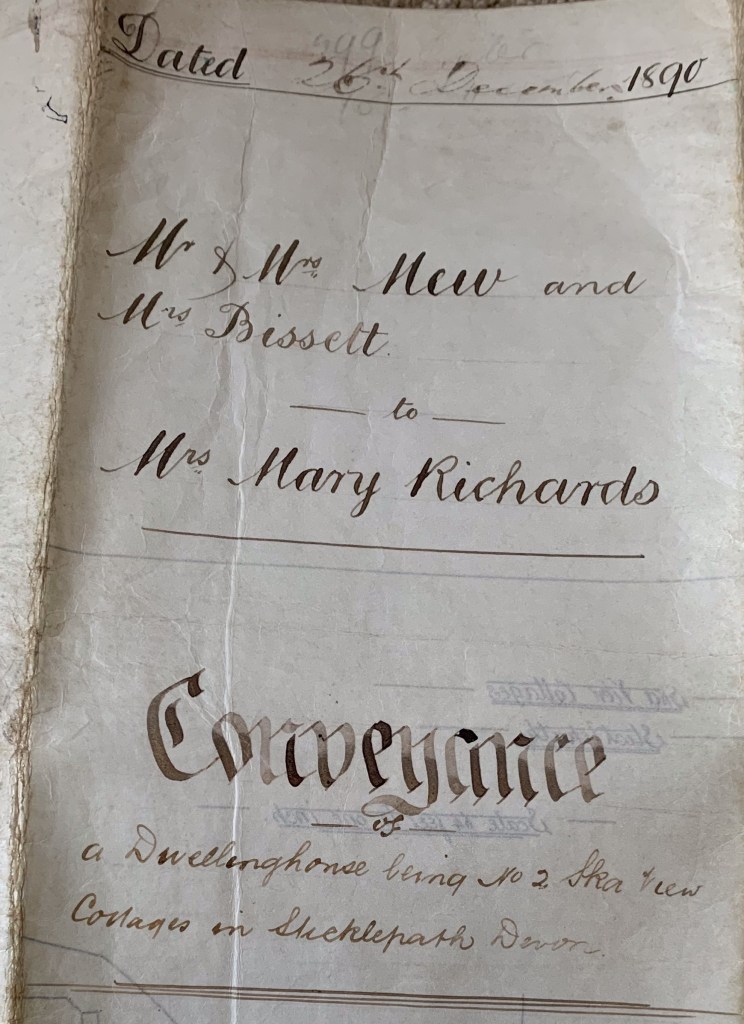
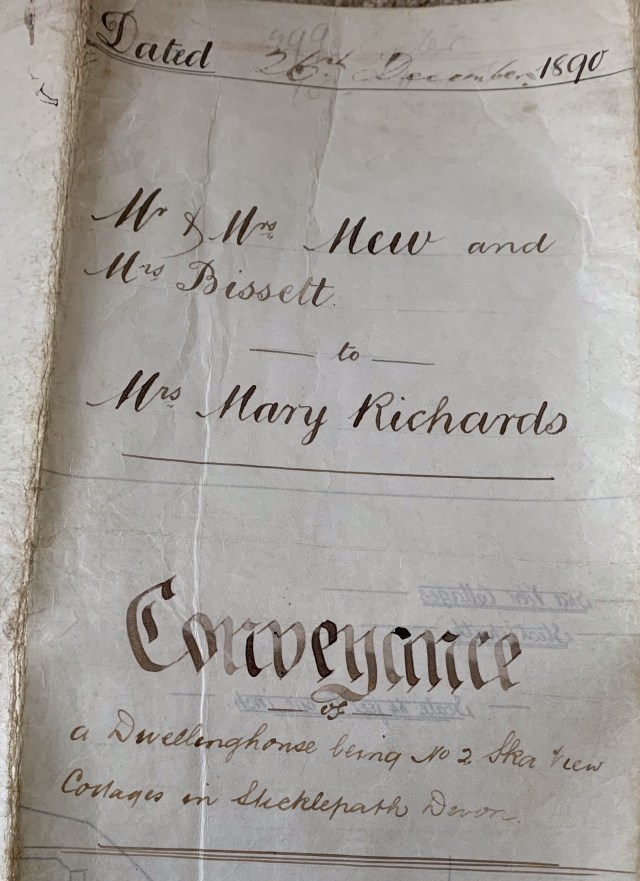
26 Dec 1890Conveyance Mr & Mrs Mew and  and Mrs Bissett (beneficiaries of Thomas Lethbridge) to Mrs Mary Richards
2 Mar 1900ProbateExtract of Will of Mary Richards, (inheritance by Elizabeth Brady)
13 Apr 1910ConveyanceMr James Brady to Mr John Brady following death of Elizabeth intestate
1924AbstractAbstract of title
27 Sep 1924ConveyanceJohn Brady (deceased) to James Neill
28 March 1927ProbateCopy  Will of James Neill deceased
24 Dec 1927ConveyanceExecutors of James Neill to Maria Palmer
1959AbstractAbstract of Title
22 Apr 1959AssentMrs Maria Palmer deceased
1959Searches
11 Dec 1959ConveyanceB.W. Palmer to Charles Bowden Esq.

From these it should be straight forward to build a list of owners. Of course they were not necessarily the occupiers, and deeds don’t mention many other family members. The Census and possibly directories can help with occupiers. Though often specific addresses are not stated in the census we can sometimes make an educated guess knowing who their neighbours were. For Sticklepath it seems the enumerator often did put entries in order. Just ‘The Old Cottage’ lies between the terrace and the village hall, which is also mentioned on the census helps.

Just to re-cap: It seems Mr Thomas Lethbridge had the terrace of 4 Ska View Cottages built, which may or may not have been completed in his lifetime. The New cottages were sold at auction 1890 by his daughters and son-in-law who had inherited the properties. There is no suggestion they were lived in at the time. Mrs Mary Richards, widow of William Richards formerly of Ball Farm, Sampford Courtenay, bought the property in 1890. Her will states her address as Ska View Cottages, good evidence she lived in No.2. She made a number of interesting bequests (lots of extra people named), but left the main part of her £561 8s 11d estate to her niece Elizabeth Brady wife of John Brady, gentleman of Barnstaple in 1900.

10 June 1909 Elizabeth Brady died intestate (no will). Mr James Brady her son of St.Paul-des-metis in the Province of Alberta, Canada, gave the property to his father, husband of Elizabeth, in a Conveyance dated 13 April 1910 for his use on the understanding it was passed back to himself on the death of the father. “In consideration of natural love and affection”. This conveyance notes that a stable and coach house had recently been erected on the garden plot.

The newspaper report of her funeral and requiem mass at the Catholic Church in Barnstaple (Western. Times Tuesday 15 June 1909) as well as knowing she is the niece of Mary Richards, would allow a basic family tree to be drawn up. It does not look like either Elizabeth or her husband actually lived in the property at No 2 Ska View.

18 May 1915 John Brady made his Will. 1 July 1924 he died. Probate granted 24 Sept 1924. His executors were another son Bernard Brady and solicitor William Edwin Pitts Tucker. There is no mention of James Brady the son in Canada in the conveyance. On 27 Sept 1924 No. 2 Ska View Cottages was sold to James Neill of No. 3 Ska View Cottages for £380. (His son-in-law Frank Richards and daughter Beatrice lived in No. 4). The property at No.2 was occupied by Mrs Portrey (Portsey/Portrey).

The documents jump from one owner’s death to the next. James Neill wrote his Will on 2 Oct 1926. He died 26 Feb 1927 at No.3 Ska View Cottages. Estate valued at £4313 19s 1d Probate was granted. No. 2 passed to his daughter Maria Palmer 24th December 1927.

At first glance No. 2 passing from father to daughter looks straight forward. However the conveyance adds a further sad part to the story. Tomorrow is another day and another installment!

Sticklepath Houses: No 2 Ska View Cottages (part 2)

#OnePlaceStudies #SticklepathOne #Sticklepath #Househistory

Exploration of Ska View Cottages continues with a detailed look at the first indenture or conveyance document, written in 1890.

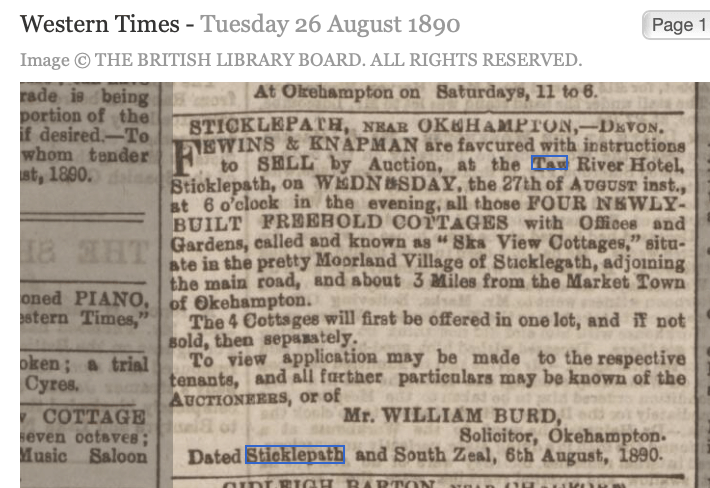
This row of cottages is not listed although both Cleave House and The Old Cottage on either side are. From the 1890 auction notice (accessed through the British Newspaper Archive ) we know Ska View Cottages were Freehold and Newly Built. The auction was due 27 August 1890, and if the 4 cottages were not sold in one lot they would be separately auctioned. It seems no one was interested in all four. Luckily I have the deeds – indentures, conveyances and will extracts, that allow a picture of the ownership of No 2 Ska View Cottages to be built up.

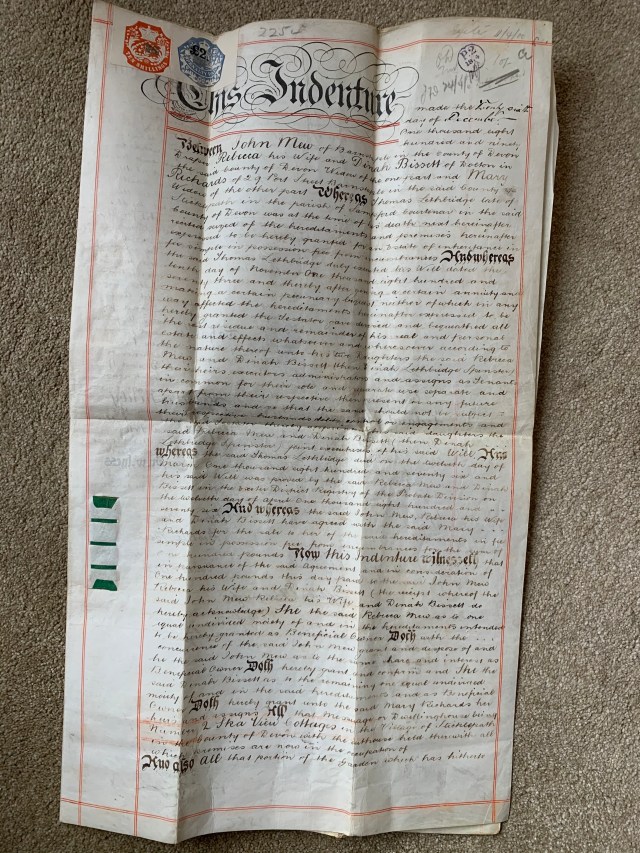
 At first sight Indentures are rather intimidating, however after finding your way around one or two, the mysteries seem to unfold rather more easily!  This one is almost a metre square, dated 26 December 1890, the Conveyance of a dwelling house.  It includes a garden a short way distant (in the allotments still in existence on Back Lane).  It dates from the time when ‘Indentures’, though still known by this name, did not any longer have a zig zag cut edge to show they were matching other copies of the same agreement. 

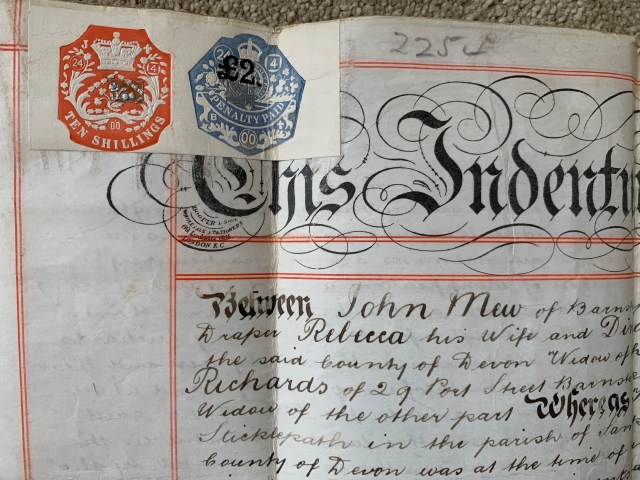
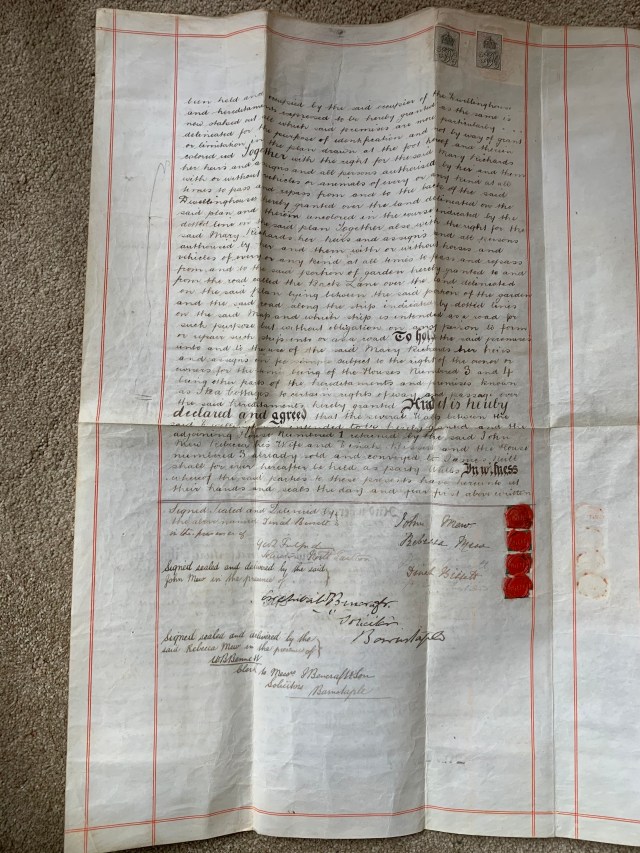
Payment of the taxes due, £2 10/- is shown by the attachment of two embossed stamps, firmly glued in place with something on the rear as well as shown below. There is also a green ribbon woven through the parchment on which the solicitor has placed his wax seal 4 times to confirm the signatories. 

Rear of stamps

It appears that Mr Thomas Lethbridge of Sticklepath had had the cottages built, or at least had started building them, but then died.  His daughters, Rebecca, wife of John Mew, draper of Barnstaple, and Dinah Bissett, widow of Dolton, inherited them and were selling the properties, along with the son-in-law, John Mew.

Indentures are legal documents covering a range of situations, mortgage or conveyance, apprenticeship etc etc. Early ones are on parchment.  They are written in ‘secretary hand’ which probably took about 3 years to fully master but which means standard script is used across England for all such legal documents. Where a property is conveyed in ‘fee simple’ this is the freehold given in perpetuity.  For more information about deeds including much older ones see Nottingham University.

All Indentures start with “This Indenture dated XXXX” and then state the parties involved in the contract.  Words in ‘bold’ then go on to note the start of each new point. (Overall sections are known as: the Testatum or what the contract concerns; the Hebendum which is the legal provisos usually ignored by genealogists; and the Testimonium, the signatures and seals). My summary interpretation follows, with CAPITALS to indicate new sections (though not using the same words as the original):

THIS INDENTURE dated 26 December 1890

BETWEEN the three people mentioned above and Mary Richards of 29 Port Street Barnstaple, widow. 

WHEREAS – Mr Thomas Lethbridge was “seized of the hereditaments and premises” (owned the property) at the time of his death and “hereby granted for an estate of inheritance in fee simple” (gave the freehold) in

HIS WILL dated 10 November 1873 (lots of details given) which came into effect when he

DIED 12 March 1876 and the Will was proved 12 April 1876. The property was inherited in by his two daughters.

THE SALE of 2 Ska View to Mary Richards is now agreed by the vendors in Fee Simple for £100.

THIS INDENTURE witnesses this sale and that the sellers acknowledge receipt of the £100.

EACH seller agrees

ALL “that Messuage or dwelling house being Number 2 Ska View Cottages in the Village of Sticklepath in the County of Devon with the outhouse held therewith all which premises are now in the occupation of “  (here a large blank space is left, suggesting to me it was unoccupied)

AND ALSO the garden area, to both of which Mary Richards and her “heirs or assigns” can take vehicles or animals as they wish.

ALLOWING access by the other cottage owners as needed

PARTY walls explained and current owners of neighbouring properties named. 

SIGNATURES AND WITNESSES of the sellers and their solicitors. 

I note Mary Richards did not sign this copy of the document, though space was made.

If you picture the document folded in half with the fold to your left.  The front ‘page’ and second page  are taken up with the statement as summarised so far (Images as shown above). On the front page there are some pencil marks in the margins and a small purple stamp mark which do not have any meaning for me. 

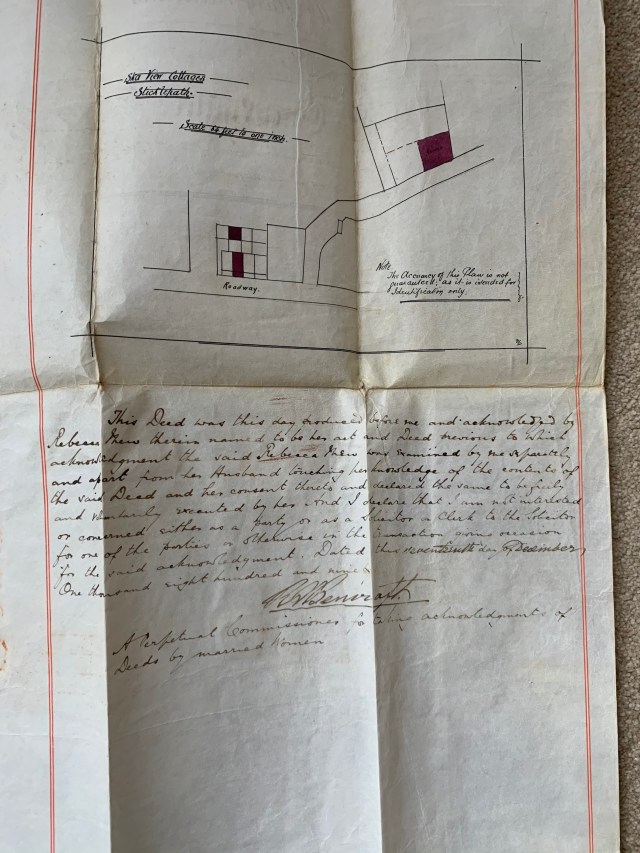
The third ‘page’  is divided into two with the plan at the top and an interesting statement on the lower part. 

‘Third page’

The plan

Scale 64 feet to one inch. The property is shown just by the main roadway. The front garden and house are coloured. The yard behind is slightly offset. The stone built outbuilding behind that is again coloured. The garden, at some distance down Back Lane is also coloured.

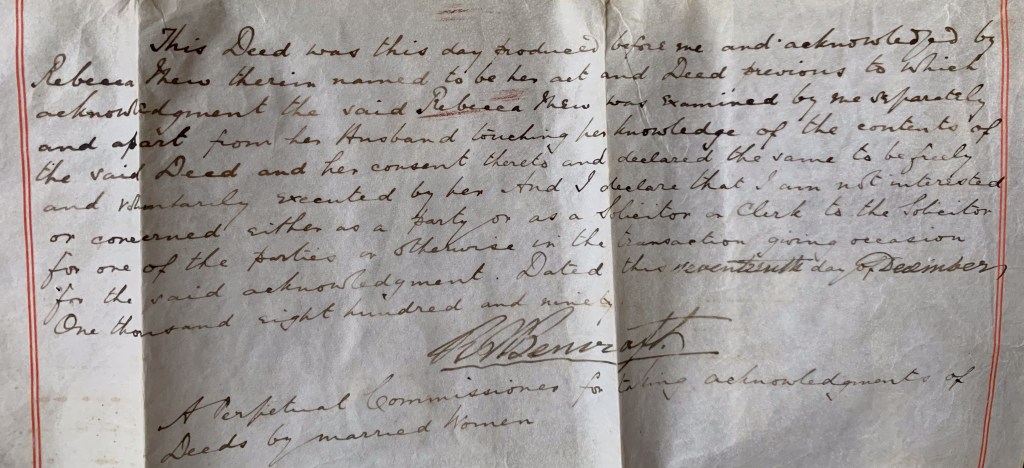
Thomas Lethbridge had left the property to his daughters solely, free from husbands wishes or debts, a statement therefore was needed to clarify that Rebecca was completing the sale “freely and voluntarily”.  She had to discuss this with the solicitor without her husband present. This is signed by “A Perpetual Commissioner for taking acknowledgements of Deeds by married women”. This statement was completed 17 Dec 1890. 

The final quarter of the document is blank other than the labelling of the document when folded up.  

Looking at this legal document in some detail has been a learning process. I now feel more confident to look at others, perhaps even older ones if the chance arises. Next time a brief overview of No 2 owners from 1890 – 2015.