
This month’s blogging prompt for #OnePlaceStudies Society and #SticklepathOne.
The advice for any genealogical project is to start with what you know. Those bits of ‘knowledge’ can then be explored, facts confirmed and expanded.
What do I know about the two longstanding Public Houses in #Sticklepath – The Taw River and The Devonshire? (There was also The Rising Sun up the hill towards Exeter, but that is probably outside my remit.)
My parents enjoyed curry nights at the Devonshire Inn. The leat runs close behind. Their car park is one the opposite side of the road, next to the old ‘candle factory’ with notices about Trafalgar Way on it. I believe the foundry men were mainly in the Devonshire Inn at the time that business literally collapsed and came to a grinding halt in 1960.
The Taw River Inn, known previously as the Taw River Hotel and prior to that The Cornish Inn, has two plaques built into the walls giving the Hole surname and dates. I know there was a devastating fire at the Taw River.
In the 1960s there were children from both attending Sticklepath school so I remember that the Devonshire was run by the Jamiesons and the Taw River by the Hawleys. Entering either building still evokes a strong emotional response in me that says ‘children are not allowed in here’ and prompts me to think more of the Methodist background and temperance tendencies of many Sticklepath folk! Yet for many villagers these institutions were the centre of their social life, a hub of village life, with many of life’s celebrations births, marriages and also deaths ending with drink at the pub. Many friends met there at the end of a hard day’s labour, to chill, for company, for fun, or to commiserate and cheer each other up.
Having worked in Wigan as a casualty officer in the later 1980s when fun theme pubs were in their heyday, I perhaps know better than most of the injuries, brawls and accidents that can result from over-indulgence!
We all recognise Pubs by their signs, usually swinging above the door.
Photo of the Devonshire Inn Sign
Photo of the Taw River Inn sign 2019.
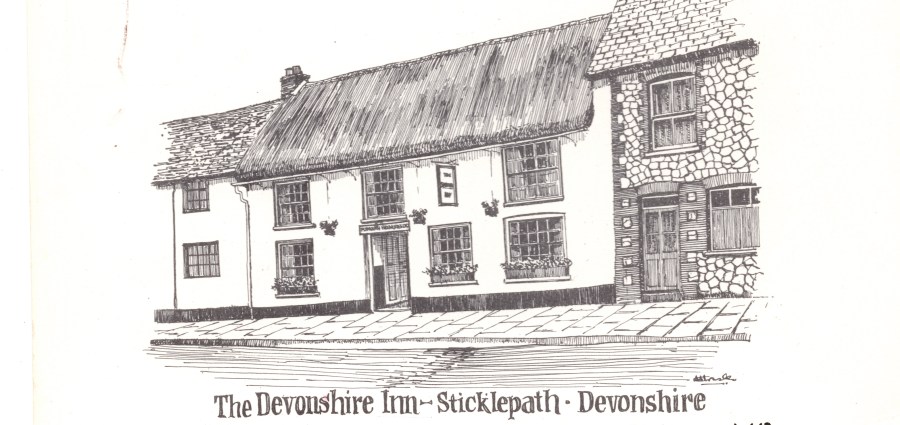
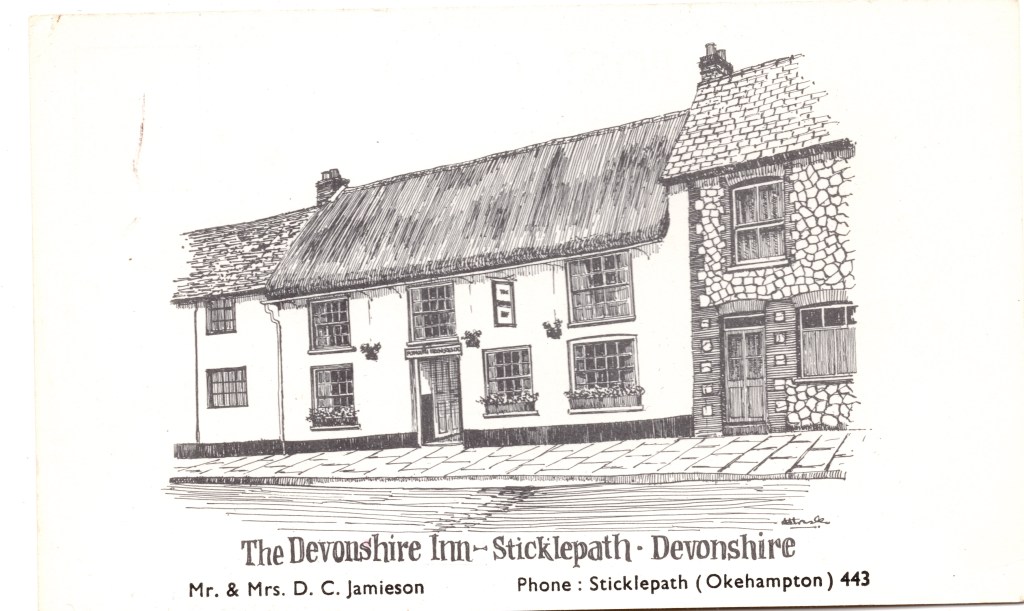
Advertising was important and having postcards made was one option. The line drawing of The Devonshire on this postcard seems to me to suit very well the ‘under-stated’ nature of this cosy institution. Perhaps from the 1960s, it also reminds us how phone numbers increased dramatically over the years! If the artist turned his head to the right there was the Post Office and shop run by Miss Gladys Ogilvie in Eddington Cottage, or turning to the left he would have seen the Foundry. The Smiths lived in the house we see here on the right, the Strattons in the house on the left. The thatched roof and window boxes make it stand out and look attractive. The often open door invites us to step inside. (Note it displays one of Sticklepath’s unusual architecture features – gutters on a thatched roof).
From reading about Sticklepath history it is clear the Taw River Inn was where coroner’s inquests were held, the November 5th bonfire was at one time held in the street outside, and the Hunt often met there. Sticklepath Revels saw sweet fruity buns and biscuits on sale from both pubs. At least the Taw River, perhaps both, were coaching Inns. Prior to the Village Hall being built, the Pubs would have been the largest meeting places apart from Church or Chapel (which were not likely to accommodate the full range of activities). Later, catering for Village Hall events was often done from the pub kitchens.
The Inns were important for the tourist trade too, as attractive places both to visit and to stay. People let rooms or their entire house to tourists, often ‘for the season’, and the names of new guests were printed in. the newspaper!
Western Times – Friday 22 August 1884 Original held at THE BRITISH LIBRARY accessed via https://www.britishnewspaperarchive.co.uk/ April 2021:
STICKLEPATH
Harvesting in this neighbourhood is proceeding rapidly, nearly two thirds being cut and carried already in capital condition; the yield is on the whole a good one. The root crops are suffering from want of rain, turnips more particularly are looking bad, mangolds promise an average crop. This little moorland village is growing in popularity with those who seek health and quietness. The latest arrivals are:Retreat, Mrs Merriman and family, Mr Munro, Misses Munro, Mrs Bennett, and Miss Bennett; Laurel Cottage Mrs Gossage and family and Miss Fox; Cleave Cottage, Mr and Mrs Croft and family; Foundry Cottage, Mrs Thompson, Mrs Quick, Miss Hatfield and Miss Porecky; Taw River Hotel, Mrs Brady and family, Miss Broome, Miss Walter, Mr JE Monk; and at Silver Lake Cottage, Captain Rhyves, and Mr Rhyves, Mr J Perritos and Brothers.
Near the bottom of the article we see that Mrs Brady and family, Miss Broome, Miss Walter and Mr J.E. Monk had all arrived to stay at the Taw River Hotel that week. Day trippers too took advantage of the scenery and enjoyed a rest and refreshment in the pub:
Exeter and Plymouth Gazette Daily Telegrams Wednesday 30 July 1884 tells us that Exeter’s St Sidwell’s and St Catherine’s Choirs along with the organist, clergy and Sunday school teachers – over 60 people, enjoyed their annual outing, this time a visit to Belstone and Sticklepath. Some of the visitors had:
“ascended Cawsand Beacon. After dinner some wandered along the picturesque vale of the Taw, while others walked over Belstone Tor. At Sticklepath Mr Knapman, of the Taw River Hotel, provided an excellent tea, after which there was a pleasant drive home.”
The court (quarter sessions or petty sessions) often have renewal or handover of Victualler’s licenses, permissions for extended opening, and information about brawls and unrest. These are not accessible to me at present, but much of this was reported in the newspapers. This transcript concerns the early days of the Flower Show:
At Oke Petty Sessions on Wednesday 12 Aug 1891 Mr C.B. Woollcombe and Mr. W. H. Holley granted extension of three hours to Mr. Richard Knapman, of tbe Taw River Hotel, and Mr. Partridge, of the Devonshire Inn, Sticklepath, on account of the Cottage Garden Show and Athletic Sports.
Here we see the license changing hands and the magistrates ‘rules’ on an extension given by Mr W.H.Holley the chairman:
Western Times Thursday 13 December 1888 Original a t The British Library, Accessed via https://www.britishnewspaperarchive.co.uk/ April 2021
OKEHAMPTON PETTY SESSIONS
…The license of the Devonshire Inn, Sticklepath, was transferred from Mr S. Hawken to Mr Wm James Drew. Mr Drew also applied for a two hours’ extension on New Year’s Eve, as his friends thought they would like to have a Christmas dance – The Chairman:- Your usual hour for closing. is 10 o’clock, and you apply for an extension until midnight. Well, the Bench will grant it, but it must be understood that the front door is not kept open for anyone to come in after closing time. It is granted for the guests of the evening. – Mr. Drew thanked their Worships and said he would comply with these instructions – he meant his application in that manner.
We can also catch glimpses of the lives of those running the pubs as with this sad ‘In Memoriam’ notice found in the Western Times Friday. 21 August 1942:
WRIGHT.- In ever fond and loving memory of our darling son, Albert James, suddenly called to higher service, August 21,1941. – Still ever missed by his loving Dad, Mum, John and Edna, Taw River Hotel, Sticklepath.
Descriptions of events can tell us more about the premises, here mentioning a skittles alley:
The Western Times Tuesday 19 August 1879 tells us “This little village was more than usually astir on Monday, when the greater portion of the working classes were to be seen in holiday attire on the occasion of a dinner being given by W.W.Symington Esq., to all who had taken part in the erection of his new residence, laying out the grounds &c.” Contractors are listed including: “the decorations by Mr Emanuel Tucker junr., of Sticklepath”. Details of the event follow “On Monday all who had worked on the buildings or premises assembled at “Rockside” (the name given to Mr Symington’s residence), where a procession was formed, which, headed by the Sticklepath Band, marched to the “Taw River Hotel”, Sticklepath, where a substantial dinner of good old English fare was provided by Mr Knapman, and laid out in the skittle-alley, which was tastefully decorated with evergreens and mottoes; there were also several fine bouquets of flowers on the tables. Dinner was served in good style and the viands were of first quality and well cooked. Mr. Symington took the chair, with Mr John Cook as vice-chairman. The company numbered between 90 and 100 persons”. Toasts were proposed. “songs were sung by the company, many in the old rustic style, and the Sticklepath Band played selections of music during the evening. A very pleasant and agreeable time was spent.”
Such reports are ‘name rich’ both inhabitants generally in the village but also the licensees which should allow a list to be created… another ‘little’ project begins!






 Sticklepath a Village and its People