A Village School Chronicle 1879-1979 by Victor W Hutchison forms the backbone of my information about Sticklepath school, supplemented where possible by other sources. We rely on the British Newspaper Archive for early reports of the school.

Following the Forster Education Act of 1870 each district was obliged to set up a school board with the power to build any “Elementary Schools” required in its district. The money was raised through local rates and in addition parents were required to pay nine pence (9d) per week for each child, except the very poor.
Kelly’s Directory tells us “A school board of five members was formed in 1874 for the united district of Sampford Courtenay and Honeychurch with Belstone contributory with two members”. Sampford Courtenay Parish included Sticklepath but Sticklepath village was 5 miles from the Parish church. Sampford Courtenay village already had a voluntary school which was taken over (1). A new school was needed in Sticklepath for the children of the village and of Belstone. Children still needed to walk 3-4 miles from surrounding farms or across the moor to get to school.

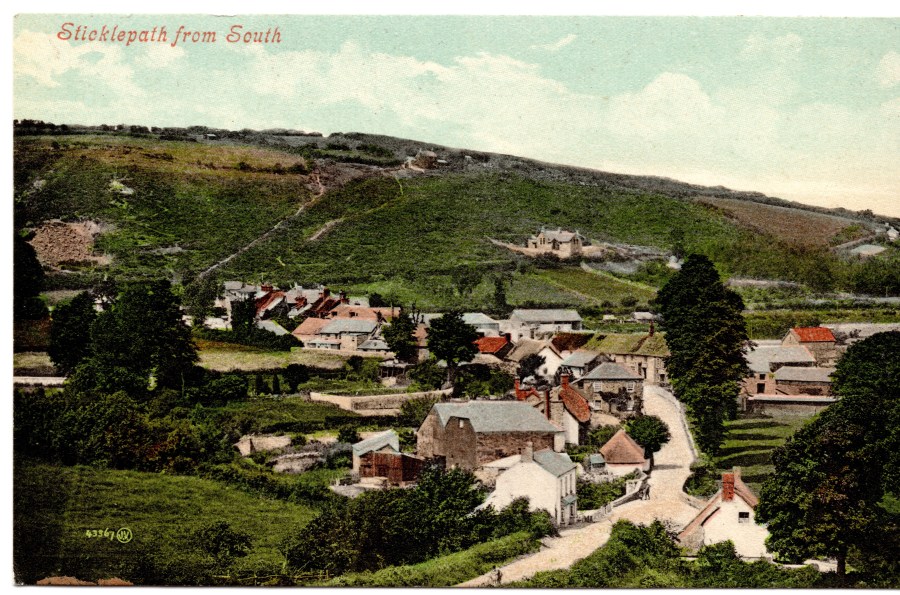
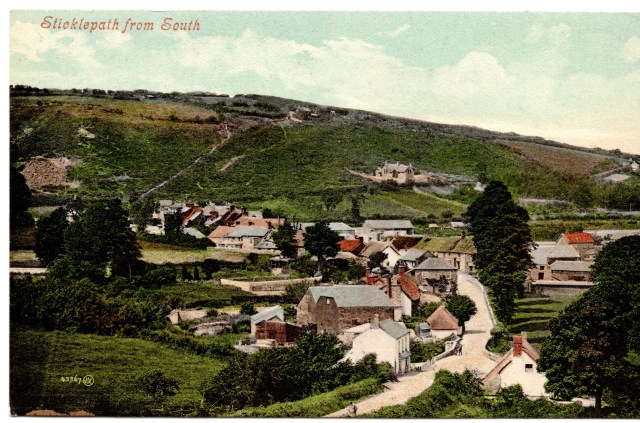
The conveyance of the site for Sticklepath School, dated 18 April 1878, is signed by George Underhill Wills, who was the closest we had to Lord of the Manor. The site is up on the hill to the West of the main houses of the village street. The school was built in the following year to accommodate 80 children.
The following year 1880 the Mundella Education act made it compulsory for children to attend school from age 5 to 10.
A headteacher was needed. We can find the advertisement in The Western Times – Friday 20 June 1879
SAMPFORD COURTENAY AND HONEYCHURCH, WITH BELSTONE, SCHOOL BOARD.
WANTED immediately a CERTIFICATED MASTER for a mixed school at Sticklepath for 80 children.
Applications, stating certificates held and salary required,
with testimonials and Inspectors’ reports,
to be sent on or before the 24th inst., to ROBERT FULFORD, Clerk.
North Tawton, North Devon. 11th June, 1879.
Whilst no school records have been found, we know Mr John Arbory was appointed as he is listed in newspapers as attending the Devonshire Union of School Teachers from Sticklepath alongside William Manuell of Sampford Courtenay (for example The Western Times of Monday 14 June 1880). There is also mention of the school inspector’s report:
Western Times – Thursday 30th September 1880
Sticklepath Board School.—The Report of Her Majesty’s Inspector on this school has just come to hand The Inspector reports as follows :— “The buildings are remarkably nice and are well furnished, and the school has made a very satisfactory start. The order of the scholars and their instruction are creditable.” Mr. John Arbory, late of Prince Town is the master. ‘
4 years after the school opened Mr Arbory is moving on:
Western Times – Friday 02 November 1883. STICKLEPATH.
PRESENTATION. An event of a very interesting character occurred Saturday evening, when a crowded meeting was held, W. W. Symington, Esq. J.P., in the chair, for the purpose of presenting Mr. John Arbory, the schoolmaster, with an elegant dressing case and set of gold studs and sleeve links, on the occasion of his leaving the town to take the post of schoolmaster in her Majesty’ convict prison, Chatham.
Mr. Arbory has done duty in Sticklepath for four years, and is held in high esteem by all with whom he has been brought in contact. Mr. Symington remarked that Mr. Arbory was leaving the neighbourhood to the regret of the inhabitants of the district after four years service. During this time the children of the school had made great progress in their studies, and the report of the inspectors was highly satisfactory each year.
Mr. Arbory had outside his school duties won the esteem of the whole neighbourhood by his honourable and upright character in private life. He wished to convey to him the hearty wishes of all the village for his future welfare. Mr. Arbory, accepting the presents and returning thanks, remarked that ha had spent four happy years amongst them. He was surprised to find himself in such a position, as he could not think of anything, he had done to call forth such a warranty of the good feeling existing towards him. A hearty vote of thanks to the chairman brought the meeting to a close
Vacancy has arisen. Who will fill Mr Arbory’s shoes?
- Sellman, Roger Devon Village Schools in the nineteenth century 1967 Latimer Trend & co.
 Sticklepath a Village and its People